UP FDA Uncovers Fake Medicine Network Using Bharatiya Nyaya Sanhita
Source:newsonair ↗
Why It Matters
Highlights critical issues in pharmaceutical regulation and public health safety at the state level. It also serves as an example of law enforcement utilizing the newly implemented Bharatiya Nyaya Sanhita to tackle organized criminal networks dealing in counterfeit essentials.
Summary
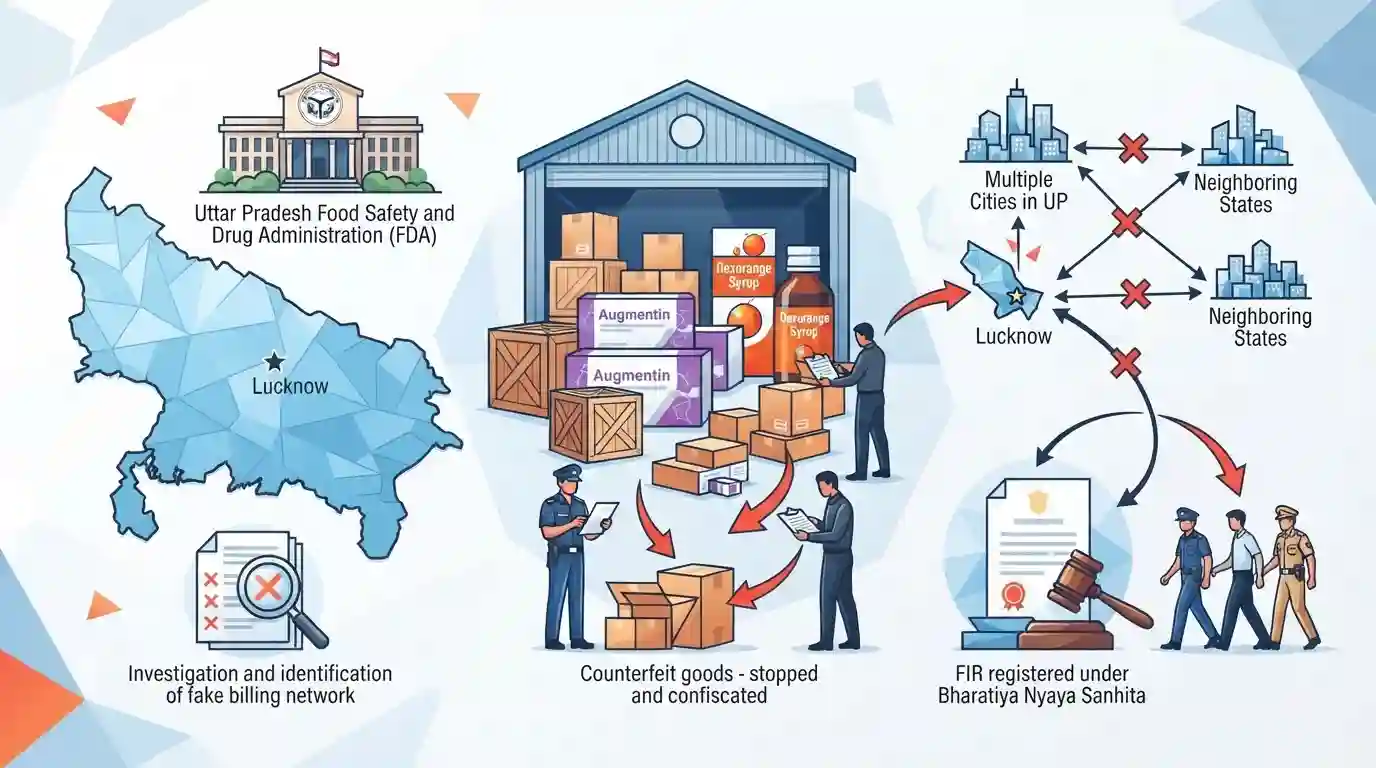
The Uttar Pradesh Food Safety and Drug Administration (FDA) recently dismantled a massive counterfeit medicine and fake billing network operating out of Lucknow. Authorities seized fake versions of commonly used drugs such as Augmentin and Dexorange Syrup and identified a complex web of paper transactions used to traffic unauthorized drugs to multiple cities in UP and neighboring states. An FIR has been registered against the primary accused under the Bharatiya Nyaya Sanhita.
Key Points
- The Uttar Pradesh Food Safety and Drug Administration (FDA) uncovered a significant network in Lucknow involved in fake billing and the distribution of counterfeit medicines.
- Counterfeit versions of popular medicines, including Zoryl M1, Augmentin, and Dexorange Syrup, were seized.
- The illegal network facilitated inter-state medicine trafficking across cities like Varanasi, Agra, Gorakhpur, Patna, and Gwalior using unauthorized and cross-billing methods.
- An FIR was registered under the Bharatiya Nyaya Sanhita against the key accused operating from an unlicensed premise.
Important Terms
Bharatiya Nyaya Sanhita (BNS)

India's new comprehensive criminal code replacing the colonial-era Indian Penal Code (IPC), 1860. Effective July 2024, it modernizes criminal law by emphasizing restorative justice, rehabilitation, and addressing contemporary offenses like organized crime and mob lynching.
UPSC context
GS Paper 2 (Governance). Tests knowledge of criminal justice reforms, modern legal frameworks, and shifts from punitive to citizen-centric justice.
State Food Safety and Drug Administration (FDA)
A state-level regulatory body responsible for field enforcement of the Drugs and Cosmetics Act and Food Safety and Standards Act. It oversees facility licensing, conducts inspections, and tackles the distribution of counterfeit medicines.
UPSC context
GS Paper 2 (Health & Governance). Highlights state-level capacity and the challenges of decentralized field enforcement in India's regulatory architecture.
Spurious Drugs
Counterfeit medications manufactured under false names or deceptively mimicking genuine brands. Punishable strictly under the Drugs and Cosmetics Act, 1940, these substandard drugs pose severe health risks like treatment failures and antimicrobial resistance.
UPSC context
GS Paper 2 (Public Health) and GS 3 (Security). Relevant for analyzing healthcare regulation failures, patient safety, and organized crime.
Fake Billing (Paper Transactions)
A financial fraud technique where shell entities generate bogus invoices and e-way bills without physical movement of goods. This creates an artificial trading trail, commonly used to unlawfully claim Input Tax Credit and evade GST.
UPSC context
GS Paper 3 (Economy & Internal Security). Crucial for topics on tax evasion, GST compliance loopholes, and money laundering mechanisms.
Central Drugs Standard Control Organisation (CDSCO)
India's apex national regulatory authority under the Ministry of Health and Family Welfare. It is responsible for approving new drugs, conducting clinical trials, setting standards, and coordinating with state authorities to ensure pharmaceutical quality.
UPSC context
GS Paper 2 (Health & Statutory Bodies). Essential for questions on drug regulation, pharmaceutical industry standards, and public health governance.
Prelims Trap
The CDSCO exclusively regulates the manufacture, distribution, and sale of all drugs within Indian states.
CDSCO regulates imports, clinical trials, and new drugs, but State Drug Control Authorities (like UP FDA) actually license and regulate the manufacture, distribution, and sale of drugs within states.
Static Concepts Connected
What constitutes a "spurious drug" under the Drugs and Cosmetics Act, 1940?
- Imitation: Manufactured under a name belonging to another drug, or packaged to look deceptively similar.
- Substitution: The medicine's true active ingredients are wholly or partly substituted with another substance.
- False claims: Bears the name of a fictitious manufacturer or a company that does not exist.
How is pharmaceutical regulation divided between the Centre and States?
- Central level: Handles import of drugs, approval of new drugs, and clinical trials (Central Drugs Standard Control Organisation).
- State level: State Drug Control Organizations grant licenses for manufacturing, distribution, and sale, and monitor drug quality.
Cross-Topic Patterns
Fake billing & GST evasion links
Fake paper transactions in pharma often double as GST evasion vehicles, linking GS-2 health regulation failures to GS-3 economic offenses and money laundering networks.
Mashelkar Committee & State capacity
The Mashelkar Committee highlighted how under-resourced State FDAs enable spurious drug networks. This reflects broader Centre-State capacity asymmetry in health governance.

Expect a 2026 GS-2 mains question on pharmaceutical regulatory architecture, focusing on CDSCO-State FDA coordination and spurious drugs.
Linked PYQs · 2
Linked PYQs · 2
- 2022UPPSC_PRELIMSGS1
Sulpha drug is which of the following types of drug ?
- 2020UPPSC_PRELIMSGS1
During the 'lockdown', the extraordinary powers used by the Government of India received legal basis from which of the following laws? 1. Mental Health Care Act, 2017 2. Disaster Management Act, 2005 3. Enemy Property Act, 1968 4. Epidemic Diseases Act, 1897 Select the correct answer using the codes given below.
