Ayodhya Temple Embezzlement Prosecution under BNS and SIT Probe
Source:newsindiatimes ↗
Why It Matters
This case is highly relevant for UPPSC GS Paper 2 and General Awareness as it demonstrates the real-world prosecution under the newly implemented Bharatiya Nyaya Sanhita (BNS), the functional role of executive-appointed Special Investigation Teams (SITs) in UP, and the administrative challenges of managing high-profile religious trusts.
Summary
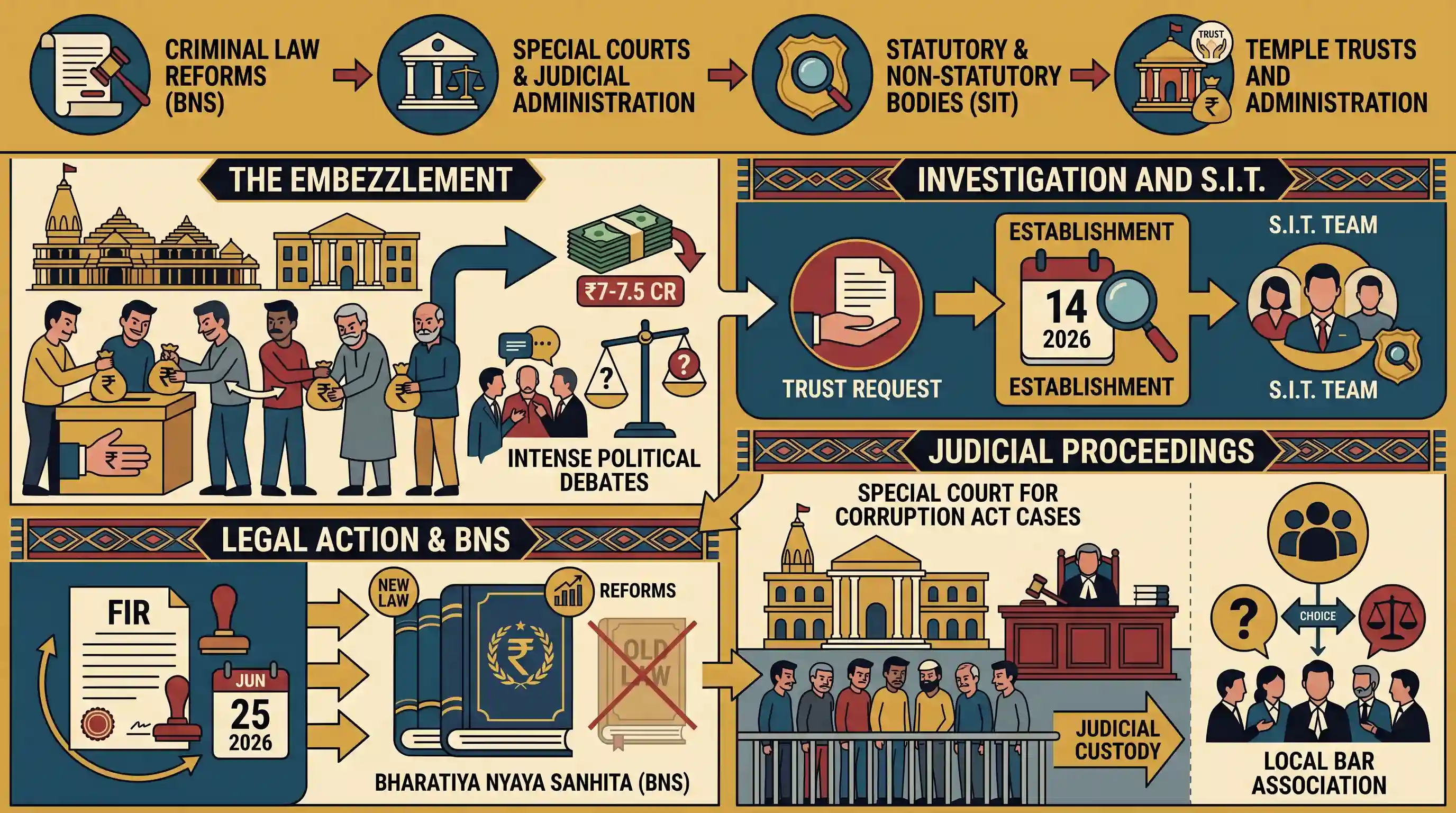
The Uttar Pradesh government has initiated prosecution against eight individuals accused of embezzling donations worth Rs 7 to 7.5 crore from the Ram Mandir in Ayodhya. Following a request by the Shri Ram Janmabhoomi Mandir Trust, a three-member Special Investigation Team (SIT) was established on June 14, 2026, to probe the scam, and an FIR was filed under multiple sections of the newly implemented Bharatiya Nyaya Sanhita (BNS) on June 25, 2026. The accused face judicial custody proceedings before the Special Court for Corruption Act cases in Ayodhya amidst intense political debates and discussions within the local Bar Association over representing the accused.
Key Points
- Eight individuals accused of embezzling donations worth Rs 7–7.5 crore at the Ayodhya Ram Mandir are scheduled to appear before the Special Court for Corruption Act cases in Ayodhya.
- The FIR was registered on June 25, 2026, under various provisions of the newly enacted Bharatiya Nyaya Sanhita (BNS), including Sections 306, 316(5), 317(4), 317(5), 61, and 3(5), showcasing the active transition from the colonial-era IPC.
- Following a formal request from the Shri Ram Janmabhoomi Mandir Trust, the Uttar Pradesh government constituted a three-member Special Investigation Team (SIT) on June 14, 2026, to conduct a specialized probe.
- The local legal community, led by Kalika Prasad Mishra (President of the Ayodhya Bar Association), held discussions through the Faizabad Advocates' Association on whether to provide legal defense to the accused, reflecting local sensitivities surrounding the Ram Temple.
- The case underscores the function of Special Courts under the Prevention of Corruption Act in processing financial irregularities involving public/religious trusts and state administration.
Important Terms
Bharatiya Nyaya Sanhita (BNS)

The primary codified substantive criminal law of India, effective from July 1, 2024. It replaced the colonial Indian Penal Code, shifting the legal focus from a doctrine of retribution and punishment to justice and victim-centricity.
UPSC context
GS Paper II (Governance) & GS Paper IV (Ethics); tests knowledge of criminal justice system reforms, restorative justice, and legal updates.
Prevention of Corruption Act, 1988
A key Indian anti-corruption legislation criminalizing bribery and misconduct by public servants. It was significantly amended in 2018 to incorporate UNCAC standards, penalizing bribe-givers, and establishing special anti-corruption courts.
UPSC context
GS Paper II (Governance) & GS Paper IV (Ethics); tests knowledge of governance probity, public service accountability, and anti-corruption frameworks.
Shri Ram Janmabhoomi Teerth Kshetra
A 15-member trust constituted by the Government of India in February 2020, following the 2019 Supreme Court verdict. It is responsible for the construction, administration, and management of the Ram Mandir in Ayodhya.
UPSC context
GS Paper I (Culture) & GS Paper II (Governance); tests understanding of public temple management, trust administration, and landmark judicial verdicts.
Special Investigation Team (SIT)
An ad-hoc investigative body constituted by executive governments or judicial orders in India. It is formed to ensure focused, impartial, and specialized investigations into high-profile or politically sensitive criminal cases.
UPSC context
GS Paper II (Governance/Executive); tests knowledge of administrative mechanisms, independent investigative bodies, and judicial oversight in high-profile cases.
Indian Penal Code (IPC)
The official substantive criminal code of India enacted during the British Raj in 1860, drafted under Macaulay. It served as India's primary criminal law until its repeal and replacement by the BNS in 2024.
UPSC context
GS Paper II (Polity/Governance) & GS Paper I (Modern History); tests understanding of colonial legacy, legal codification, and administrative reforms.
Prelims Trap
Bar Associations possess the autonomy to pass resolutions refusing to represent accused individuals in cases involving severe public or religious sentiments.
The Supreme Court in 'A.S. Mohammed Rafi (2010)' held that such resolutions are unconstitutional, null, and void, as they violate Articles 21 and 22(1). Professional ethics mandate representation.
Static Concepts Connected
What is the legal status of Bar Association resolutions boycotting an accused?
- Constitutional Conflict: Violates Article 22(1) (right to be defended by a legal practitioner of choice) and Article 21 (right to a fair trial).
- Supreme Court Ruling: In A.S. Mohammed Rafi v. State of TN (2010), the SC declared collective boycott resolutions null, void, and a form of professional misconduct.
- Bar Council Rules: An advocate is bound to accept a brief in courts where they propose to practice, provided a consistent fee is offered.
How are Special Courts under the Prevention of Corruption Act, 1988 established?
- Appointing Authority: Section 3 of the Act empowers both Central and State Governments to appoint Special Judges for designated areas or cases.
- Eligibility Criteria: To qualify as a Special Judge, a person must be or have been a Sessions Judge, Additional Sessions Judge, or Assistant Sessions Judge.
- Judicial Powers: They possess the powers of a Court of Session when trying offences under criminal procedure codes.
Cross-Topic Patterns
Article 22(1) vs. Professional Ethics
Analyzes the conflict between a citizen's Article 22(1) right to legal defense and local Bar resolutions, highlighting the intersection of professional ethics and constitutional mandates.
Temple Autonomy vs. State Oversight
Compares autonomous religious trusts (like the Ram Mandir Trust) with state-controlled temple endowment boards, analyzing state oversight boundaries under Articles 25 and 26.

The constitutional invalidity of Bar Association boycotts under Article 22(1) is highly likely to feature in future GS-II Polity questions.
Linked PYQs · 1
Linked PYQs · 1
- 2018UPPSC_PRELIMSGS1
Arrange the following temples in a chronological order and select the correct answer from the codes given below: i. Brhidishwar temple ii. Gangaikonda cholapuram temple iii. Shore temple of Mahabalipuram iv. Sapt pagoda
