Drone Technology Boosts Sugarcane Yield in Uttar Pradesh Farming
Source:chinimandi ↗
Why It Matters
Uttar Pradesh has the largest area under sugarcane cultivation and is a leading sugar producer in India. Integrating drone-based precision farming directly addresses critical challenges such as water scarcity, high input costs, and low nitrogen use efficiency. This aligns with government initiatives like the Sub-Mission on Agricultural Mechanization (SMAM) and highlights technological solutions to achieve sustainable agriculture and double farmers' income, which are recurring themes in UPPSC and UPSC exams.
Summary
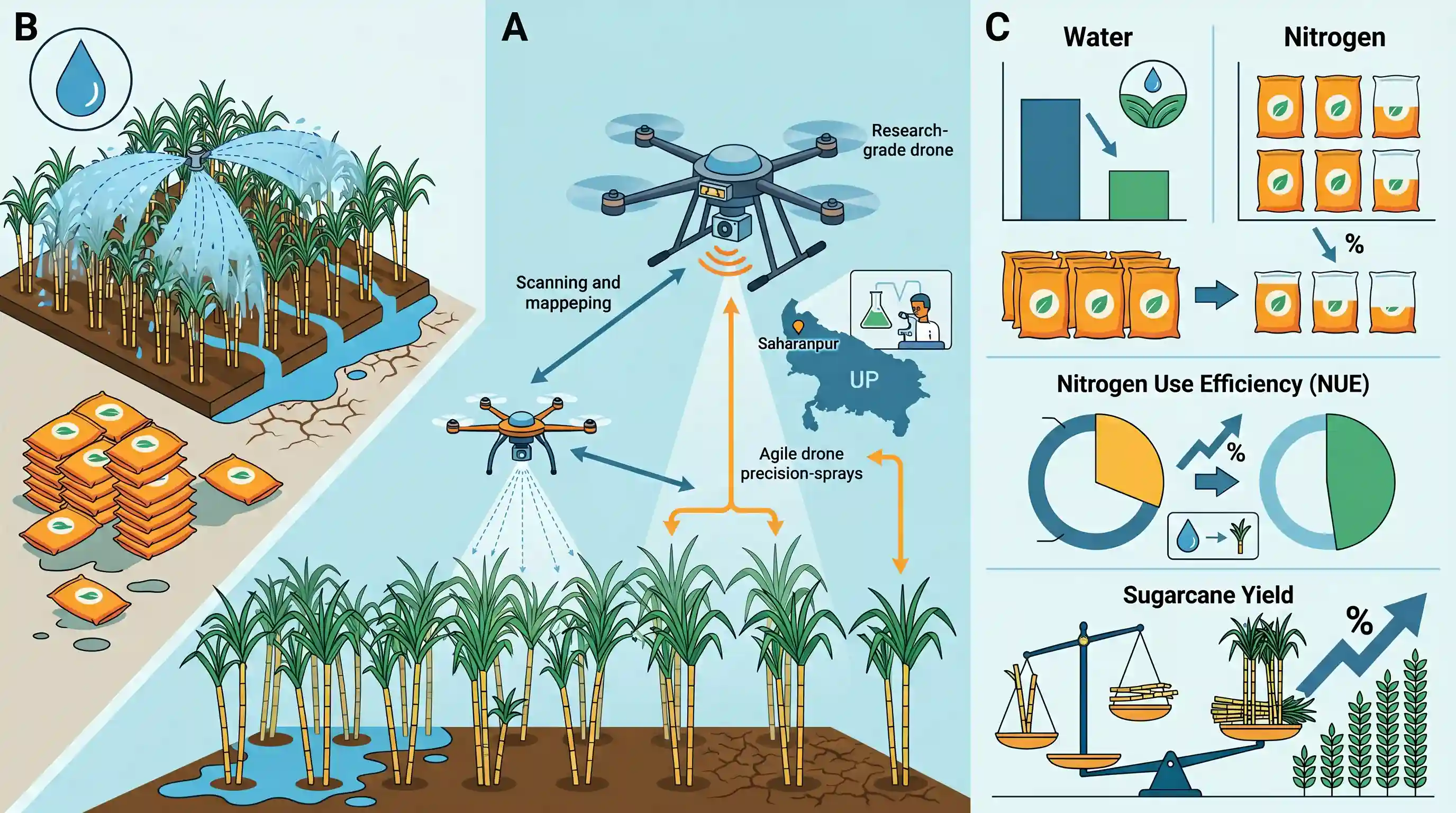
Researchers at the Indian Institute of Information Technology (IIIT) have developed a dual-drone precision agriculture system that significantly reduces water and nitrogen consumption while boosting sugarcane yield and farmer profits. Conducted in Uttar Pradesh's Saharanpur district on the Co-0238 sugarcane variety, the study demonstrated a 30% reduction in irrigation water, a 24% reduction in nitrogen fertilizer, an increase in Nitrogen Use Efficiency (NUE) from 31% to 48%, and a 16.8% increase in overall crop yield, showcasing a sustainable pathway for climate-smart agriculture in India's leading sugarcane-producing state.
Key Points
- Researchers from the Indian Institute of Information Technology (IIIT) have developed a precision farming dual-drone system designed to optimize input use in sugarcane cultivation.
- The field study was conducted on the prominent Co-0238 sugarcane variety in Nanota block, Saharanpur district, Uttar Pradesh, and the findings were published in the journal 'Discover Agriculture'.
- The dual-drone system works by using a first drone equipped with a multispectral camera to map crop health, nutrient deficiencies, and soil moisture, while a second drone targets fertilizer and input application specifically where required.
- The precision technology reduced irrigation water consumption by nearly 30% (dropping from 8,900 m³/ha to 6,200 m³/ha) and nitrogen use by 24% (dropping from 250 kg/ha to 190 kg/ha).
- Nitrogen Use Efficiency (NUE) improved from 31% to 48%, crop yield grew by 16.8% (from 78.2 tonnes/ha to 91.3 tonnes/ha), and net farm profits rose from ₹52,000 to ₹81,200 per hectare.
Important Terms
Precision Agriculture

A modern farm management approach using technologies like GPS, IoT, drones, and AI to apply agricultural inputs precisely according to site-specific crop and soil variations, maximizing yield while minimizing resource waste.
UPSC context
GS Paper 3 (Agriculture): tests knowledge of resource efficiency, modernization of farming, and technological interventions in crop production.
Climate-Smart Agriculture (CSA)
An integrated landscape management approach that sustainably increases agricultural productivity and incomes, adapts and builds resilience to climate change, and reduces greenhouse gas emissions where possible.
UPSC context
GS Paper 3 (Agriculture/Environment): tests sustainable development, cropping systems, and climate change adaptation/mitigation frameworks.
Nitrogen Use Efficiency (NUE)
The ratio of crop yield to the amount of nitrogen absorbed by the plant, measuring how effectively crops utilize applied nitrogen fertilizers to produce biomass, thereby reducing fertilizer waste and environmental pollution.
UPSC context
GS Paper 3 (Agriculture/Environment): evaluates knowledge of fertilizer subsidies, soil health, crop physiology, and eco-friendly farming practices.
Co-0238 Sugarcane Variety
A high-yielding, high-sugar, and early-maturing hybrid variety developed by ICAR-SBI, which revolutionized sugar production and farmers' incomes in subtropical India, particularly Uttar Pradesh.
UPSC context
GS Paper 3 (Agriculture/Geography): tests awareness of major cash crops, localized cropping patterns, and indigenously developed high-yielding crop varieties.
Agri-Drones
Unmanned aerial vehicles (UAVs) equipped with sensors and cameras, used in precision agriculture for real-time crop health monitoring, soil analysis, and targeted spraying of water, fertilizers, and pesticides.
UPSC context
GS Paper 3 (S&T/Agriculture): examines knowledge of emerging technology, farm mechanization, and digital infrastructure in Indian agriculture.
Indian Institutes of Information Technology (IIITs)
A group of premier technical universities in India, established under public-private partnerships or central funding, focusing on advanced information technology education, research, and technical human resource development.
UPSC context
GS Paper 2 (Education/Human Resources): tests understanding of higher education policies, skill development, and institutional frameworks in India.
Prelims Trap
Under the SMAM scheme, the Central Government provides a 100% financial grant to individual farmers for purchasing agricultural drones.
100% grants are restricted to public scientific institutions (ICAR, SAUs). Individual farmers only receive up to 40-50% subsidy depending on their category, not a full grant.
Static Concepts Connected
What is Nitrogen Use Efficiency (NUE) and how can it be enhanced?
- Definition: It measures the ratio of nitrogen absorbed by the crop to the total nitrogen fertilizer applied to the soil.
- Indian Scenario: India's average NUE is low (around 30-35%), meaning more than 60% of applied nitrogen is lost to volatilization, leaching, and runoff.
- Enhancement Tools: Enhanced using neem-coated urea, fertigation, split application of fertilizers, and targeted precision-spraying via drones.
What are the primary commercial by-products of sugarcane processing?
- Bagasse: The fibrous residue left after juice extraction, used as biomass fuel for green power cogeneration or pulp for paper manufacturing.
- Molasses: The dark, viscous byproduct used as the primary raw feedstock for fermenting bio-ethanol under India's Ethanol Blended Petrol (EBP) Programme.
- Pressmud: The residue cake filtered from cane juice, used as organic manure or feedstock for Compressed Biogas (CBG) under the SATAT initiative.
Cross-Topic Patterns
Precision Drones + Agri-Subsidies
Integrating Kisan Drones under SMAM with fertilizer rationalization targets demonstrates how capital subsidies are shifting toward climate-smart precision inputs to reduce import bills.
Sugarcane Monoculture + Varietal Breakdown
Over-reliance on the high-yielding Co-0238 sugarcane variety highlights crop vulnerability to fungal pathogens like Red Rot, making genetic diversification a food security priority.

Prelims 2026 may contrast Kisan Drone subsidy tiers under SMAM with chemical footprint targets like Nitrogen Use Efficiency (NUE).
Linked PYQs · 3
Linked PYQs · 3
- 2015UPPSC_PRELIMSGS1
Which Indian State has the highest area under sugarcane cultivation?
- 2008UPPSC_PRELIMSGS1
The main commercially produced crop of Uttar Pradesh is
- 2009UPPSC_PRELIMSGS1
'Nitrogen use efficiency' in crop production may be enhanced by
