Uttar Pradesh Cow Conservation and Rural Bio Economy Model
Source:freepressjournal ↗
Why It Matters
This initiative highlights a novel, sustainable approach to resolving the stray cattle problem in Uttar Pradesh while advancing rural development, organic farming, and renewable energy. It represents a practical application of circular bio-economy concepts, directly relevant to GS Paper 3 topics like agriculture, energy, and the environment.
Summary
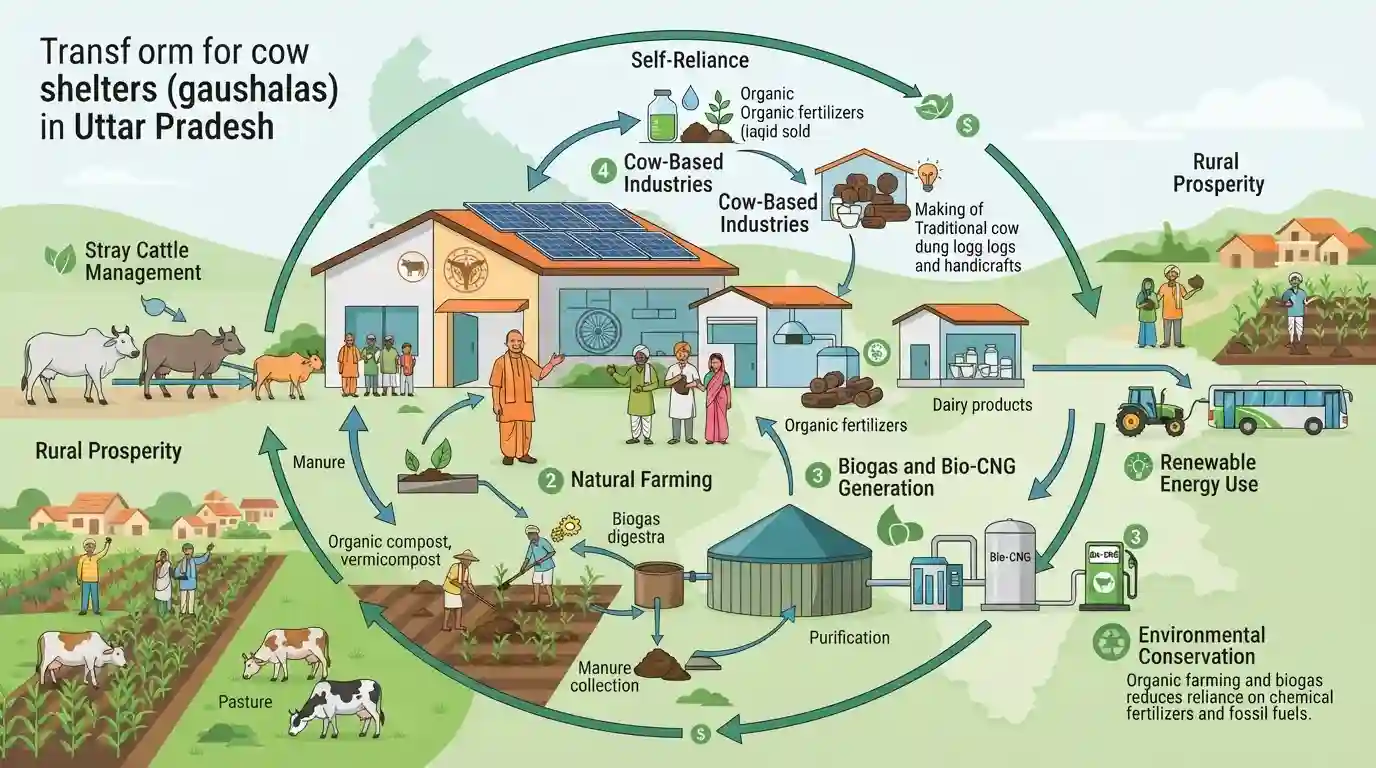
Chief Minister Yogi Adityanath is spearheading an initiative in Uttar Pradesh to transform cow shelters (gaushalas) into models of rural prosperity and a sustainable economy. The comprehensive plan focuses on natural farming, biogas and bio-CNG generation, and various cow-based industries to make gaushalas self-reliant, effectively reducing their dependence on government funds. By collaborating with organizations like the Global Confederation of Cow-Based Industries (GCCI), the state government seeks to turn these shelters into 'rural circular bio-economy hubs', simultaneously addressing the stray cattle issue and promoting green energy and rural development.
Key Points
- Chief Minister Yogi Adityanath plans to transform UP's cow shelters into self-reliant hubs of rural prosperity.
- The initiative aims to convert gaushalas into 'rural circular bio-economy hubs' through natural farming and green energy production.
- Activities include generating biogas, bio-CNG, and electricity from cow dung, and producing natural paints and fertilizers.
- Uttar Pradesh currently operates around 7,200 cow shelters housing approximately 15 lakh destitute cattle.
- The Global Confederation of Cow-Based Industries (GCCI) and other organizations will provide training and technical support to implement successful models, such as Gujarat's Gram Dham Gaushala.
Important Terms
Uttar Pradesh Go Seva Aayog

A state commission responsible for cow welfare. It currently spearheads UP's initiative to transform traditional gaushalas into self-sustaining hubs of natural farming, green energy, and rural entrepreneurship.
UPSC context
Important for GS-2 (State Bodies) and GS-3 (Rural Economy). Highlights policy shifts from mere animal protection to economic integration.
Global Confederation of Cow-Based Industries (GCCI)
A Section 8 non-profit established to formalize and strengthen the global cow-based economic ecosystem. It partners with governments to monetize gaushala byproducts through organic manure, biogas, and natural farming inputs.
UPSC context
Relevant for GS-3 (Agricultural Economics, Bio-economy). Showcases institutional support for rural value-addition and stray cattle management.
Gomutra Dairy
An enterprise from Gujarat that scientifically processes cow urine into natural farming products. It serves as a successful benchmark for UP’s policies linking cattle conservation with rural income opportunities.
UPSC context
Useful for GS-3 (Agriculture) as a successful case study of chemical-free farming and wealth-from-waste rural enterprise.
Gram Dham Gaushala
A model cow shelter in Siddhpura, Lucknow, recognized for developing an innovative cow-based electricity generation model, showcasing how local resources can make gaushalas financially self-reliant.
UPSC context
Applicable to GS-3 (Renewable Energy, Rural Development) as a case study for decentralized bio-energy generation.
Pay Amrit Sanstha
An organization focused on transforming traditional cow shelters into 'rural circular bio-economy hubs' by emphasizing the commercial viability of cow-derived byproducts and natural farming integrations.
UPSC context
Fits GS-3 (Environment, Circular Economy). A practical example of linking traditional conservation practices with modern sustainable economic models.
Prelims Trap
"The GOBAR-Dhan scheme is an initiative under the Ministry of New and Renewable Energy (MNRE)."
GOBAR-Dhan is actually a solid waste management component of Swachh Bharat Mission (Grameen) managed by the Ministry of Jal Shakti, not MNRE or Agriculture.
Static Concepts Connected
What is the SATAT initiative and its primary objective?
- Objective: Promotes Compressed Biogas (CBG) as an alternative, green transport fuel to reduce import dependence.
- Feedstock: Utilizes agricultural residue, cattle dung, sugarcane press mud, and municipal solid waste.
- Nodal Ministry: Operates under the Ministry of Petroleum and Natural Gas (MoPNG).
What are the four core pillars of Zero Budget Natural Farming (ZBNF)?
- Jeevamrutha: Microbial ferment of cow dung, urine, jaggery, and pulse flour to stimulate soil microbiome.
- Bijamrita: Natural seed-treatment concoction (dung, urine, limestone) to protect roots from soil-borne diseases.
- Acchadana & Whapasa: Biomass mulching (Acchadana) and maintaining soil moisture aeration (Whapasa) for microclimate management.
Cross-Topic Patterns
Waste-to-Wealth + Rural Sanitation
Transitioning gaushalas into biogas hubs aligns with Swachh Bharat Mission-Grameen's ODF Plus goals, bridging renewable energy (CBG) with village sanitation targets.
Circular Economy + Fertilizer Subsidy
Promoting bio-fertilizers from cow dung reduces reliance on imported chemical fertilizers, linking rural bio-waste management to easing the national fertilizer subsidy burden.

A composite GS3 question on 'Rural Circular Economy' linking SATAT, GOBAR-Dhan, and ZBNF to rural income augmentation is highly probable.
Linked PYQs · 2
Linked PYQs · 2
- 2023UPPSC_PRELIMSGS1
Natural resources should be used by the present generation in such a way that if there is minimum degradation of natural resources, then what kind of development would it be called?
- 2021UPPSC_PRELIMSGS1
A non-renewable source of energy is
