Uttar Pradesh Samvidhan Hatya Diwas and Welfare for Veterans
Source:organiser ↗
Why It Matters
The 1975 Emergency and its associated constitutional provisions (Article 352, 44th Amendment) are foundational and high-yield topics for Indian Polity in UPPSC. Recent policy updates, such as UP's specific welfare initiatives for Loktantra Senanis and the observance of 'Samvidhan Hatya Diwas', are highly relevant for both state-specific current affairs and Indian polity sections.
Summary
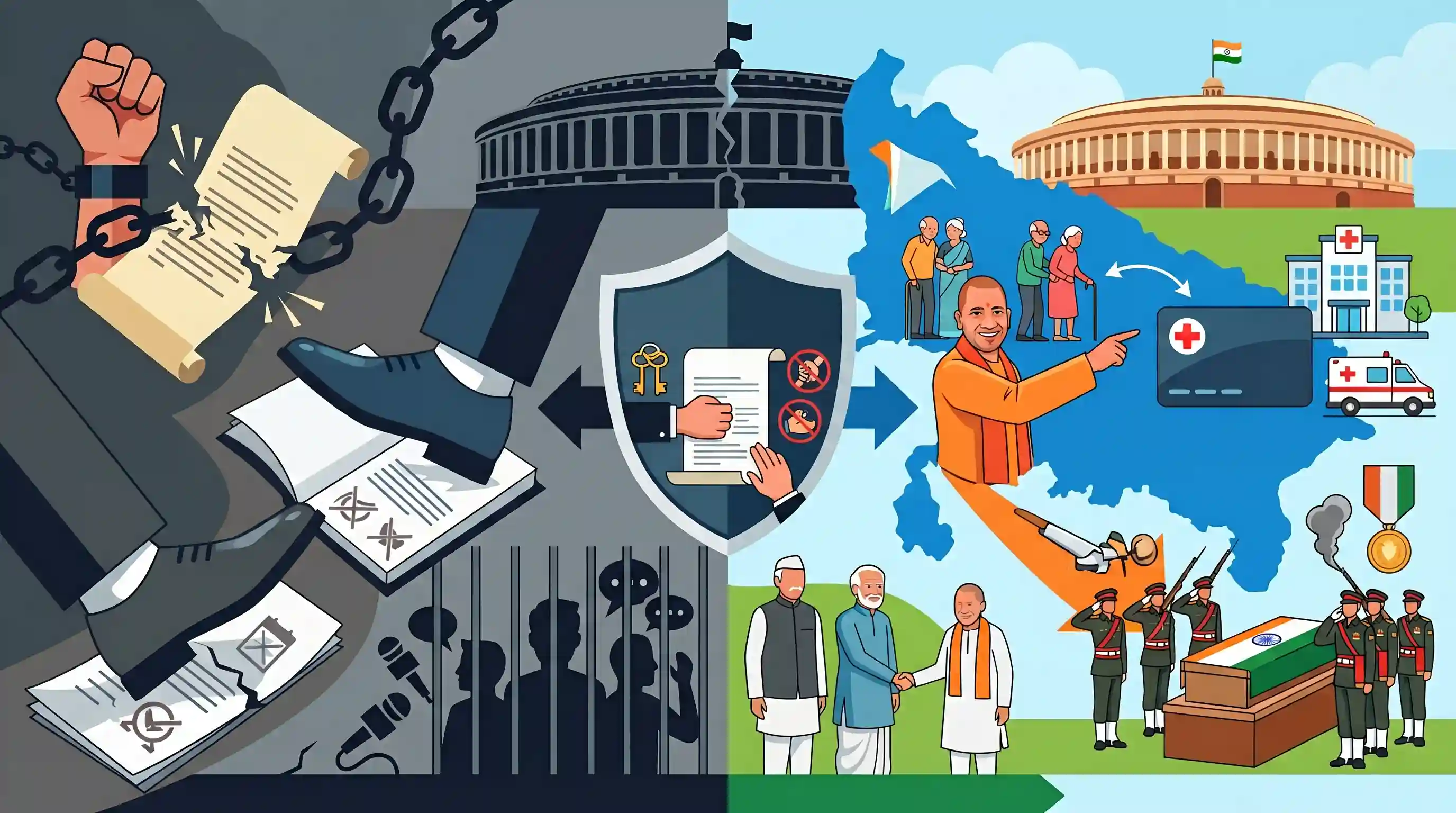
On the occasion of 'Samvidhan Hatya Diwas' (marking the anniversary of the 1975 Emergency), Uttar Pradesh Chief Minister Yogi Adityanath announced two major welfare schemes for the state's 'Loktantra Senanis' (Democracy Fighters): a cashless healthcare facility of up to Rs 5 lakh annually at empanelled hospitals, and the conduct of their last rites with full State Honours. He also launched a sharp critique of the Congress and other opposition parties like SP and RJD, labeling the 1975 Emergency as the 'darkest chapter' of Indian democracy that directly trampled upon the Constitution.
Key Points
- Observance of Samvidhan Hatya Diwas: Uttar Pradesh CM Yogi Adityanath marked June 25, 2026, as 'Samvidhan Hatya Diwas' (Constitution Murder Day), a day officially designated in July 2024 to commemorate the 1975 Emergency declaration and honor those who resisted it.
- Cashless Health Scheme for Loktantra Senanis: The UP government announced a cashless medical treatment facility worth up to Rs 5 lakh annually for 'Loktantra Senanis' (Democracy Fighters) at empanelled government and private hospitals.
- State Honours for Last Rites: In a second major announcement, the CM declared that deceased Loktantra Senanis will receive full state honors during their last rites, for which a distinct legal and protocol framework will be drafted by the UP government.
- Historical Context of the 1975 Emergency: The National Emergency was imposed on June 25, 1975, under Article 352 on grounds of 'internal disturbance' by the Indira Gandhi-led Congress government. Civil liberties were suspended, media censorship was imposed, and opposition leaders were jailed under laws like MISA and DIR.
- Constitutional Changes: The 44th Constitutional Amendment Act of 1978 subsequently replaced the ground of 'internal disturbance' with 'armed rebellion' and made a written recommendation of the Union Cabinet mandatory for the declaration of a National Emergency.
Important Terms
Samvidhan Hatya Diwas

A day declared by the Government of India, observed annually on June 25, to commemorate those who suffered and fought against the gross abuse of power during the 1975 national Emergency.
UPSC context
GS Paper II (Polity). Tests understanding of historical challenges to democracy, civil liberties, and constitutionalism.
44th Constitutional Amendment Act, 1978
An amendment passed by the Janata Party government to undo the excesses of the 42nd Amendment, introducing safeguards like replacing 'internal disturbance' with 'armed rebellion' for declaring a National Emergency.
UPSC context
GS Paper II (Polity). Essential for studying Emergency Provisions (Articles 352-360), fundamental rights safeguards, and checks on executive overreach.
Maintenance of Internal Security Act (MISA)
A controversial preventive detention law enacted in 1971 that was widely misused during the 1975–1977 Emergency to arrest political opponents and dissenters without trial, before being repealed in 1978.
UPSC context
GS Paper II (Polity & Constitution). Tests knowledge of historical preventive detention laws, civil liberties, and major legislative milestones.
Defence of India Rules (DIR)
A set of emergency rules, rooted in colonial-era laws, used by the state to regulate trade, speech, and public order during wars and the 1975 Emergency to suppress political dissent.
UPSC context
GS Paper II (Polity). Relevant for studying state power, historic emergency legislations, and their impact on fundamental rights.
Uttar Pradesh Loktantra Senani Samman Scheme
A state welfare scheme honoring 'democracy fighters' imprisoned under MISA/DIR during the 1975 Emergency, providing them monthly pensions, free transport, and newly announced cashless healthcare and state-honored funerals.
UPSC context
GS Paper II (Welfare Schemes). Important for analyzing state-level interventions, social security for historical groups, and political welfare policies.
Prelims Trap
The 44th Amendment mandated that a National Emergency can only be declared on the written advice of the Prime Minister.
The amendment requires written advice from the entire Union Cabinet (PM + cabinet-rank ministers), not the PM alone, specifically to prevent unilateral executive decisions.
Static Concepts Connected
What are the key safeguards introduced by the 44th Amendment Act (1978) to Article 352?
- Grounds restricted: Substituted the vague term 'internal disturbance' with 'armed rebellion' to prevent executive misuse during peaceful political protests.
- Cabinet concurrence: Mandated written recommendation of the entire Union Cabinet (not just the PM) before the President can issue a proclamation.
- Tighter timelines: Reduced parliamentary approval window from two months to one month, requiring a special majority instead of a simple majority.
Is the proclamation of a National Emergency subject to judicial review?
- 38th CAA vs 44th: The 38th CAA (1975) made the President’s satisfaction immune to judicial review, but this exclusion was deleted by the 44th CAA.
- Minerva Mills case: The Supreme Court ruled that a National Emergency declaration can be challenged if based on malafide or completely irrelevant grounds.
Cross-Topic Patterns
Federalism & state welfare politics
State-level pensions and benefits for 'Loktantra Senanis' demonstrate how regional governments use welfare policy to shape historical narratives and counter centralizing tendencies.
Emergency & Basic Structure evolution
The post-Emergency constitutional repairs directly influenced the Supreme Court’s eventual holding of Article 21's non-suspendability as a core basic structure element.

With 'Samvidhan Hatya Diwas' institutionalized, expect a conceptual Prelims question comparing the 38th and 44th CAAs on judicial review.
Linked PYQs · 1
Linked PYQs · 1
- 2024UPPSC_PRELIMSGS1
Given below are two statements, one is labelled as Assertion (A) and the other as Reason (R). Assertion (A) : Article 352 of the Indian Constitution deals with the declaration of an emergency. Reason (R) : An emergency may take place at any time. Select the correct answer from the codes given below:
