Uttar Pradesh Loktantra Senani Welfare Scheme and Health Benefits
Source:organiser ↗
Why It Matters
The announcement combines constitutional history (the 1975 Emergency and the 44th Constitutional Amendment) with state-specific administrative initiatives and welfare schemes, which are high-yielding topics for UPPSC Prelims.
Summary
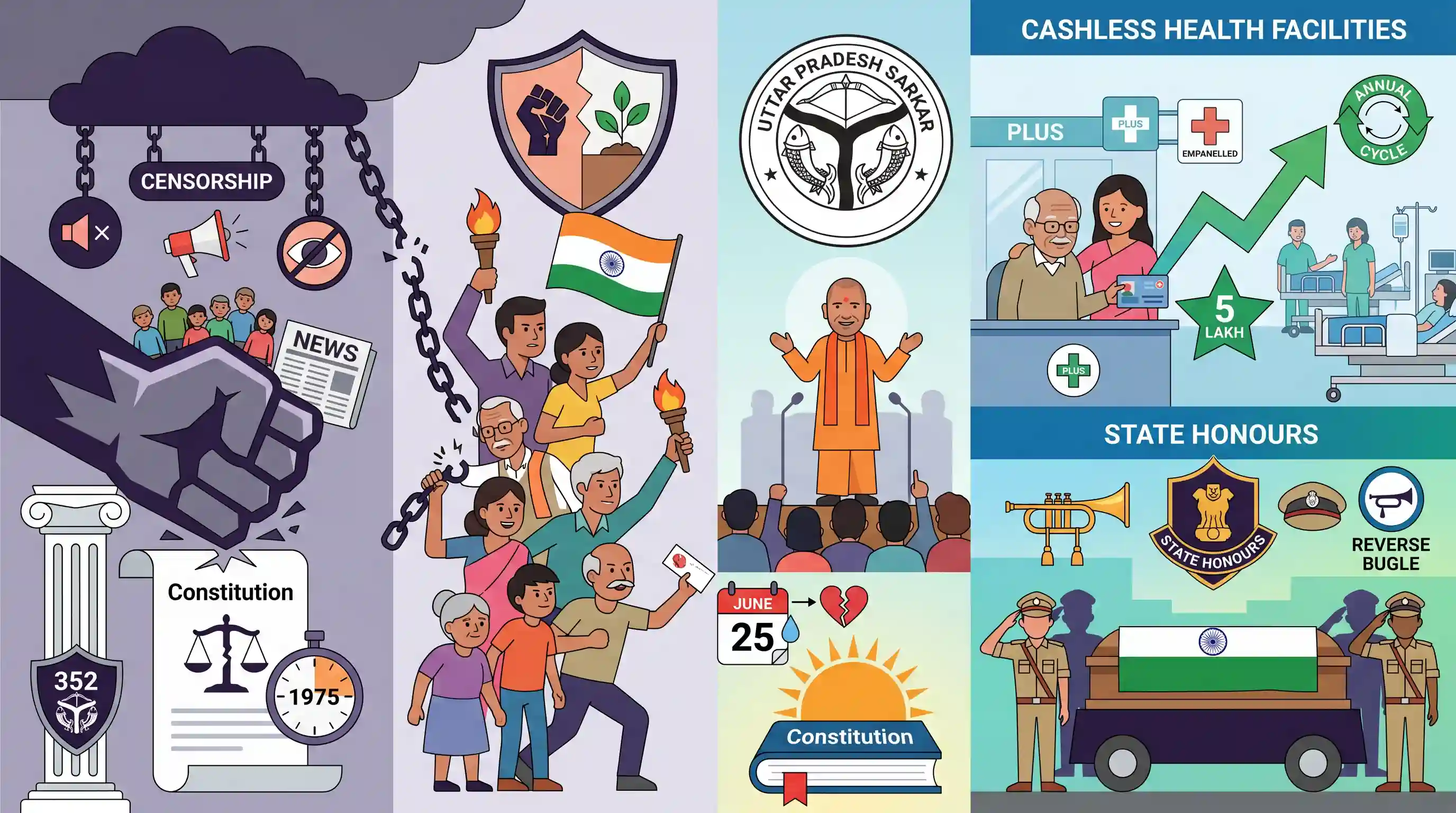
Uttar Pradesh Chief Minister Yogi Adityanath announced major welfare benefits for the state's 'Loktantra Senanis' (Democracy Fighters) who resisted the 1975 Emergency. Under these initiatives, they will receive cashless health facilities up to ₹5 lakh annually at empanelled hospitals, and their last rites will be performed with full State Honours. The announcements were made on 'Samvidhan Hatya Diwas' (June 25), marking the anniversary of the Emergency imposed by the Indira Gandhi government in 1975.
Key Points
- UP CM Yogi Adityanath announced two major welfare benefits for 'Loktantra Senanis' (Democracy Fighters) in Uttar Pradesh: a cashless health facility up to ₹5 lakh annually and last rites with full State Honours.
- The announcement was made on the occasion of 'Samvidhan Hatya Diwas' (Constitution Murder Day), which is observed on June 25 to mark the anniversary of the 1975 Emergency.
- The cashless healthcare benefit of ₹5 lakh annually can be availed at empanelled government and private hospitals, as most Loktantra Senanis are now senior citizens.
- A formal legal framework and protocol will be formulated by the state government to extend full State Honours for the funerals of deceased Loktantra Senanis.
- CM Yogi Adityanath criticized the 1975 Emergency as the 'darkest chapter' in Indian democracy, where the soul of the Constitution drafted by Dr. B.R. Ambedkar was trampled, civil liberties suspended, and opposition leaders imprisoned.
Important Terms
44th Constitutional Amendment Act, 1978

A constitutional amendment enacted by the Janata Party government to reverse authoritarian changes introduced by the 42nd Amendment during the 1975 Emergency, restoring key democratic safeguards and fundamental rights.
UPSC context
GS Paper II (Polity & Constitution). Tests knowledge of constitutional amendments, emergency safeguards, and institutional checks and balances.
Samvidhan Hatya Diwas
Observed on June 25, this day was designated by the Government of India in 2024 to honor those who fought against the 1975 Emergency and to remember the suspension of democratic liberties.
UPSC context
GS Paper II (Polity & Governance). Tests awareness of contemporary commemorative events, national political history, and constitutional morality.
Rashtriya Swayamsevak Sangh
A prominent Hindu nationalist volunteer organization founded in 1925 that played an active role in organizing underground resistance, distributing independent literature, and staging satyagrahas during the 1975 Emergency.
UPSC context
GS Paper I & II (History & Pressure Groups). Tests understanding of civil society groups, political history, and resistance movements in independent India.
Indian National Congress
One of India's oldest political parties, which spearheaded the independence movement and subsequently led the central government that imposed the controversial 1975 Emergency under Indira Gandhi.
UPSC context
GS Paper I & II (Post-Independence History & Polity). Tests understanding of India's political evolution, party dynamics, and significant policy regimes.
Government of Uttar Pradesh
The state-level governing authority of Uttar Pradesh, responsible for administering local laws, managing provincial development, and executing welfare policies such as health benefits for anti-Emergency activists.
UPSC context
GS Paper II (Governance & Welfare Schemes). Tests knowledge of subnational administration, federal structure, and state-level policy implementation.
Prelims Trap
During a National Emergency, the President can suspend the right to move any court for the enforcement of all Fundamental Rights.
Aspirants confuse Article 358 (which automatically suspends Article 19) with Article 359 (which requires a presidential order to suspend the enforcement of other rights). Crucially, post-1978, Article 359 cannot suspend the enforcement of Articles 20 and 21 under any circumstance.
Static Concepts Connected
How did the 44th Constitutional Amendment Act, 1978 safeguard against the abuse of Article 352?
- Grounds redefined: Replaced 'internal disturbance' with 'armed rebellion' to limit the grounds for declaring a National Emergency.
- Cabinet consensus: Mandated that the President can only declare an emergency upon the written advice of the entire Union Cabinet, not the PM alone.
- Fundamental Rights immunity: Explicitly barred the suspension of the right to life and personal liberty (Article 21) and protection against conviction (Article 20).
- Parliamentary approval timelines: Required the emergency proclamation to be approved by Parliament within one month (reduced from two months) by a special majority.
What is the Ninth Schedule's historical connection with the emergency-era MISA?
- Judicial immunity shield: The Maintenance of Internal Security Act (MISA), 1971, was inserted into the Ninth Schedule by the 39th Amendment (1975) to immunize it from judicial review.
- Repeal and exclusion: The 44th Amendment in 1978 stripped MISA's constitutional protection, and Parliament subsequently repealed the Act.
- Subsequent judicial standard: The Supreme Court in the I.R. Coelho case (2007) ruled that any law added to the Ninth Schedule after April 24, 1973, is subject to judicial review if it violates the Basic Structure.
Cross-Topic Patterns
Emergency excesses + Basic Structure doctrine
The excesses of the 1975 Emergency directly catalyzed the landmark Minerva Mills (1980) judgment, cementing judicial review of emergency proclamations as part of the Basic Structure.
State welfare + civil liberties recognition
Loktantra Senani benefits show how states use executive powers under Article 162 to officially recognize, pension, and validate historical political resistance movements.

The 2024 gazette notification of Samvidhan Hatya Diwas makes the legislative history of MISA and the 44th Amendment ripe for a 2026 question.
Linked PYQs · 2
Linked PYQs · 2
- 2024UPPSC_PRELIMSGS1
Given below are two statements, one is labelled as Assertion (A) and the other as Reason (R). Assertion (A) : Article 352 of the Indian Constitution deals with the declaration of an emergency. Reason (R) : An emergency may take place at any time. Select the correct answer from the codes given below:
- 2023UPPSC_PRELIMSGS1
Which of the following scheme/s is/are related to Uttar Pradesh? (1) Anuthee Uphar Scheme (2) Matra Shakti Udyamita Scheme (3) Kaushalya Matritva Scheme (4) Stree Nidhi Scheme Select the 'correct' answer using the code given below -
