UP orders strict action against sugar hoarding
Source:chinimandi ↗
Why It Matters
The management of essential commodity prices and anti-hoarding measures directly relates to food security and inflation control. Additionally, the shift in ethanol production feedstocks from sugarcane to grains represents a critical evolution in India's biofuel policy, balancing energy security with food inflation concerns.
Summary
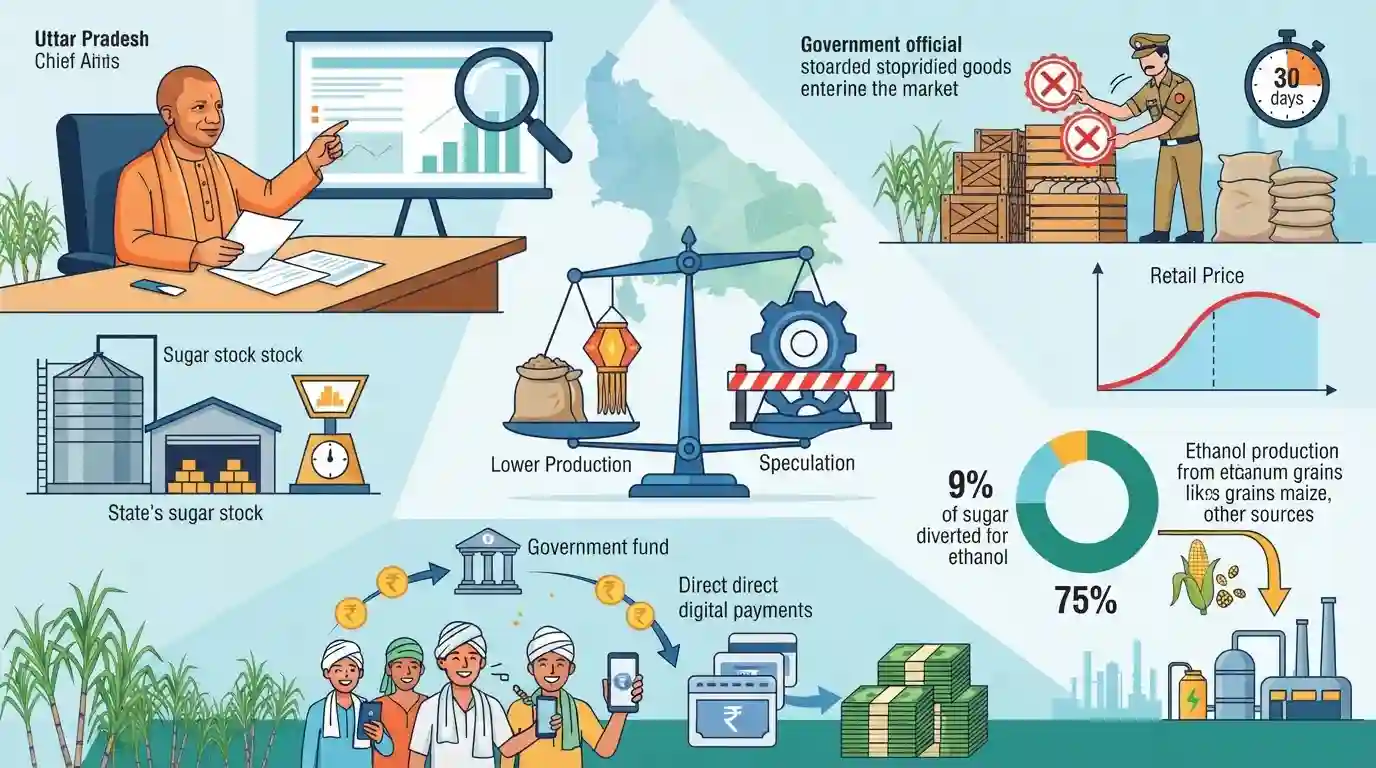
Uttar Pradesh Chief Minister Yogi Adityanath reviewed the state's sugar availability and ordered stringent action against hoarding and black-marketing under the Essential Services Maintenance Act (ESMA). With 179.38 lakh quintals in stock, the state is targeting dealers holding over 400 tonnes or hoarding for more than 30 days to curb rising retail prices. The Central Government noted that the price inflation is driven by lower domestic production, festive demand, and speculation, rather than ethanol blending. Data shows the diversion of sugar for ethanol has dropped to 9%, as 75% of ethanol output now comes from grains like maize. Additionally, the UP government has disbursed record sugarcane payments of ₹3,217 crore to farmers.
Key Points
- Uttar Pradesh CM Yogi Adityanath directed strict action under the Essential Services Maintenance Act (ESMA) against hoarding and black-marketing of sugar.
- Dealers are prohibited from holding sugar stocks for more than 30 days, with targeted action against those hoarding over 400 tonnes.
- The Centre attributed the recent spike in retail sugar prices (from ₹48.18 to ₹55.70 per kg) to lower domestic production, festive demand, weather damage, and speculation.
- The Ministry of Consumer Affairs clarified that ethanol blending is not causing the sugar price rise; the share of sugar diverted for ethanol dropped to 9% in 2025-26, with 75% of ethanol now produced from grains like maize.
- The UP government reported record sugarcane payments of ₹3,217 crore to 48 lakh farmers ahead of the new crushing season starting October 15.
Important Terms
Essential Services Maintenance Act (ESMA)

A legislative act empowering the government to prohibit strikes and enforce the uninterrupted delivery of critical public services, ensuring normal life is not disrupted during emergencies or severe shortages.
UPSC context
GS Paper 2 (Governance). Tests knowledge of statutory mechanisms available to the state to maintain public order and essential supplies.
Essential Commodities Act
A 1955 central law enabling the government to regulate the production, supply, and distribution of declared 'essential' goods to prevent hoarding, curb inflation, and ensure equitable availability.
UPSC context
GS Paper 3 (Economy/Food Security). Frequently tested in the context of inflation management, market interventions, and agricultural supply chains.
Ethanol Blended Petrol Programme
A central initiative to blend ethanol (derived from sugarcane, maize, and other biomass) with petrol, aiming to reduce crude oil imports, cut carbon emissions, and boost farmer incomes.
UPSC context
GS Paper 3 (Environment/Energy). Vital for questions on India's biofuel policies, renewable energy targets, and agricultural value addition.
Prelims Trap
Sugarcane remains the primary feedstock driving India's Ethanol Blended Petrol (EBP) Programme.
Aspirants often assume ethanol in India is still mostly sugar-derived. Currently, 75% of ethanol is produced from grains like maize, with sugar diversion dropping heavily.
Static Concepts Connected
What is the regulatory framework for sugarcane pricing in India?
- FRP (Fair and Remunerative Price): Announced by the Central Government based on the recommendations of the Commission for Agricultural Costs and Prices (CACP).
- SAP (State Advised Price): Announced by key sugarcane-producing states like Uttar Pradesh, Punjab, and Haryana. It is generally higher than the FRP.
- Sugarcane Control Order 1966: Requires sugar mills to pay farmers within 14 days of supply, failing which interest is levied.
How do the Essential Commodities Act (ECA) and ESMA function?
- ECA 1955: Used by the government to regulate the production, supply, and distribution of commodities (like sugar) to prevent hoarding and price spikes via stock limits.
- ESMA 1968: Enacted to ensure the continuous delivery of critical services (like transport, health). States sometimes invoke it broadly to mandate sugar mill operations or prevent hoarding disruptions.
Cross-Topic Patterns
Biofuels vs. Food Inflation dynamics
The shift towards maize for ethanol highlights the 'food-vs-fuel' debate. Policy adjustments (stock limits, feedstock diversion) act as supply-side administrative tools to manage food inflation where RBI's monetary policy is ineffective.
Sugarcane Pricing vs. Mill Arrears
States like Uttar Pradesh announcing State Advised Prices (SAP) higher than the Centre's FRP frequently triggers arrears, pushing state governments to intervene via ESMA or strict mill regulations.

Multi-statement questions will likely test the recent ethanol feedstock shift (grains > sugar) alongside the Centre's FRP vs. UP's SAP.
Linked PYQs · 4
Linked PYQs · 4
- 2021UPPSC_PRELIMSGS1
Headline inflation refers to the change in value of all goods on the basket. On which basis is the headline inflation measured ?
- 2025UPPSC_PRELIMSGS1
Given below are two statements, one is labelled as Assertion (A) and the other as Reason (R). Assertion (A) : Food security is necessary even in surplus food production years. Reason (R) : Starvation can still occur due to unequal distribution and lack of accessibility. Select the correct answer from the code given below :
- 2016UPPSC_PRELIMSGS1
Which one of the following gases, released from bio-gas plant is used as a fuel gas?
- 2025UPPSC_PRELIMSGS1
Which of the following two are the major constituent of Bio-gas ? 1. Methane 2. Butane 3. Carbon dioxide 4. Carbon monoxide Select the correct answer from the code given below :
