Uttar Pradesh Anti-Land Mafia Task Force Reclaims Public Land
Source:freepressjournal ↗
Why It Matters
The initiative highlights the integration of e-governance, administrative restructuring (task forces), and stringent legal frameworks to combat organized crime. It demonstrates how effective law enforcement and land management can directly contribute to economic growth by creating a substantial land bank for industrial and infrastructural development, serving as an important case study for state-level governance in India.
Summary
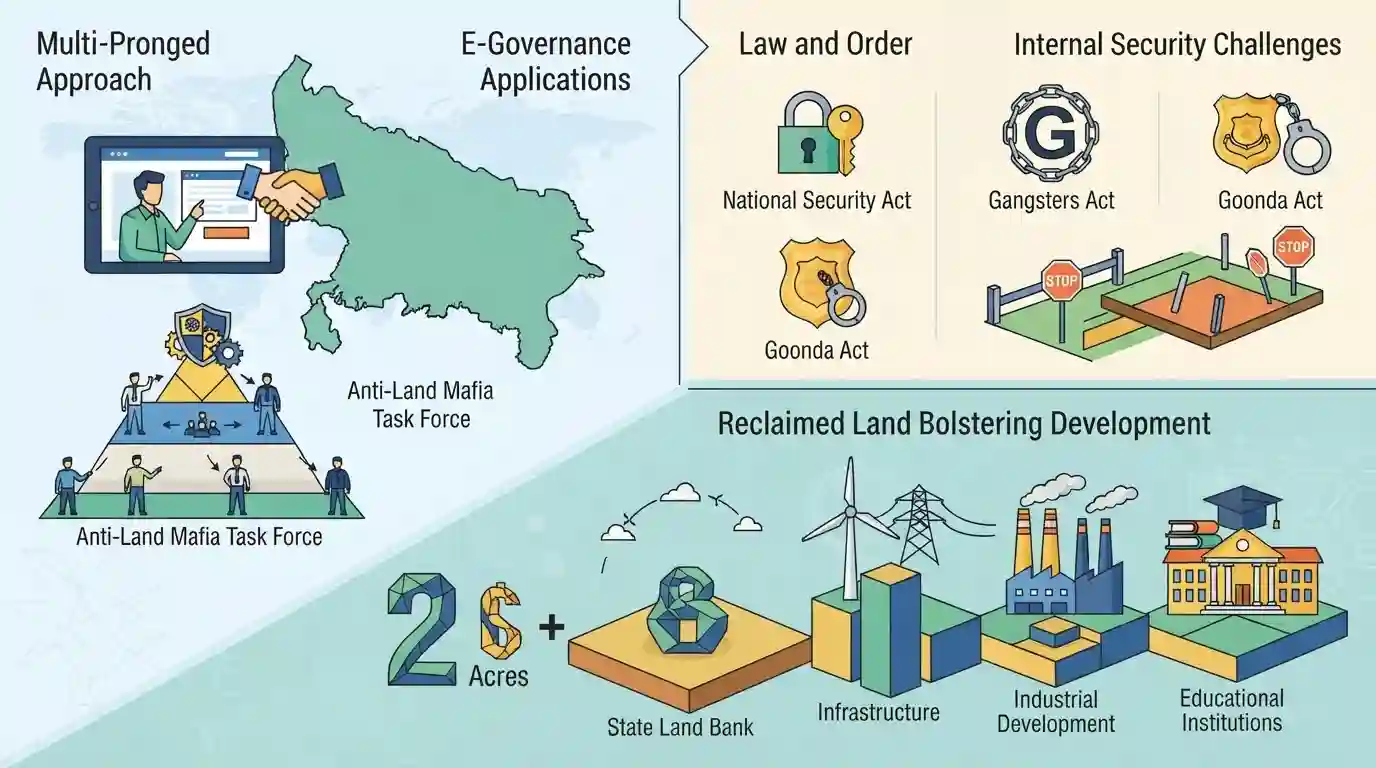
The Uttar Pradesh government, under Chief Minister Yogi Adityanath, has conducted a massive crackdown on land mafias over the past 9.5 years, reclaiming over 2 lakh acres of illegally encroached public land. The initiative utilized a multi-pronged approach, including the creation of a four-tier Anti-Land Mafia Task Force and a dedicated online portal for citizen complaints. To enforce the crackdown, strict legal measures under the National Security Act, Gangsters Act, and Goonda Act were applied. The freed land has significantly bolstered the state's land bank, facilitating investments in infrastructure, industrial development, and educational institutions.
Key Points
- The Uttar Pradesh government has freed over 2.08 lakh acres (84,005 hectares) of public land from illegal encroachment by land mafias over the past 9.5 years.
- A four-tier Anti-Land Mafia Task Force was established across state, divisional, district, and tehsil levels to systematically tackle encroachments.
- The state launched the 'Anti-Land Mafia Portal' to allow citizens to register complaints online, leading to the resolution of over 3.83 lakh out of 3.86 lakh complaints.
- The reclaimed land is being utilized to build a vast land bank for infrastructure projects, MSMEs, industrial investments, logistics parks, and educational institutions.
- Strict legal actions have been enforced using laws like the National Security Act (NSA), Gangsters Act, and Goonda Act, resulting in the registration of over 27,000 cases and the imprisonment of more than 20,000 individuals.
Important Terms
National Security Act (NSA)

A stringent preventive detention law allowing the government to detain individuals for up to 12 months without formal charges if they are deemed a threat to national security or public order.
UPSC context
Relevant for GS Paper 2 & 3. It tests the balance between internal security measures and fundamental rights like civil liberties.
Anti-Land Mafia Task Force
A dedicated four-tier administrative body in Uttar Pradesh (state, divisional, district, and tehsil levels) designed to systematically identify land grabbers and reclaim illegally encroached public properties.
UPSC context
Relevant for GS Paper 2 (State Governance) to illustrate effective public administration and institutional mechanisms tackling organized crime.
Anti-Land Mafia Portal
An e-governance platform in Uttar Pradesh allowing citizens to register complaints about illegal land encroachment online, enabling continuous tracking, monitoring, and swift administrative resolution.
UPSC context
Key example for GS Paper 2 (E-Governance). Demonstrates how digital portals enhance transparency, accountability, and the citizen-administration interface.
UP Gangsters and Anti-Social Activities (Prevention) Act
A strict state law in Uttar Pradesh aimed at curbing organized crime. It allows authorities to detain suspects, attach properties acquired illegally, and enforce special evidentiary rules against gang members.
UPSC context
Important for GS Paper 3 (Internal Security). Examines state-level legal frameworks against organized crime and the judicial debate over potential misuse.
Uttar Pradesh Control of Goondas Act
A preventive state law allowing the detention and externment (removal from municipal limits) of habitual offenders to stop them from disrupting public peace and continuing anti-social activities.
UPSC context
Tests GS Paper 2 & 3 concepts, specifically the maintenance of public order versus the protection of constitutional rights against executive overreach.
Prelims Trap
"Preventive detention under the National Security Act (NSA) can exclusively be authorized by the Central Government."
State governments, and even District Magistrates or Commissioners of Police under state direction, are fully empowered to invoke the NSA for public order threats.
Static Concepts Connected
What are the Constitutional safeguards for Preventive Detention under Article 22?
- Advisory Board: Detention exceeding three months requires approval from an Advisory Board comprising persons qualified to be High Court judges.
- Communication of Grounds: The detaining authority must communicate the grounds of detention to the detainee as soon as practically possible.
- Right to Representation: The detainee must be afforded the earliest opportunity to make a representation against the detention order to the relevant authority.
How is organized crime legally tackled in India's federal structure?
- State-level Laws: Due to the absence of a comprehensive central organized crime act, states enact specific regional laws like MCOCA (Maharashtra) and the UP Gangsters Act.
- Central Niche Laws: Central frameworks like the PMLA, NDPS Act, and UAPA are utilized to tackle specialized facets of organized crime such as money laundering, drugs, or terror financing.
- Concurrent Subject: Criminal law is on the Concurrent List, allowing states to draft stringent measures tailored to local mafias, subject to Presidential assent.
Cross-Topic Patterns
E-Governance + Internal Security
Digital grievance redressal portals serve a dual purpose: ensuring transparent governance (GS-2) while crowdsourcing actionable intelligence to dismantle localized organized crime syndicates (GS-3).
Land Banks + Industrial Corridors
Reclaiming encroached public land removes fundamental acquisition bottlenecks, creating ready 'land banks' that are essential for accelerating GS-3 infrastructure, MSME clusters, and logistics parks.

Article 22 safeguards vs state use of the National Security Act (NSA) for public order is a highly probable GS-2 Mains question for 2026.
Linked PYQs · 2
Linked PYQs · 2
- 2017UPPSC_PRELIMSGS1
The web based platform 'Pratibimba' to project government's achievements was launched in March 2017 by the government of:
- 2023UPPSC_PRELIMSGS1
Which of the following Scheme/Programme is not the Central Government Programme and it is Uttar Pradesh Government's Programme?
