Cow Based Natural Farming and Stray Cattle Management in Uttar Pradesh
Source:freepressjournal ↗
Why It Matters
This article provides critical factual data regarding UP's agricultural policies, such as the exact target districts (34 total, 27 Ganga-side, 7 Bundelkhand), the precise financial outlays of the Mukhyamantri Sahbhagita Yojana (Rs 1,500 per cattle per month), and regional initiatives of cow-based natural farming, which are highly testable under UP-specific GS and general agriculture categories in UPPSC PCS Prelims.
Summary
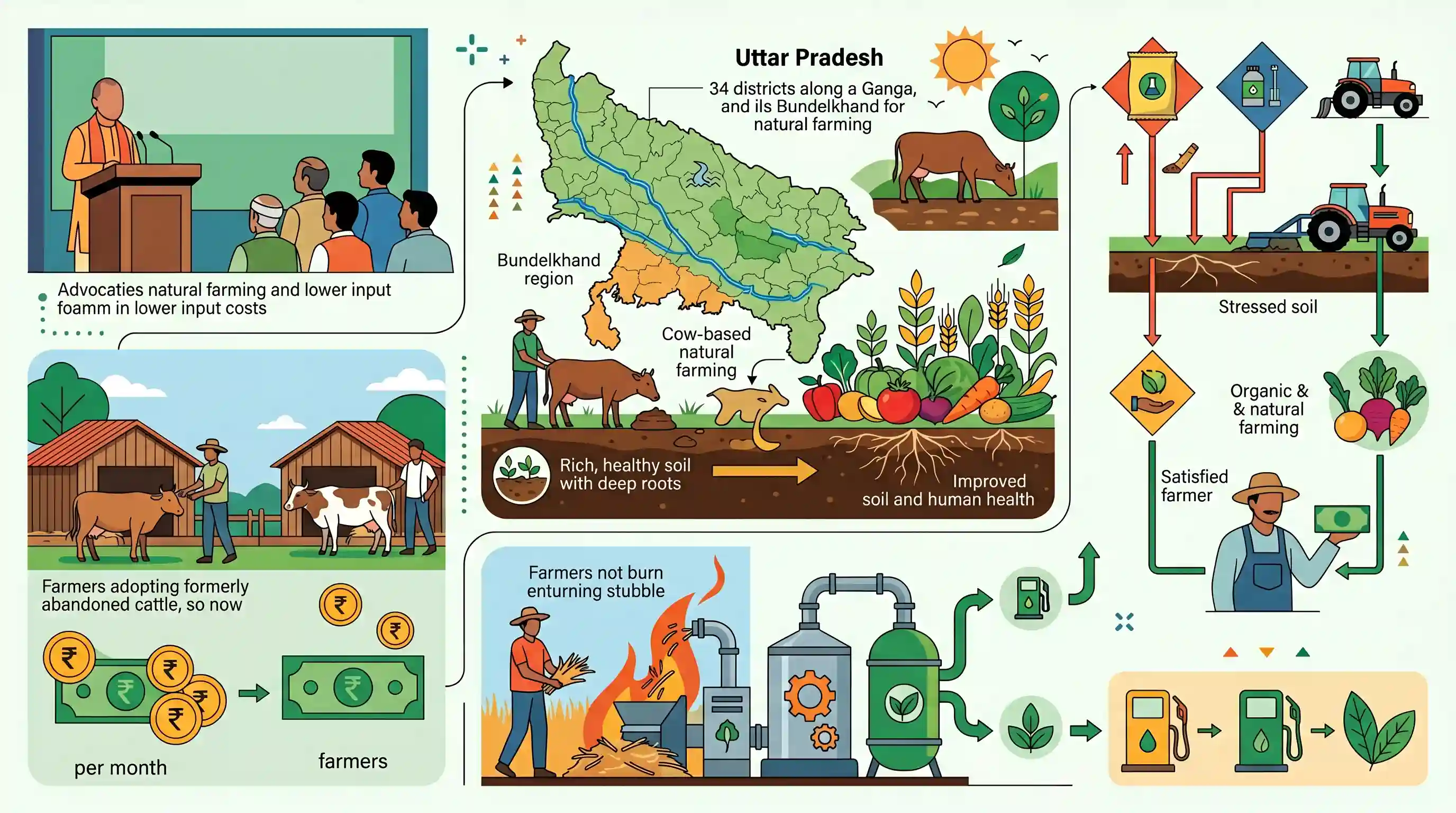
At the 'Prakritik Kheti Karyashala-2026' in Kanpur, UP Chief Minister Yogi Adityanath strongly advocated for cow-based natural farming, emphasizing its role in lowering input costs and enhancing soil and human health. To drive this, 34 UP districts (including 27 along the Ganga and 7 in Bundelkhand) have been earmarked for natural farming. He detailed the Mukhyamantri Sahbhagita Yojana, which pays farmers Rs 1,500/month per cow to adopt abandoned cattle, benefiting 1.5 lakh farmers. He also called on farmers to process crop residue into Compressed Biogas (CBG) and ethanol instead of burning stubble, and contrasted modern agricultural costs with organic savings.
Key Points
- Chief Minister Yogi Adityanath addressed the 'Prakritik Kheti Karyashala-2026' in Kanpur, urging farmers to adopt cow-based natural farming.
- In Uttar Pradesh, 34 districts are rapidly adopting natural farming practices, consisting of 27 districts along the banks of the Ganga River and 7 districts of the Bundelkhand region.
- Under the Mukhyamantri Sahbhagita Yojana, the UP government provides financial assistance of Rs 1,500 per month per cattle animal to farmers who maintain abandoned cattle (amounting to Rs 6,000 per month if a farmer rears four cattle).
- Over 14 lakh cattle are currently protected in more than 7,700 gaushalas across UP, and nearly 1.5 lakh farmers have adopted cattle rearing under the Sahbhagita scheme.
- The CM highlighted 'Jeevamrit' (a mix of cow dung, jaggery, and water) as a self-sufficient alternative to chemical fertilizers that can save farmers Rs 10,000 to Rs 12,000 per acre.
- Farmers were encouraged to divert crop residue to Compressed Biogas (CBG) and ethanol production instead of burning it, aiding energy self-reliance.
- The CM shared historical economic data: India's share in the global economy was 44% around 2,000 years ago, remained 24% during the Mughal period, and shrunk to 2% at Independence.
Important Terms
Mukhyamantri Sahbhagita Yojana

An initiative by the Uttar Pradesh government providing families adopting destitute cattle with a monthly allowance of ₹1,500 to support animal welfare, rural livelihoods, and organic farming.
UPSC context
GS Paper 2/3: Welfare schemes, rural development, animal husbandry, and organic farming practices.
Farmer Producer Organisations (FPOs)
Collectives of primary producers, especially small and marginal farmers, legally registered to leverage economies of scale in input procurement, crop marketing, and shared agricultural technologies.
UPSC context
GS Paper 3: Issues related to agricultural produce marketing, cooperative models, and supply chain constraints.
Soil Health Card Scheme
A flagship scheme under the Ministry of Agriculture that provides farmers with reports on twelve crucial soil parameters to ensure balanced fertilizer application and sustainable nutrient management.
UPSC context
GS Paper 3: Land degradation, sustainable farming, soil fertility, and agricultural input management.
Kisan Samman Nidhi
A Central Sector direct benefit transfer scheme providing eligible landholding farmer families across India ₹6,000 annually in three equal installments to assist with input costs.
UPSC context
GS Paper 2/3: Direct income support, poverty alleviation, rural economy, and welfare policies.
Krishi Vigyan Kendras (KVKs)
District-level agricultural extension centers run under the Indian Council of Agricultural Research (ICAR) to translate scientific research into localized, field-level solutions for farmers.
UPSC context
GS Paper 3: E-technology in aid of farmers, agricultural extension services, and technology transfer.
Pradhan Mantri Krishi Sinchai Yojana
A centrally sponsored umbrella scheme aimed at expanding cultivated areas under assured irrigation, conserving water, and enhancing on-farm water use efficiency via micro-irrigation techniques.
UPSC context
GS Paper 3: Irrigation systems, water resource management, and resource use efficiency.
Pradhan Mantri Fasal Bima Yojana
A national crop insurance scheme providing comprehensive financial risk coverage to farmers against crop yields or post-harvest damage caused by unforeseen natural calamities, pests, and diseases.
UPSC context
GS Paper 3: Risk mitigation in agriculture, crop insurance, and agricultural safety nets.
Prelims Trap
Zero Budget Natural Farming is identical to organic farming, as both rely heavily on purchasing off-farm organic fertilizers and vermicompost.
ZBNF strictly rejects purchased organic manures like vermicompost to eliminate input costs, relying exclusively on on-farm microbial inoculants prepared from indigenous cow dung and urine.
Static Concepts Connected
What are the four core pillars of Zero Budget Natural Farming (ZBNF)?
- Jeevamrit: A fermented microbial mixture of cow dung, urine, jaggery, pulse flour, and soil to enrich soil microflora.
- Bijamrit: A seed and seedling treatment mixture of dung, urine, and lime to protect crops from soil-borne pathogens.
- Acchadana: Covering the soil surface with crop residues or cover crops to conserve soil moisture and prevent weed growth.
- Whapasa: Promoting water-vapor condensation in soil aeration zones, drastically reducing the physical liquid irrigation water requirement.
What is the SATAT Initiative and its Compressed Bio-Gas (CBG) blending mandate?
- Objective: Launched in 2018 to establish commercial CBG production plants utilizing green waste and agricultural residues.
- Blending Mandate: Introduces a phased, mandatory blending of CBG in CNG/PNG networks starting at 1% in FY26, rising to 5% by FY29.
- Feedstock Utilization: Utilizes crop residues, animal dung, and sewage treatment plant waste, curbing stubble burning and carbon emissions.
Cross-Topic Patterns
Riverine Ecology + Agroecology
Scaling natural farming along the Ganga basin acts as a non-structural barrier, preventing chemical fertilizer runoff, agricultural eutrophication, and heavy metal contamination in riverine ecosystems.
Livestock Economics + Bioenergy
Linking stray cattle welfare schemes with CBG production converts a rural social liability (stray cattle crop-grazing) into a clean-energy resource, fostering a closed-loop rural bioeconomy.

Mandatory CBG blending targets under SATAT paired with core ZBNF components like Whapasa and Jeevamrit likely to trend in 2026 Prelims.
Linked PYQs · 4
Linked PYQs · 4
- 2023UPPSC_PRELIMSGS1
Natural resources should be used by the present generation in such a way that if there is minimum degradation of natural resources, then what kind of development would it be called?
- 2021UPPSC_PRELIMSGS1
Which of the following Schemes in Uttar Pradesh were introduced in Budget of 2021-22? I. Atmanirbhar Krishak Samanvit Vikas Yojna II. Mukhya Mantri Saksham Suposhan Yojna III. Mukhya Mantri Pravasi Shramik Udyamita Vikas Yojna IV. Yuva Udyamita Vikas Abhiyan Select the correct answer from the codes given below.
- 2022UPPSC_PRELIMSGS1
Compressed Natural Gas (CNG) is mainly composed of
- 2022UPPSC_PRELIMSGS1
Consider the following statements about farm subsidies in India. 1. The input subsidies in India, such as on fertilizers fall under indirect farm subsidies. 2. Reduction in power and irrigation bills offered to farmers fall under direct farm subsidies. 3. The agricultural provisions of the World Trade Organization (WTO) though allow direct farm subsidies, prohibit indirect subsidies. 4. All subsidies provided by the governments in India fall under the indirect subsidies. Select the correct statements using the code given below.
