Uttar Pradesh Cabinet Approval for New Private Universities
Source:eletsonline ↗
Why It Matters
UPPSC frequently tests candidates on state-specific governance decisions, including the setup of new universities, their exact geographic locations (districts), and broader developments in higher education like the NEP 2020 implementation.
Summary
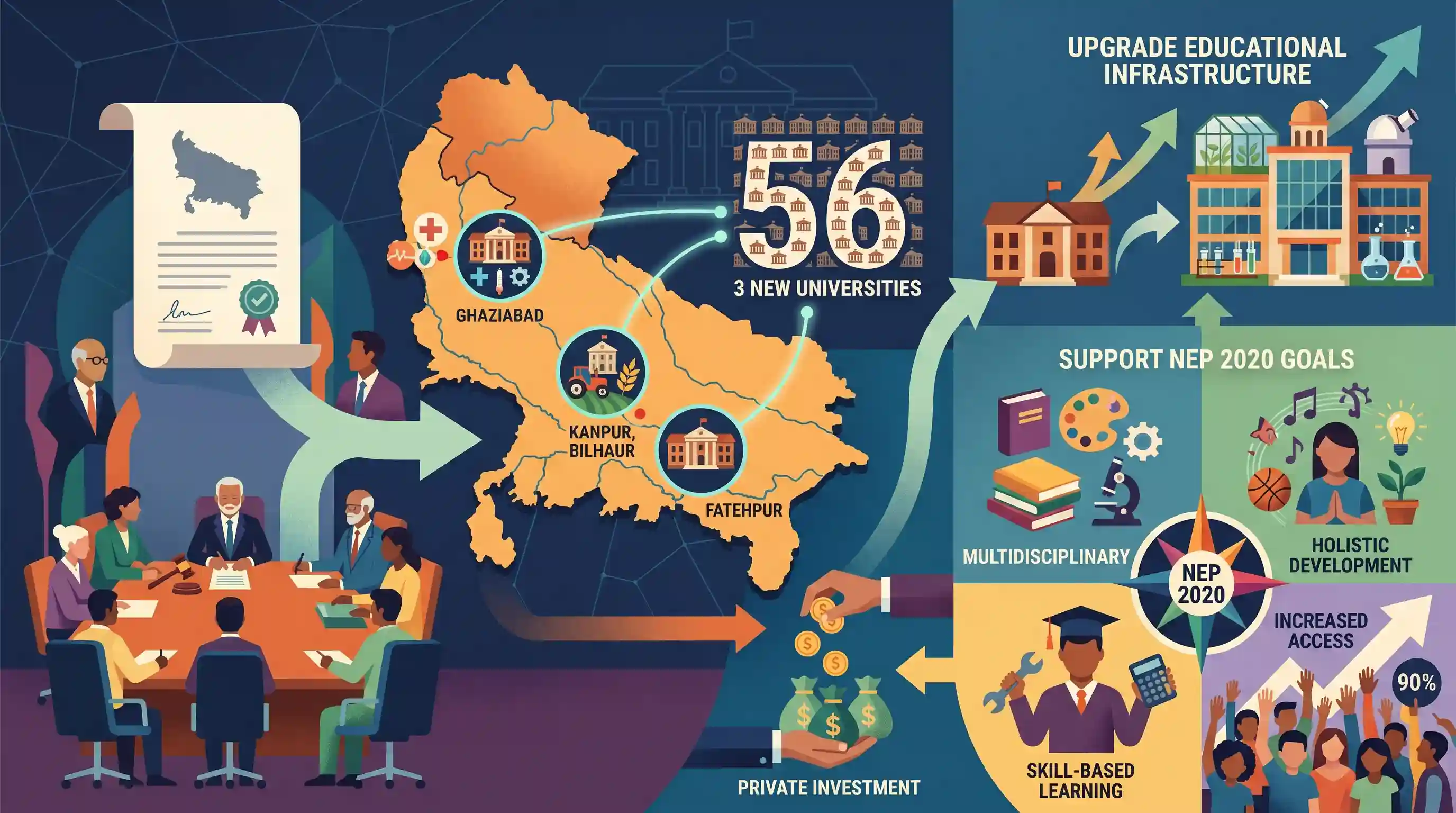
The Uttar Pradesh Cabinet approved the setting up of three new private universities in Kanpur (Bilhaur), Ghaziabad (Dasna), and Fatehpur, bringing the state's total tally of private universities to 56. The move aims to upgrade educational infrastructure and support NEP 2020 goals.
Key Points
- The Uttar Pradesh Cabinet, chaired by Chief Minister Yogi Adityanath, has approved the establishment of three new private universities in the state.
- The new private universities will be located in Bilhaur (Kanpur Nagar), Dasna (Ghaziabad), and Fatehpur.
- With this approval, the total number of private universities in Uttar Pradesh rises to 56.
- The step aims to scale up academic infrastructure, attract private investment in higher education, and align the state's educational landscape with the National Education Policy (NEP) 2020.
Important Terms
National Education Policy (NEP) 2020

A comprehensive policy framework launched in 2020 to reform India's school and higher education systems, introducing a 5+3+3+4 structure and promoting multidisciplinary studies.
UPSC context
GS Paper II (Social Sector - Education); tests understanding of educational structural reforms, access, and Gross Enrolment Ratio targets.
State Cabinet
The executive committee of state ministers, headed by the Chief Minister, responsible for making key policy decisions and approving state legislative bills and proposals.
UPSC context
GS Paper II (Polity and Governance); tests the executive's role, cabinet system, and decision-making processes at the subnational level.
Ordinance
A temporary law promulgated by the President under Article 123 or Governor under Article 213 when the respective legislature is not in session.
UPSC context
GS Paper II (Constitutional Provisions); tests the executive's legislative powers, procedural limitations, and separation of powers doctrine.
Uttar Pradesh Private Universities Act, 2019
A state legislation regulating the establishment, academic compliance, administrative governance, and operations of private universities within Uttar Pradesh.
UPSC context
GS Paper II (Education & State Laws); tests the federal division of educational regulation and state-level higher education policies.
Private Universities
Non-profit higher education institutions set up by sponsoring societies or trusts via state legislative acts, subject to regulatory oversight by the UGC.
UPSC context
GS Paper II (Social Sector - Education); tests issues of commercialization, public-private balance, and equity in higher education.
Prelims Trap
Achieving a 50% Gross Enrolment Ratio (GER) in higher education by 2030 under NEP 2020.
UPSC frequently swaps target years. NEP 2020 targets a 100% GER in school education by 2030, but the 50% GER target for higher education is set for 2035.
Static Concepts Connected
What is the constitutional status of Education in India?
- Concurrent List: Education was shifted from the State List to the Concurrent List by the 42nd Constitutional Amendment Act of 1976.
- Fundamental Right: Article 21A, added by the 86th Amendment Act in 2002, makes free and compulsory education for ages 6-14 a Fundamental Right.
- Legislative Competence: Both Parliament and State Legislatures can pass laws, but Central legislation prevails in case of conflict under Article 254.
What are the key regulatory bodies for Higher Education in India?
- UGC: A statutory body established in 1956 to coordinate, determine, and maintain standards of university education in India.
- AICTE: The apex advisory and regulatory body for technical and management education in India.
- HECI: Proposed under NEP 2020 as a single, overarching umbrella body to replace the UGC and AICTE.
Cross-Topic Patterns
Private Capital vs Equitable Higher Education
The expansion of private universities boosts Gross Enrolment Ratio (GER) but raises concerns over regional disparity, high tuition fees, and social exclusion of marginalized sections.
Federalism in Education Policy Implementation
Education being on the Concurrent List requires state-level legislative alignments to successfully implement centrally drafted frameworks like the NEP 2020.

NEP 2020's dual timelines (2030 school vs 2035 higher ed GER) and state legislative compliance rules are prime targets for a 2026 MCQ.
Linked PYQs · 3
Linked PYQs · 3
- 2020UPPSC_PRELIMSGS1
The Uttar Pradesh Cabinet has approved on 29th July, 2020 to establish a National Law University at which of the following cities ?
- 2008UPPSC_PRELIMSGS1
The number of Central Universities in Uttar Pradesh is
- 2020UPPSC_PRELIMSGS1
Consider the following statements about New National Education Policy approved by Union Cabinet of India on 29th July, 2020 : 1. It was drafted by a Committee headed by Dr. K Kasturirangan. 2. It will replace the previous Education Policy which has been followed since last 38 years. Select the correct statement(s) from the codes given below.
