Uttar Pradesh Approves Rani Lakshmibai Scooty Scheme
Source:The Hindu ↗
Why It Matters
UPPSC PCS Prelims frequently tests candidates on state-specific welfare schemes, their objectives, target demographics, and eligibility criteria. Understanding this scheme is crucial for answering questions pertaining to women empowerment and educational initiatives in UP.
Summary
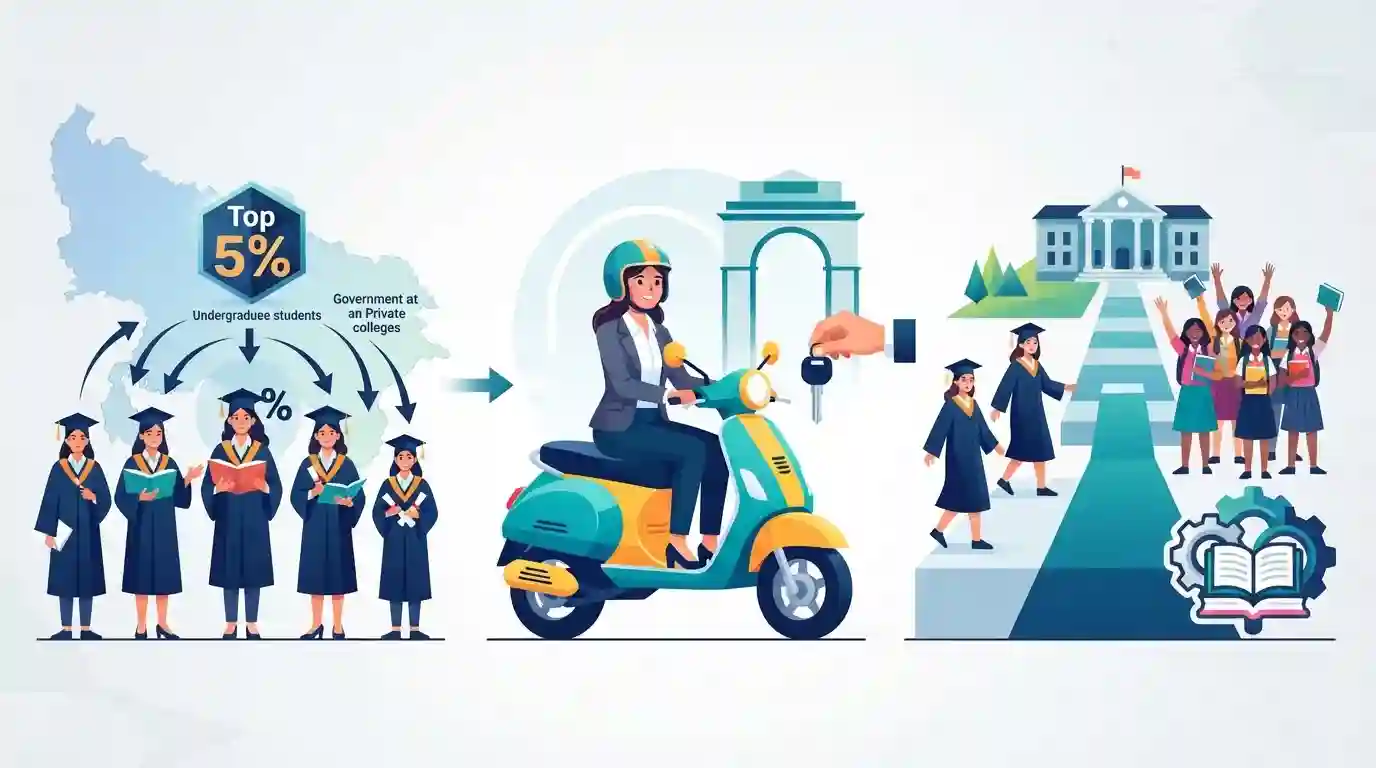
The Uttar Pradesh government has given the green light to the 'Rani Lakshmibai Scooty Yojana', which aims to provide free petrol-powered scooters to top-performing female undergraduate students. Focusing on female students ranking in the top 5% across various government and private colleges, the scheme is designed to facilitate safe and independent mobility. The broader objectives of the initiative are to reduce female dropout rates in higher education and actively boost the Gross Enrolment Ratio (GER). Procurement of the scooters and associated accessories will be handled through the Government e-Marketplace (GeM) portal.
Key Points
- The Uttar Pradesh cabinet approved the 'Rani Lakshmibai Scooty Yojana' to distribute free petrol scooters to meritorious undergraduate girl students.
- The initiative is primarily aimed at reducing the dropout rate among girls pursuing higher education and improving the state's Gross Enrolment Ratio (GER).
- Eligibility extends to UP-domiciled female students ranked in the top 5% of their undergraduate courses in state, private, and government colleges.
- The scheme package includes the scooter, registration fees, insurance, a helmet, and four liters of petrol, with procurement happening via the GeM portal.
Important Terms
Rani Lakshmibai Scooty Yojana

A welfare initiative by the Uttar Pradesh government providing free petrol-powered scooters to top-performing female undergraduate students to reduce dropout rates and support independent, safe mobility.
UPSC context
GS Paper II: Government Schemes; tests policies targeting women's empowerment, education access, and state-level welfare programs.
Gross Enrolment Ratio (GER)
A statistical metric representing the total enrollment in a specific level of education, regardless of age, as a percentage of the official school-age population for that level.
UPSC context
GS Paper II: Social Justice (Education); essential for assessing educational penetration and targets under National Education Policy 2020.
Government e-Marketplace (GeM)
A unified, paperless online procurement portal launched in 2016 that enables government departments, ministries, and PSUs to purchase common-use goods and services directly from sellers.
UPSC context
GS Papers II & III: Governance and Economy; evaluates public procurement transparency, administrative efficiency, and digital economic reforms.
Prelims Trap
"Provides free electric scooters universally to all undergraduate college girls in UP."
The scheme provides petrol-powered scooters, not EVs, and is merit-restricted to the top 5% of students, rather than being a universal freebie for all college girls.
Static Concepts Connected
What is the Gross Enrolment Ratio (GER) target under NEP 2020?
- Definition: The ratio of total enrolment in a specific level of education to the eligible official school-age population for that level.
- NEP 2020 Target: The National Education Policy (NEP) 2020 aims to increase the GER in higher education (including vocational education) to 50% by 2035.
What is the Government e-Marketplace (GeM)?
- Core Function: A completely paperless, cashless, and system-driven electronic platform for procurement of common use goods and services by government bodies.
- Nodal Ministry: It was launched in 2016 and is administered by the Directorate General of Supplies and Disposals (DGS&D) under the Ministry of Commerce and Industry.
Cross-Topic Patterns
Cash vs. In-kind welfare transfers
State schemes providing physical mobility assets (like UP's scooters or Bihar's bicycles) are classic case studies in overcoming patriarchal and geographical bottlenecks to education, contrasting with pure Direct Benefit Transfers (DBT).
Welfare delivery vs. EV transition goals
Procuring petrol-powered scooters under welfare schemes highlights a governance trade-off: balancing immediate upfront cost-efficiency for state budgets against the national policy push for Electric Vehicle (EV) adoption.

Expect a GS2 mains question evaluating the efficacy of 'in-kind' state transfers (cycles/scooters) vs DBT in improving female GER.
Linked PYQs · 5
Linked PYQs · 5
- 2023UPPSC_PRELIMSGS1
Which of the following scheme/s is/are related to Uttar Pradesh? (1) Anuthee Uphar Scheme (2) Matra Shakti Udyamita Scheme (3) Kaushalya Matritva Scheme (4) Stree Nidhi Scheme Select the 'correct' answer using the code given below -
- 2021UPPSC_PRELIMSGS1
Which of the following Schemes in Uttar Pradesh were introduced in Budget of 2021-22? I. Atmanirbhar Krishak Samanvit Vikas Yojna II. Mukhya Mantri Saksham Suposhan Yojna III. Mukhya Mantri Pravasi Shramik Udyamita Vikas Yojna IV. Yuva Udyamita Vikas Abhiyan Select the correct answer from the codes given below.
- 2023UPPSC_PRELIMSGS1
Which of the following Scheme/Programme is not the Central Government Programme and it is Uttar Pradesh Government's Programme?
- 2022UPPSC_PRELIMSGS1
Right to Education has been included into the Fundamental Rights by the
- 2021UPPSC_PRELIMSGS1
With reference to 'birth rate' which of the following statement(s) is/are correct ? 1. Urbanization helps in reducing the birth rate. 2. High literacy rate is directly related to low birth rate. Select the correct answer using the codes given below.
