Startup Policy 2026 and Startup Mission approved in Uttar Pradesh
Source:free-press-journal ↗
Why It Matters
UPPSC Prelims regularly features factual and analytical questions regarding Uttar Pradesh's specific state policies, regional developmental targets (like the $1 trillion economy goal), financial thresholds of schemes (e.g., grants, subsidies), and regional-specific allocations (like the Bundelkhand/Purvanchal incubator provisions).
Summary
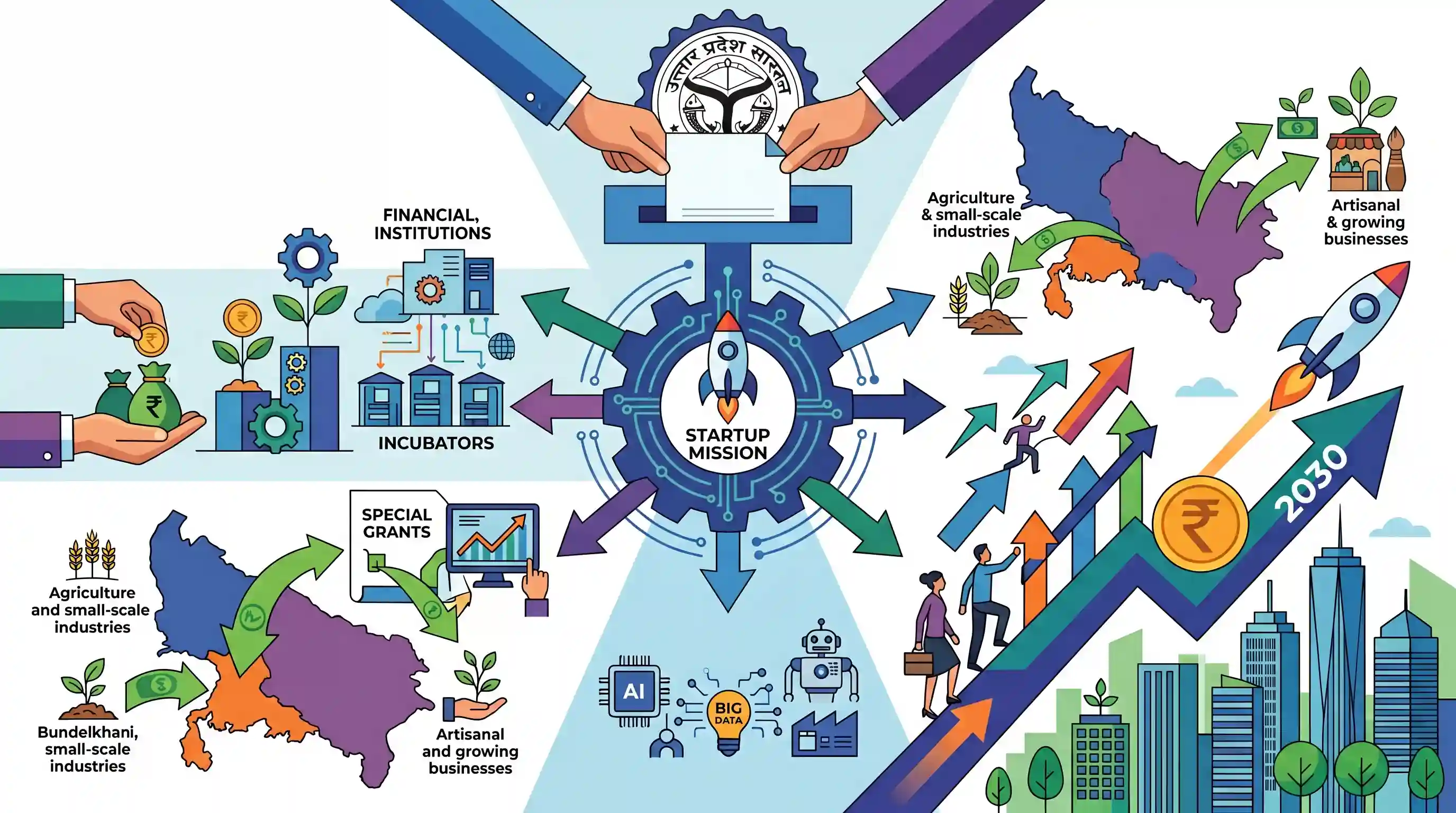
The Uttar Pradesh Cabinet approved the Uttar Pradesh Startup Policy 2026 and launched the Uttar Pradesh Startup Mission to boost innovation, entrepreneurship, and investment. Under the new policy, the state government has substantially increased financial and institutional support for startups, deep-tech industries, and regional incubators (including special grants for Purvanchal and Bundelkhand). The Startup Mission will operate under the Societies Registration Act under the Department of IT & Electronics, seeking to propel the state towards a $1 trillion economy by 2030.
Key Points
- The Uttar Pradesh Cabinet, chaired by CM Yogi Adityanath, approved the Uttar Pradesh Startup Policy 2026 and the establishment of the Uttar Pradesh Startup Mission.
- The policy aims to foster a globally competitive startup ecosystem to assist in making Uttar Pradesh a $1 trillion economy by 2030.
- Financial assistance under the Startup Policy 2026 includes: Monthly sustenance allowance increased to ₹20,000 for up to two years; prototype grants doubled to ₹10 lakh; and seed funding increased to ₹15 lakh (up to ₹50 lakh in special circumstances).
- Deep-tech startups (AI, robotics, quantum tech, space tech) will receive specialized assistance: up to ₹20 lakh for prototypes, ₹30 lakh for seed funding, patience capital up to ₹100 crore, and up to 40% financial assistance for R&D.
- Incubator capital grants are raised to ₹1.25 crore, with a special provision of up to ₹1.50 crore for incubators in the economically lagging Purvanchal and Bundelkhand regions. Operational expenditure grants are increased to ₹40 lakh per year.
- A state-level 'Deep-Tech U-Hub' will be set up as an integrated platform. Additionally, 20 new Centres of Excellence (CoEs) will be established, with financial assistance increased from ₹10 crore to ₹12 crore.
- The Uttar Pradesh Startup Mission will be constituted under the Societies Registration Act, operating under the administrative control of the Department of IT & Electronics as the nodal agency.
Important Terms
Uttar Pradesh Startup Policy 2026

A comprehensive policy of the Uttar Pradesh government designed to foster entrepreneurship, double seed funding, provide substantial incentives for deep-tech sectors, and establish Centres of Excellence to build a globally competitive startup ecosystem.
UPSC context
GS Paper III: Economic Development, specifically relating to mobilization of resources, industrial growth, employment generation, and technological innovation.
Uttar Pradesh Startup Mission
An autonomous agency established under the Societies Registration Act, headed by the State Chief Secretary, to serve as the nodal implementer of the state’s startup policy and coordinate incubation activities.
UPSC context
GS Paper II: Governance and State Government Policies; tests knowledge of institutional mechanisms driving local economic growth and innovation ecosystems.
UP Data Center Policy 2026
A policy replacing the 2021 framework, aiming to develop Uttar Pradesh as a green, AI-ready global data center hub targeting over 2 gigawatts of additional capacity and attracting massive infrastructure investments.
UPSC context
GS Paper III: Infrastructure and IT sector; tests understanding of state policies in digital infrastructure, clean energy integration, and tech-driven investments.
Societies Registration Act
A central legislation in India enacted in 1860 that allows the registration of scientific, literary, and charitable societies, providing them with a legal status to manage funds, operations, and public welfare activities.
UPSC context
GS Paper II: Statutory, regulatory, and various quasi-judicial bodies; tests understanding of legal structures governing non-profit and autonomous state-run entities.
Startup Mission Directorate
A newly approved dedicated executive body in Uttar Pradesh, headed by a CEO, created to coordinate between startups, incubators, and Centres of Excellence to streamline administrative and financial support.
UPSC context
GS Paper II: Governance and institutional structures; tests awareness of structural administrative reforms to promote digital economy and direct job creation.
Prelims Trap
The Uttar Pradesh Startup Mission's governing steering committee is chaired directly by the Chief Minister of the State.
While the Cabinet under the CM approved the policy, the Mission's governing steering committee is actually chaired by the Chief Secretary.
Static Concepts Connected
What is 'Patient Capital' and why is it critical for Deep-Tech?
- Definition: An investment made without expectation of quick short-term profits, where the investor is willing to wait for long-term growth.
- Gestation tolerance: Crucial for deep-tech (AI, biotech, quantum) which requires extensive, capital-intensive R&D before reaching commercial viability.
- Risk appetite: Offers stable, long-term funding, protecting early-stage research from the pressure of rapid venture-capital exit cycles.
How do startup incubators reduce intra-state regional developmental disparities?
- Infrastructure parity: Establishes high-tech workspaces and R&D facilities in economically lagging zones like Purvanchal and Bundelkhand.
- Asymmetric funding: Higher capital grants offset the absence of private angel investors in backward regions, attracting local entrepreneurial talent.
- Brain drain mitigation: Creates high-value local employment, retaining skilled youth who would otherwise migrate to tier-1 metropolitan cities.
Cross-Topic Patterns
Competitive Federalism and Startup Rankings
How state-specific policies (like UP's 2026 framework) compete for human capital, directly influencing India's overall standing in global innovation indices.
Asymmetric Fiscal Devolution
Using targeted state-level industrial policies to correct historical sub-regional imbalances, complementing Union-level schemes like Aspirational Districts.

Mains 2026 may ask how states utilize asymmetric fiscal incentives in deep-tech policies to address intra-state regional disparities.
Linked PYQs · 3
Linked PYQs · 3
- 2023UPPSC_PRELIMSGS1
Which of the following scheme/s is/are related to Uttar Pradesh? (1) Anuthee Uphar Scheme (2) Matra Shakti Udyamita Scheme (3) Kaushalya Matritva Scheme (4) Stree Nidhi Scheme Select the 'correct' answer using the code given below -
- 2023UPPSC_PRELIMSGS1
Which of the following Scheme/Programme is not the Central Government Programme and it is Uttar Pradesh Government's Programme?
- 2024UPPSC_PRELIMSGS1
Match List-I with List-II and select the correct answer from the codes given below. List-I (State): (A) Maharashtra (B) Uttar Pradesh (C) Tamil Nadu (D) Karnataka List-II (Rank according to expenditure on infrastructure 2019 - 23): 1. First 2. Second 3. Third 4. Fourth
