UP notifies aggregator policy capping dynamic ride fares
Source:freepressjournal ↗
Why It Matters
It highlights the expanding state-level regulatory frameworks addressing the gig economy, consumer protection against arbitrary surge pricing, social security for platform workers, and climate commitments through EV mandates.
Summary
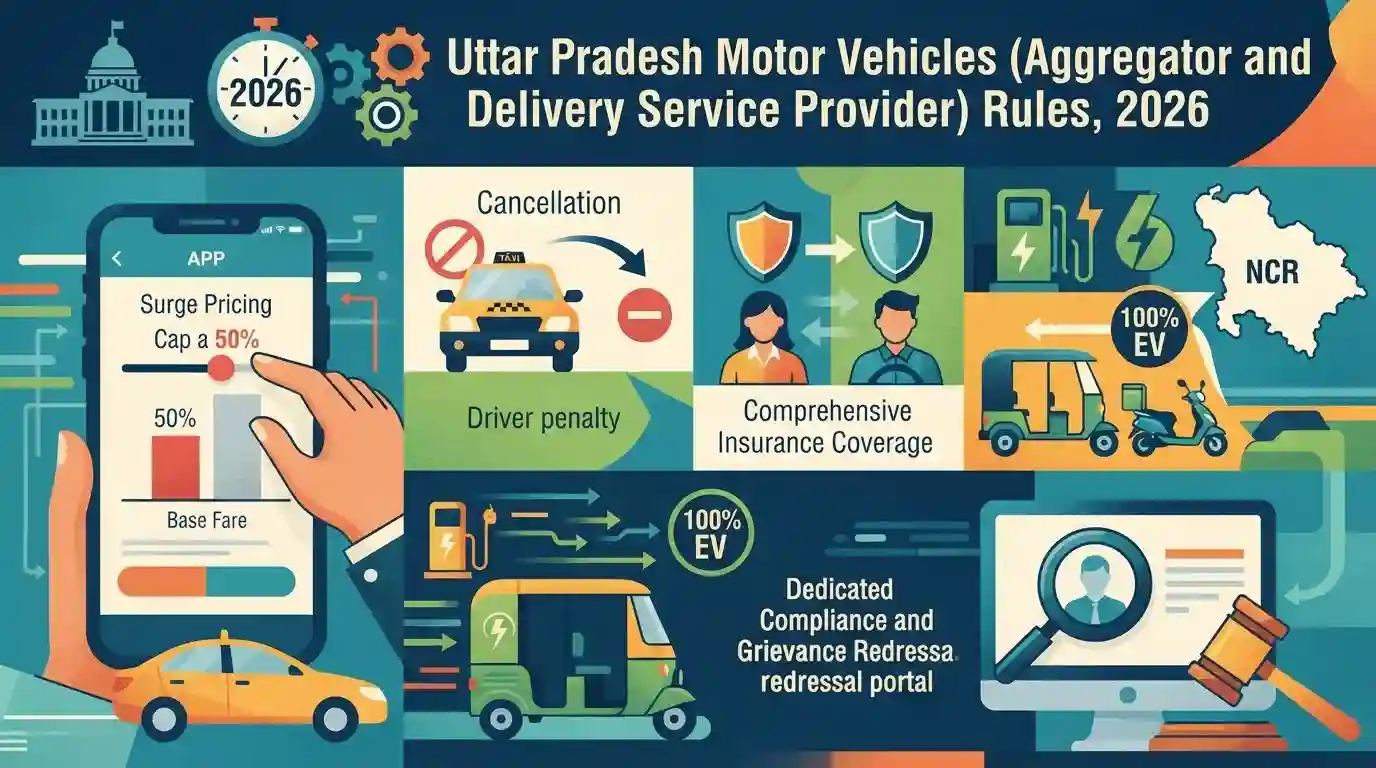
The Uttar Pradesh government has notified the Uttar Pradesh Motor Vehicles (Aggregator and Delivery Service Provider) Rules, 2026, aimed at regulating the gig economy and app-based transport services. The comprehensive policy caps surge pricing at 50% above the base fare, penalizes drivers Rs 100 for ride cancellations, and mandates significant insurance coverage for both passengers and drivers. Additionally, it mandates a phased transition to electric vehicles, with an ambitious target of a 100% EV fleet in the National Capital Region by 2030. A dedicated portal will oversee compliance and consumer grievance redressal.
Key Points
- The UP government introduced new rules to strictly regulate app-based ride-hailing and delivery platforms.
- Dynamic pricing (surge pricing) by aggregators is capped at a maximum of 50% above the state-notified base fare.
- A penalty of Rs 100 will be imposed on drivers who cancel rides after accepting them.
- Aggregators are mandated to provide health and life insurance for drivers (minimum Rs 2 lakh) and passengers (Rs 5 lakh).
- The rules enforce a phased transition to electric vehicles (EVs), targeting a 100% EV aggregator fleet in the NCR by 2030.
- A centralized portal (upmyfleet.com) will be launched to monitor compliance, track vehicles, and handle consumer grievances.
Important Terms
Uttar Pradesh Motor Vehicles (Aggregator and Delivery Service Provider) Rules, 2026

State framework regulating app-based transport and logistics platforms. It caps dynamic pricing at 50% above base fare, mandates comprehensive passenger and driver insurance, and penalizes unwarranted ride cancellations.
UPSC context
Vital for UPPSC GS Paper 5 (UP Governance) regarding gig economy regulation and social security.
UP My Fleet Portal
A digital portal launched by the Uttar Pradesh government to monitor aggregator compliance, track commercial vehicle registrations, and oversee the targeted transition to an electric vehicle fleet.
UPSC context
Important for UPPSC GS Paper 5 (State e-Governance initiatives) and digital transport regulation.
Gig Economy
A labor market reliant on short-term, flexible, or freelance work facilitated by digital platforms, encompassing delivery personnel and ride-hailing drivers targeted by the new state welfare rules.
UPSC context
High relevance for GS Paper 3 (Employment) and GS Paper 2 (Welfare of unorganized sector workers).
Dynamic Pricing
A flexible pricing strategy where fares fluctuate based on real-time market demand and supply. The new UP policy restricts aggregators to charging a maximum of 50% above the base fare.
UPSC context
Key concept for GS Paper 3 (Economy) concerning market regulation, inflation control, and consumer protection.
Uttar Pradesh State Transport Authority
The state regulatory body tasked with issuing operation licenses to aggregators, enforcing the new Motor Vehicles Rules, and ensuring compliance with safety and environmental mandates.
UPSC context
Relevant for UPPSC GS Paper 5 (State Administration and regulatory institutions).
Prelims Trap
The policy mandates a 100% EV aggregator fleet across the entire state of Uttar Pradesh by 2030.
The 100% EV target by 2030 applies specifically to the National Capital Region (NCR) districts of UP, not the entire state. Examiners often generalize regional targets.
Static Concepts Connected
What defines the Gig Economy and Platform Workers?
- Gig Economy: A labor market characterized by short-term contracts or freelance work as opposed to permanent jobs.
- Platform Workers: Workers whose work is facilitated and matched via online software apps or digital platforms (e.g., ride-hailing, food delivery).
- Legal Recognition: The Code on Social Security, 2020 was India's first central legislation recognizing gig workers for welfare benefits.
What are the pillars of UP's broader Electric Vehicle (EV) Policy?
- Consumer Subsidies: Provides 100% exemption on road tax and registration fees for EVs purchased and registered in Uttar Pradesh.
- Infrastructure & Manufacturing: Capitalizes on creating EV manufacturing hubs and mandates the setup of widespread charging infrastructure.
Cross-Topic Patterns
Gig workers + Code on Social Security
UP's state-level insurance mandate bridges the implementation gap of the central Code on Social Security, 2020, addressing the welfare of gig workers, a recurring theme in Economy/Polity.
NCR Air Quality + EV Transition
The 2030 100% EV mandate for UP's NCR districts directly supports CAQM directives and GRAP measures designed to combat severe vehicular pollution in the Delhi-NCR airshed.

Expect a multi-statement question testing specific facts: the 50% surge cap, Rs 100 cancellation fee, and the 2030 EV target for NCR only.
Linked PYQs · 3
Linked PYQs · 3
- 2020UPPSC_PRELIMSGS1
Which of the following Indian States/Union Territories launched Electric Vehicle Policy on 7th August, 2020 ?
- 2023UPPSC_PRELIMSGS1
Which of the following Scheme/Programme is not the Central Government Programme and it is Uttar Pradesh Government's Programme?
- 2017UPPSC_PRELIMSGS1
Rashtriya Swasthya Bima Yojana launched under Social Security Act 2008 covers:
