UPERC Adopts Solar Tariffs for Agricultural Power under PM KUSUM
Source:mercomindia ↗
Why It Matters
This decision highlights the operational implementation of India's flagship agricultural solar scheme (PM-KUSUM) at the state level in Uttar Pradesh, focusing on regulatory frameworks (UPERC), state-level execution agencies (UPNEDA), and electricity tariff economics—all highly relevant topics for UPPSC GS Prelims.
Summary
The Uttar Pradesh Electricity Regulatory Commission (UPERC) has adopted solar tariffs of ₹2.98/kWh and ₹2.99/kWh for procurement of 165.5 MW of solar power under the PM-KUSUM Component-C2 program. In addition, the regulator approved 29 Power Purchase Agreements (PPAs) executed between Uttar Pradesh Power Corporation Limited (UPPCL) and developers, a bidding process facilitated by the state's nodal agency, UPNEDA, to drive feeder-level agricultural solarisation.
Key Points
- UPERC adopted solar tariffs of ₹2.98 (~$0.0313)/kWh and ₹2.99 (~$0.0314)/kWh for purchasing 165.5 MW of solar power under PM-KUSUM Component-C2.
- Approved 29 Power Purchase Agreements (PPAs) signed between the state discom Uttar Pradesh Power Corporation Limited (UPPCL) and successful developers.
- The competitive bidding and selection process was carried out by Uttar Pradesh New and Renewable Energy Development Agency (UPNEDA), the state's renewable energy nodal agency.
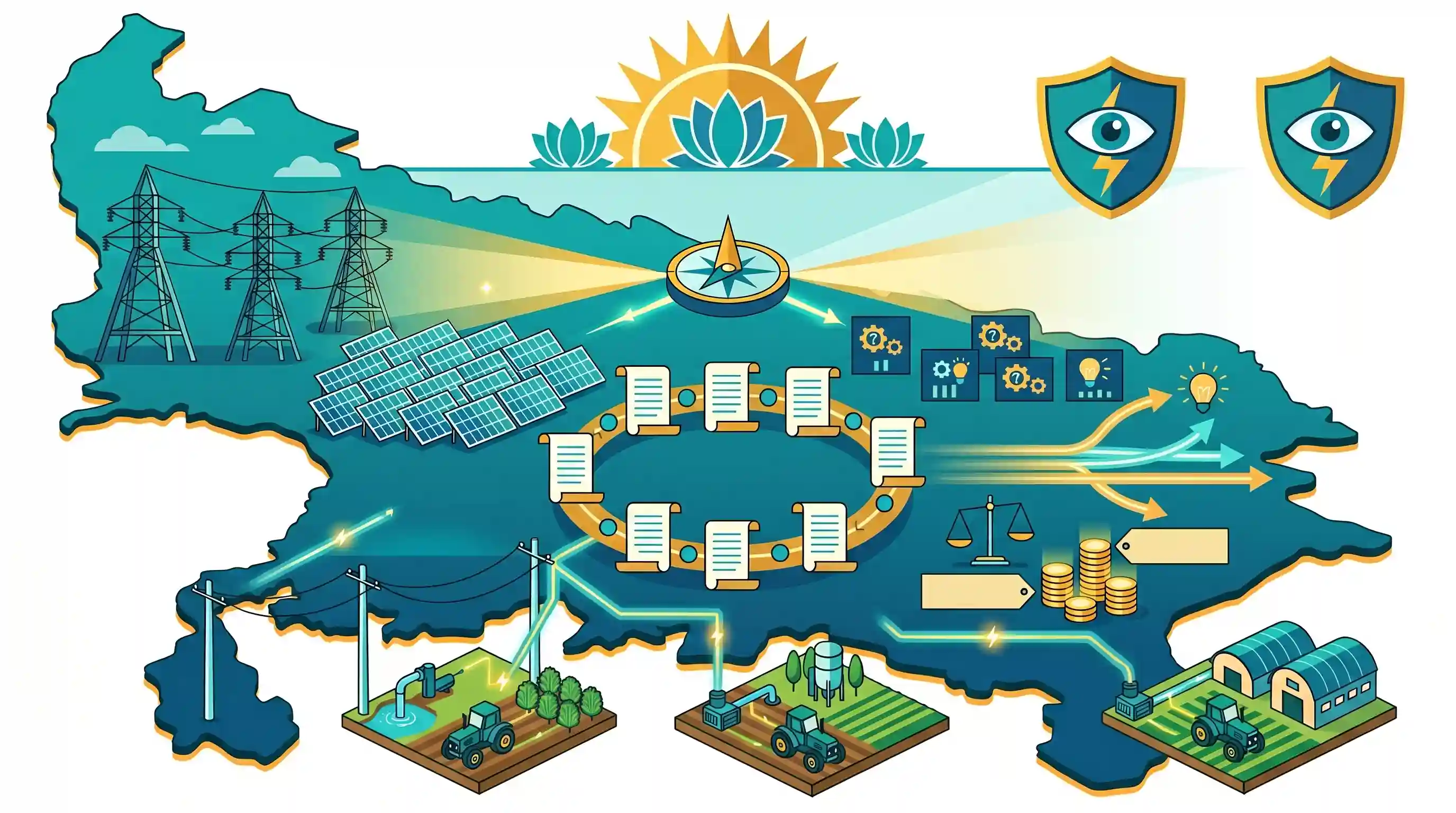
- PM-KUSUM Component-C2 focuses on Feeder Level Solarisation (FLS), supplying daytime solar electricity to agricultural feeders to cut discom subsidies and boost farmer incomes.
Important Terms
PM-KUSUM (Pradhan Mantri Kisan Urja Suraksha evam Utthaan Mahabhiyan)

A central government scheme aimed at de-dieselising the farm sector and enhancing farmers' income and water security through solar pumps, decentralized solar plants, and feeder solarisation.
UPSC context
GS Paper III (Agriculture & Infrastructure); tests government welfare schemes, farmer income, and decentralized solar initiatives.
Uttar Pradesh Electricity Regulatory Commission (UPERC)
An autonomous state-level regulatory body corporate in Uttar Pradesh responsible for determining power tariffs, regulating electricity distribution, and promoting efficiency and renewable energy.
UPSC context
GS Paper II (Regulatory Bodies); tests state-level regulatory architecture and electricity sector reforms.
Uttar Pradesh Power Corporation Limited (UPPCL)
A state-owned utility responsible for the planning, transmission, and distribution of electricity across Uttar Pradesh, managing various regional power distribution companies.
UPSC context
GS Paper III (Infrastructure); tests public-sector discom performance, power reforms, and utility health.
Uttar Pradesh New and Renewable Energy Development Agency (UPNEDA)
The state nodal agency in Uttar Pradesh responsible for executing, promoting, and monitoring projects based on renewable energy sources and energy conservation.
UPSC context
GS Paper III (Renewable Energy); tests institutional framework, state policies, and clean energy execution.
Ministry of New and Renewable Energy (MNRE)
The nodal ministry of the Government of India for policies, targets, and administrative architecture regarding solar, wind, bioenergy, and other renewable sources.
UPSC context
GS Paper III (Infrastructure & Environment); tests federal policy-making, renewable targets, and clean energy transition.
Prelims Trap
PM-KUSUM Component-C only subsidizes individual farmers to solarize their existing grid-connected agricultural pumps.
PM-KUSUM was updated to include Component C2 (Feeder Level Solarisation). Under C2, farmers do not install individual panels; instead, a single developer-led solar plant solarises the entire segregated feeder.
Static Concepts Connected
What are the three pillars of the PM-KUSUM scheme?
- Component-A: Decentralized ground-mounted grid-connected renewable power plants (up to 2 MW) on barren land.
- Component-B: Installation of standalone solar agriculture pumps (up to 7.5 HP) in off-grid areas.
- Component-C: Solarisation of existing grid-connected agriculture pumps, including individual pumps and feeder-level solarisation.
What is Feeder Level Solarisation (FLS)?
- Centralized generation: A single solar plant (0.5-5 MW) powers an entire dedicated agricultural feeder, rather than solarising individual pumps.
- Financial model: Implemented via CAPEX or RESCO models, with 30% Central Financial Assistance (50% in hilly/NE states).
- Benefits: Drastically reduces state electricity distribution losses, eliminates diesel consumption, and secures daytime power supply for farmers.
Cross-Topic Patterns
Agri-Solarisation + DISCOM Financial Health
Agricultural power subsidies heavily strain state DISCOMs. Feeder-level solarisation cuts transmission losses, provides cheap daytime power, and replaces expensive state-subsidized coal power, directly improving utility finances.
Water-Energy-Food Nexus & Solarisation
While cheap solar power de-dieselizes farming, unchecked daytime solar energy without micro-irrigation mandates risks accelerating ground-water depletion, highlighting the conflict between clean energy and water conservation goals.

UPSC may test PM-KUSUM's implementation models, contrasting standalone solar pumps with grid-connected feeder-level solarisation (Component-C).
Linked PYQs · 3
Linked PYQs · 3
- 2022UPPSC_PRELIMSGS1
Solar energy is converted into electric energy through
- 2021UPPSC_PRELIMSGS1
A non-renewable source of energy is
- 2022UPPSC_PRELIMSGS1
Most of the sources of energy we use, represent stored solar energy. Which of the following is NOT ultimately derived from the sun's energy ?
