US Russia Summit in Alaska Highlights Evolving Diplomatic Dynamics
Source:Indian Express ↗
Why It Matters
The resumption of high-level US-Russia bilateral talks impacts the geopolitical balance of power, the trajectory of the Ukraine war without direct Ukrainian participation, and the potential negotiation of future strategic nuclear arms treaties (similar to New START). This shift in US foreign policy will significantly influence European security and international diplomatic alignments.
Summary
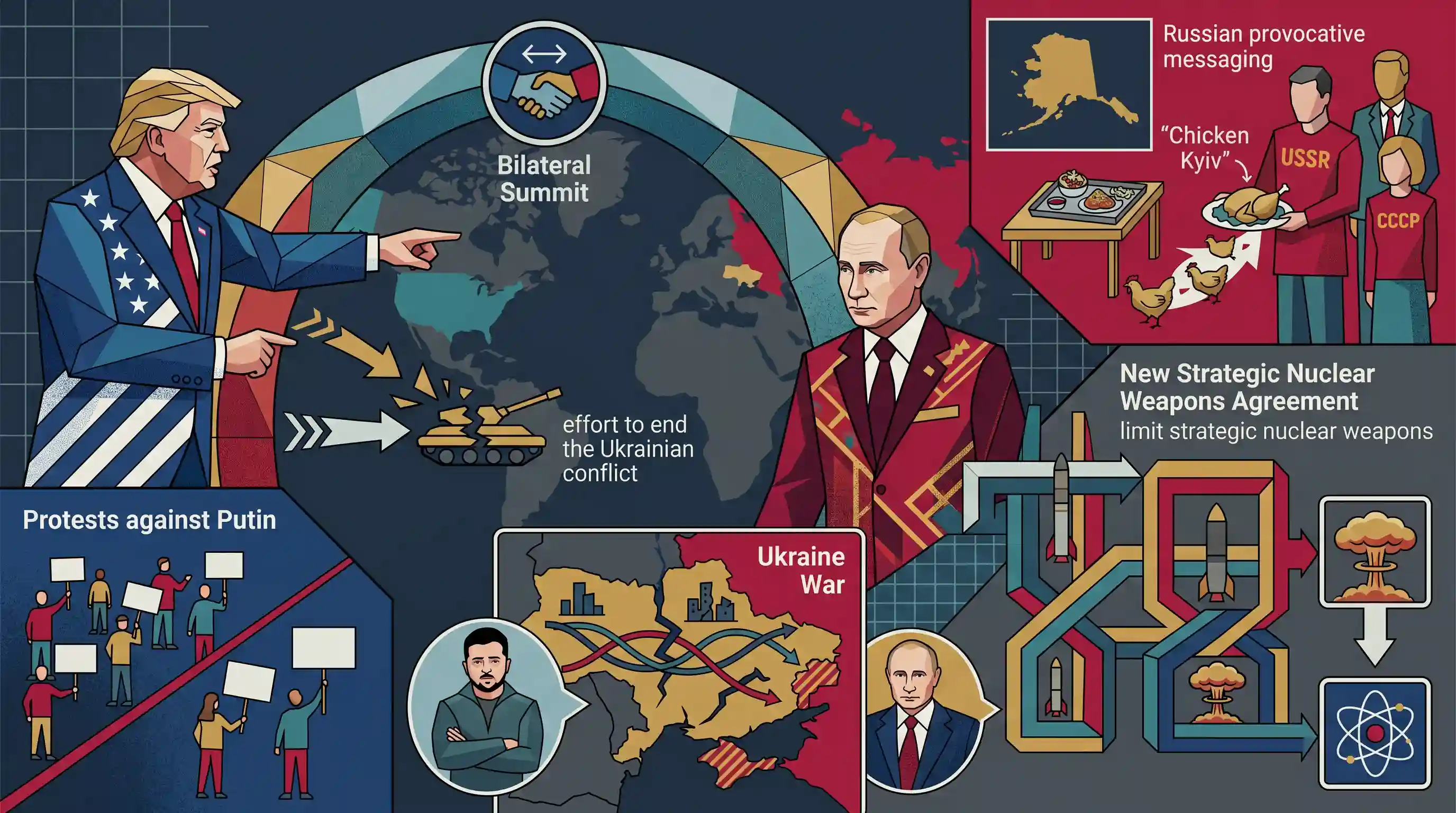
The first US-Russia bilateral summit in four years took place between US President Donald Trump and Russian President Vladimir Putin in Anchorage, Alaska. Held against the backdrop of the ongoing war in Ukraine, Trump positioned the talks as an effort to end the conflict, while Putin expressed interest in a new agreement limiting strategic nuclear weapons. The summit was marked by protests against Putin and provocative geopolitical messaging by the Russian delegation, including 'USSR' apparel and serving chicken kyiv. Notably, Ukrainian President Volodymyr Zelenskyy was not invited to participate in the discussions.
Key Points
- The first US-Russia summit in four years took place between Donald Trump and Vladimir Putin in Anchorage, Alaska.
- Trump framed the meeting as an attempt to end the Ukraine war, while Putin hinted at negotiating a new strategic nuclear weapons pact.
- Russian delegates made provocative symbolic gestures, such as Foreign Minister Sergey Lavrov wearing a 'USSR' sweatshirt and the serving of chicken kyiv cutlets.
- Ukrainian President Volodymyr Zelenskyy was deliberately excluded from the bilateral talks.
- The summit site in Alaska held historical resonance, as the US purchased the territory from the Russian Empire in 1867.
Important Terms
Joint Base Elmendorf-Richardson (JBER)

A premier U.S. military facility in Anchorage, Alaska, serving as a strategic Arctic defense hub. It hosted the 2025 Trump–Putin summit due to its security and midway location between Moscow and Washington.
UPSC context
GS Paper II/III; crucial for understanding Arctic geopolitics and the role of strategic military installations in superpower diplomacy.
New START Treaty
The last major nuclear arms control treaty between the U.S. and Russia, capping deployed strategic warheads. It expired in February 2026, marking a significant lapse in global security frameworks.
UPSC context
GS Paper II (International Relations); essential for questions on nuclear non-proliferation and the erosion of international security architectures.
Anchorage Understanding
A framework or informal agreement reportedly reached at the Alaska summit aimed at ending the Ukraine war, potentially involving territorial concessions such as the recognition of Donbas as Russian territory.
UPSC context
GS Paper II; tests understanding of bilateral mediation, sovereignty disputes, and the diplomatic impact of excluding primary stakeholders from negotiations.
Strategic Nuclear Arms Control
International regulatory efforts to limit or reduce long-range nuclear weapons. Following New START's expiration, the focus shifted to a potential new trilateral agreement involving China.
UPSC context
GS Paper II; core concept for topics regarding global strategic stability and superpower arms races.
Geopolitics of Identity
The use of cultural symbols, language (e.g., 'Kyiv' vs 'Kiev'), and historical branding to assert sovereignty, territorial claims, or soft power during diplomatic engagements.
UPSC context
GS Paper II; illustrates how symbolic gestures and naming conventions are weaponized in international relations to influence political narratives.
Prelims Trap
The New START treaty currently restricts US and Russian strategic nuclear weapons deployments.
The treaty expired in February 2026. Aspirants often miss treaty expiration dates; presently, there is no legally binding US-Russia nuclear arms framework in effect.
Static Concepts Connected
What is the New START Treaty and its historical significance?
- Core Objective: Signed in 2010 to establish verifiable limits on the number of deployed strategic nuclear warheads and delivery vehicles by the US and Russia.
- Verification Mechanism: It included robust mutual inspection protocols and data exchanges to verify compliance, acting as a cornerstone of post-Cold War strategic stability.
- Current Status: Its expiration in early 2026 leaves the world without a bilateral nuclear limitation framework for the first time in 50 years.
How does Alaska dictate US strategic positioning in the Arctic?
- Historical Origin: The US purchased Alaska from the Russian Empire in 1867 (Treaty of Cession), permanently shifting North American geopolitical boundaries.
- Institutional Access: It grants the US sovereign Arctic coastline, enabling its membership in the Arctic Council and military presence in the High North.
Cross-Topic Patterns
Global arms control & India's stance
The collapse of US-Russia bilateral nuclear frameworks heightens the relevance of India's demand for universal, non-discriminatory nuclear disarmament rather than NPT-style regional limits.
Great Power Politics vs UN Charters
Excluding Ukraine from talks about its own territory mirrors Cold War sphere-of-influence politics, conflicting with UN principles of sovereign equality championed by the Global South.

Expect a 2026 Prelims question mapping historic nuclear treaties (New START, INF, ABM) against their current active/expired status.
Linked PYQs · 3
Linked PYQs · 3
- 2011PrelimsGS1
The "New START" treaty was in the news. What is this treaty?
- 2025MainsGS2
"The reform process in the United Nations remains unresolved, because of the delicate imbalance of East and West and entanglement of the USA vs. Russo-Chinese alliance.” Examine and critically evaluate the East-West policy confrontations in this regard.
- 2021MainsGS2
“The USA is facing an existential threat in the form of a China, that is much more challenging than the erstwhile Soviet Union.” Explain.
