Environmental Impact of Wearable Healthcare Technology Growth
Source:The Hindu ↗
Why It Matters
It highlights the hidden ecological and climate costs associated with the rapid adoption of digital healthcare and wearable technologies, presenting a critical intersection of GS3 S&T (health innovation) and Environment (e-waste, life-cycle carbon emissions, critical minerals).
Summary
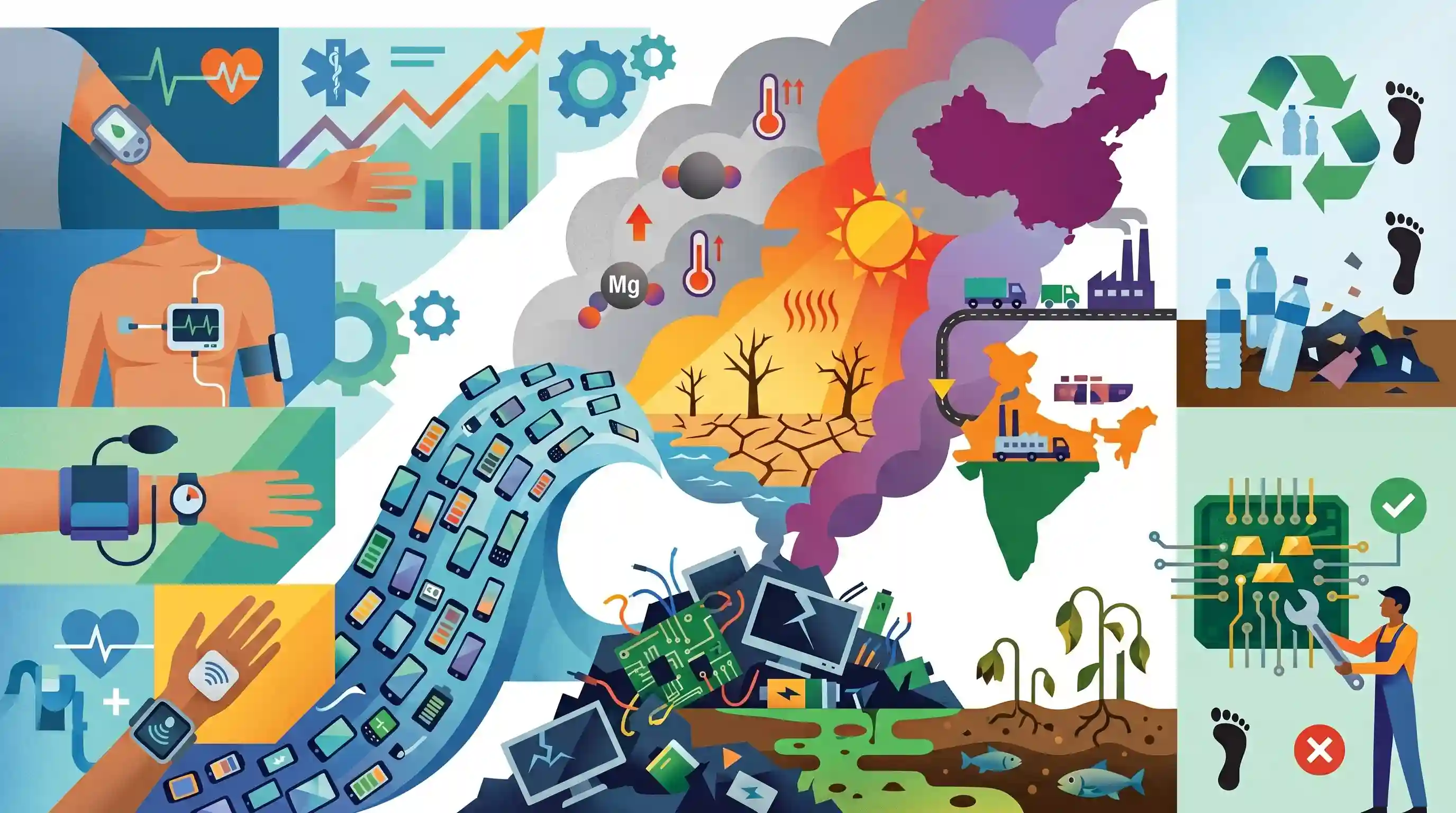
A recent study published in the journal Nature forecasts a 42-fold surge in the global use of wearable healthcare technology by 2050, raising significant environmental concerns. Devices such as continuous glucose monitors, continuous ECGs, blood pressure monitors, and point-of-care ultrasound patches could see combined annual sales of nearly two billion units. This boom is projected to generate 3.4 metric tonnes of CO2-equivalent emissions, alongside mounting ecotoxicity and e-waste challenges, with China and India leading in emissions. The researchers emphasize that substituting critical-metal conductors and optimizing circuit designs are necessary to effectively reduce the carbon footprint, as recyclable plastics alone provide insufficient mitigation.
Key Points
- Global consumption of wearable healthcare tech (e.g., continuous glucose and ECG monitors) is projected to increase 42-fold by 2050, nearing two billion units annually.
- This exponential growth poses severe environmental challenges, potentially emitting 3.4 metric tonnes of CO2-equivalent yearly and compounding ecotoxicity and e-waste crises.
- China and India are projected to be the largest contributors to greenhouse gas emissions from wearable healthcare electronics by 2050.
- Life cycle assessments indicate that a single device emits 1.1 to 6.1 kg of CO2-equivalent from raw material extraction to disposal.
- Mitigating these environmental impacts requires substituting critical-metal conductors and optimizing circuit architectures, as relying solely on recyclable or biodegradable plastics offers only marginal benefits.
Important Terms
E-waste (Electronic Waste)

Discarded electrical or electronic devices. In India, managed under E-Waste (Management) Rules, 2022, which mandate registration for stakeholders and establish an Extended Producer Responsibility (EPR) framework for scientific disposal.
UPSC context
GS III (Environment); focuses on pollution management, circular economy, and the effectiveness of government regulatory frameworks.
Critical Minerals
Metallic or non-metallic elements essential for modern technology and national security, yet vulnerable to supply chain disruptions. India has identified 30 critical minerals vital for high-tech manufacturing.
UPSC context
GS III (Economy/S&T); tests knowledge of resource security, import dependence, and strategic industrial policies.
Wearable Healthcare Technology
Electronic devices worn on the body to continuously monitor health data (e.g., glucose, ECG). While improving patient care, they pose significant environmental challenges due to disposal and manufacturing emissions.
UPSC context
GS III (Science & Technology); relates to emerging technologies, personalized medicine, and their socio-environmental trade-offs.
Carbon Footprint
The total greenhouse gas emissions, primarily CO2, generated by an individual, product, or organization. In healthcare, it encompasses emissions from medical supply chains, manufacturing, and transport.
UPSC context
GS III (Environment/Climate Change); central to discussions on Net Zero targets and environmental sustainability in various sectors.
Ecotoxicity
The potential for chemical, physical, or biological stressors to impact ecosystems. It assesses how human-caused 'toxicants' (like heavy metals in electronics) disrupt biological communities and food webs.
UPSC context
GS III (Environment); concerns the ecological impact of pollutants and the study of toxic effects on biodiversity.
Point-of-care (POC) Diagnostics
Medical diagnostic testing conducted at or near the time and place of patient care. Examples include portable ultrasound patches and rapid blood monitors that provide immediate clinical results.
UPSC context
GS III (Science & Technology); focuses on healthcare delivery innovations and the digitalization of medical infrastructure.
Prelims Trap
"Replacing device casings with biodegradable plastics is the most effective way to reduce the carbon footprint of wearable health tech."
The study highlights that substituting critical-metal conductors and optimizing circuits are necessary, as recyclable plastics offer only marginal mitigation against tech's carbon footprint.
Static Concepts Connected
What are the key features of the E-Waste (Management) Rules, 2022?
- EPR framework: Introduces mandatory tradeable Extended Producer Responsibility (EPR) certificates and phased annual recycling targets.
- Coverage expansion: Broadens the regulatory scope to include solar photo-voltaic modules, panels, and medical devices.
- Centralized Portal: Mandates registration of manufacturers, producers, refurbishers, and recyclers on a centralized CPCB portal.
Why is 'Urban Mining' significant for Critical Minerals?
- Resource recovery: Extracts rare earth elements and critical metals (lithium, cobalt, copper) from discarded electronics.
- Supply security: Reduces import dependency on dominant nations like China for strategic technology sectors.
- Environmental mitigation: Avoids the severe ecotoxicity, land degradation, and carbon footprint associated with virgin raw material extraction.
Cross-Topic Patterns
Digital Health vs. Net Zero targets
The push for digital health and telemedicine inflates e-waste and critical mineral demand, creating a policy friction between SDG 3 (Good Health) and SDG 13 (Climate Action).
Market mechanisms in E-waste management
Like Carbon Credits, the tradeable Extended Producer Responsibility (EPR) certificates introduced in the 2022 E-waste rules rely on market dynamics to ensure compliance in the fast-growing tech sector.

E-waste from digital health wearables + EPR Rules 2022 + Urban Mining will likely form a multi-statement Prelims question in 2026.
Linked PYQs · 4
Linked PYQs · 4
- 2019PrelimsGS1
In India, 'extended producer responsibility' was introduced as an important feature in which of the following?
- 2021PrelimsGS1
'R2 Code of Practices' constitutes a tool available for promoting the adoption of
- 2020MainsGS3
What do you understand by nanotechnology and how is it helping in health sector?
- 2022MainsGS3
Discuss global warming and mention its effects on the global climate. Explain the control measures to bring down the level of greenhouse gases which cause global warming, in the light of the Kyoto Protocol, 1997.
