Supreme Court denies bail in examination malpractice and fraud case
Source:The Hindu ↗
Why It Matters
The article highlights the critical governance issue of exam malpractices, directly relevant to recent legislative efforts like the Public Examination (Prevention of Unfair Means) Act, 2024. It demonstrates the judiciary's strict approach to maintaining meritocracy and transparency in public recruitment.
Summary
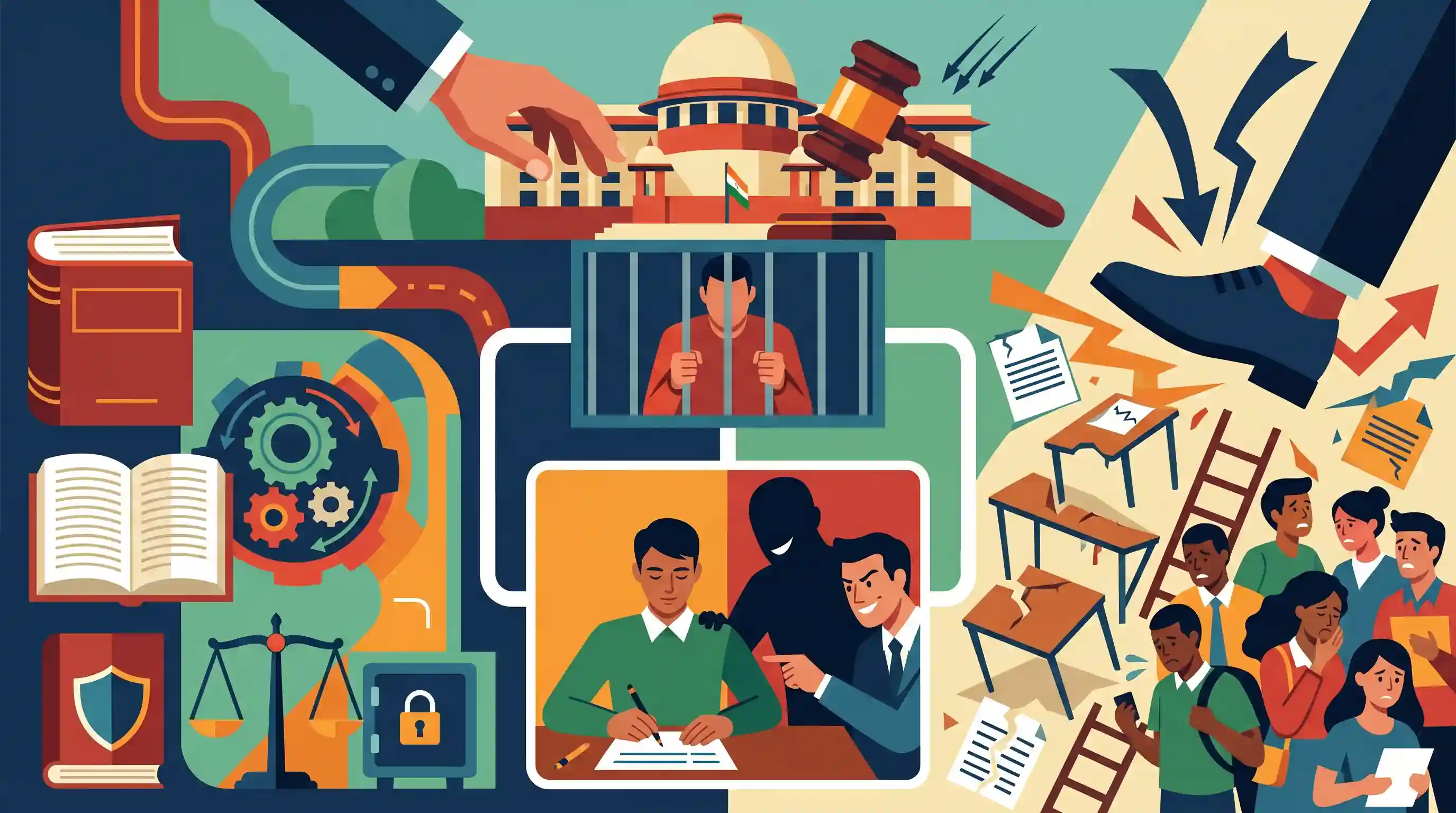
The Supreme Court of India strongly reprimanded the use of unfair means in public examinations, denying bail to an accused (Sandeep Singh Patel) who allegedly used a proxy "solver" to write the CTET exam in Uttar Pradesh. Justices Vikram Nath and Sandeep Mehta observed that such malpractices "destroy the entire system of public examinations," penalizing countless deserving candidates. The accused was booked under the Bharatiya Nyaya Sanhita (BNS) and the UP Public Examination (Prevention of Unfair Means) Act. The ruling underscores the judiciary's strict, zero-tolerance approach toward exam fraud and its commitment to protecting the integrity of India's educational and recruitment systems.
Key Points
- The Supreme Court of India denied bail to an accused who employed a proxy 'solver' to write the Central Teacher Eligibility Test (CTET) in Uttar Pradesh.
- The bench observed that utilizing unfair means destroys the entire system of public examinations and severely harms the prospects of genuine, deserving candidates.
- The accused faces charges under the Bharatiya Nyaya Sanhita (BNS) and the Uttar Pradesh Public Examination (Prevention of Unfair Means) Act.
- The Allahabad High Court previously rejected the bail plea, noting that proxy test-taking undermines the integrity of the educational system and has broad societal implications.
- The judicial observations emphasize a strict stance against systemic corruption and malpractices in public recruitment processes, reflecting a zero-tolerance policy towards exam fraud.
Important Terms
Bharatiya Nyaya Sanhita (BNS)

India's primary criminal code that replaced the colonial-era Indian Penal Code (IPC) on July 1, 2024, aimed at modernizing the criminal justice system.
UPSC context
GS Paper II (Governance) and GS Paper III; tests knowledge of legal reforms and substantive criminal law.
Public Examinations (Prevention of Unfair Means) Act, 2024
A landmark central law enacted to curb malpractices like question paper leaks and organized cheating in national-level recruitment and entrance examinations.
UPSC context
GS Paper II (Governance); tests understanding of statutory measures to ensure transparency and merit in public institutions.
UP Public Examination (Prevention of Unfair Means) Act
State legislation (1998/2024) providing stringent penalties, including imprisonment and heavy fines, for cheating and impersonation in examinations conducted within Uttar Pradesh.
UPSC context
GS Paper II (Governance); relevant for studying state-level administrative responses to systemic exam malpractices.
Central Teacher Eligibility Test (CTET)
A national eligibility exam conducted by the CBSE to ensure that candidates possess the necessary skills and aptitude to teach in schools across India.
UPSC context
GS Paper II (Social Justice/Education); tests awareness of standards-setting in the teacher recruitment process under the RTE Act.
Proxy Solver
An unauthorized person who impersonates a legitimate candidate to write an examination, often as part of an organized crime syndicate.
UPSC context
GS Paper IV (Ethics); tests analysis of corruption, administrative failure, and ethical challenges in public examinations.
Cognizable and Non-Bailable Offences
Serious criminal offenses where police can arrest without a warrant and where the court has discretionary power to deny bail.
UPSC context
GS Paper II (Judiciary); tests understanding of criminal procedure and the legal consequences of grave social offenses.
Prelims Trap
"The Public Examinations (Prevention of Unfair Means) Act, 2024 applies uniformly to all State PSCs."
The 2024 Central Act applies only to designated central authorities (UPSC, SSC, NTA, RRB, IBPS). State-level exams are governed by respective state laws, like the UP Act.
Static Concepts Connected
What are the key features of the Public Examinations (Prevention of Unfair Means) Act, 2024?
- Central Agencies: Applies strictly to exams conducted by UPSC, SSC, RRB, IBPS, NTA, and designated central ministries.
- Nature of Offences: All offences under the legislation are classified strictly as cognizable, non-bailable, and non-compoundable.
- Organized Crime Penalty: Organized syndicates and complicit service providers face 5 to 10 years imprisonment and minimum ₹1 crore fines.
How does systemic exam fraud violate Constitutional Fundamental Rights?
- Article 16: Guarantees equality of opportunity in public employment. Malpractices destroy the level playing field, directly stripping genuine candidates of their fundamental rights.
- Article 14: Violates the right to equality before the law by allowing an arbitrary, unlawful advantage to those utilizing unfair means over honest citizens.
Cross-Topic Patterns
Probity in Governance (GS4)
Exam fraud erodes institutional trust. Expect case studies in GS4 on the ethical dilemmas faced by administrators managing recruitment drives, paper leaks, and proxy solvers.
IPC to BNS transition
Proxy solvers are now booked under Bharatiya Nyaya Sanhita (BNS) Section 319 (personation), highlighting the active transition from the colonial IPC framework in criminal justice.

The 2024 Central Exam Act + BNS cheating provisions are highly likely to appear as a multi-statement Prelims polity question in 2026.
Linked PYQs · 2
Linked PYQs · 2
- 2024MainsGS2
What are the aims and objects of recently passed and enforced, The Public Examination (Prevention of Unfair Means) Act, 2024? Whether University/State Education Board examinations, too, are covered under the Act ?
- 2017MainsGS4
You are an honest and responsible civil servant. You often observe the following: There is a general perception that adhering to ethical conduct one may face difficulties to oneself and cause problems for the family, whereas unfair practices may help to reach the career goals. When the number of people adopting unfair means is large, a small minority having a penchant towards ethical means makes no difference. Sticking to ethical means is detrimental to the larger developmental goals. While one may not involve oneself in large unethical practices, but giving and accepting small gifts makes the system more efficient. Examine the above statements with their merits and demerits.
