Supreme Court Ruling on Social Media Platform Access
Source:Indian Express ↗
Why It Matters
The case clarifies the boundaries of fundamental rights in the digital age, establishing that access to a privately owned social media or messaging platform is not a constitutionally guaranteed fundamental right. It also highlights the growing judicial recognition of indigenous digital alternatives ('Atmanirbhar Bharat' in tech).
Summary
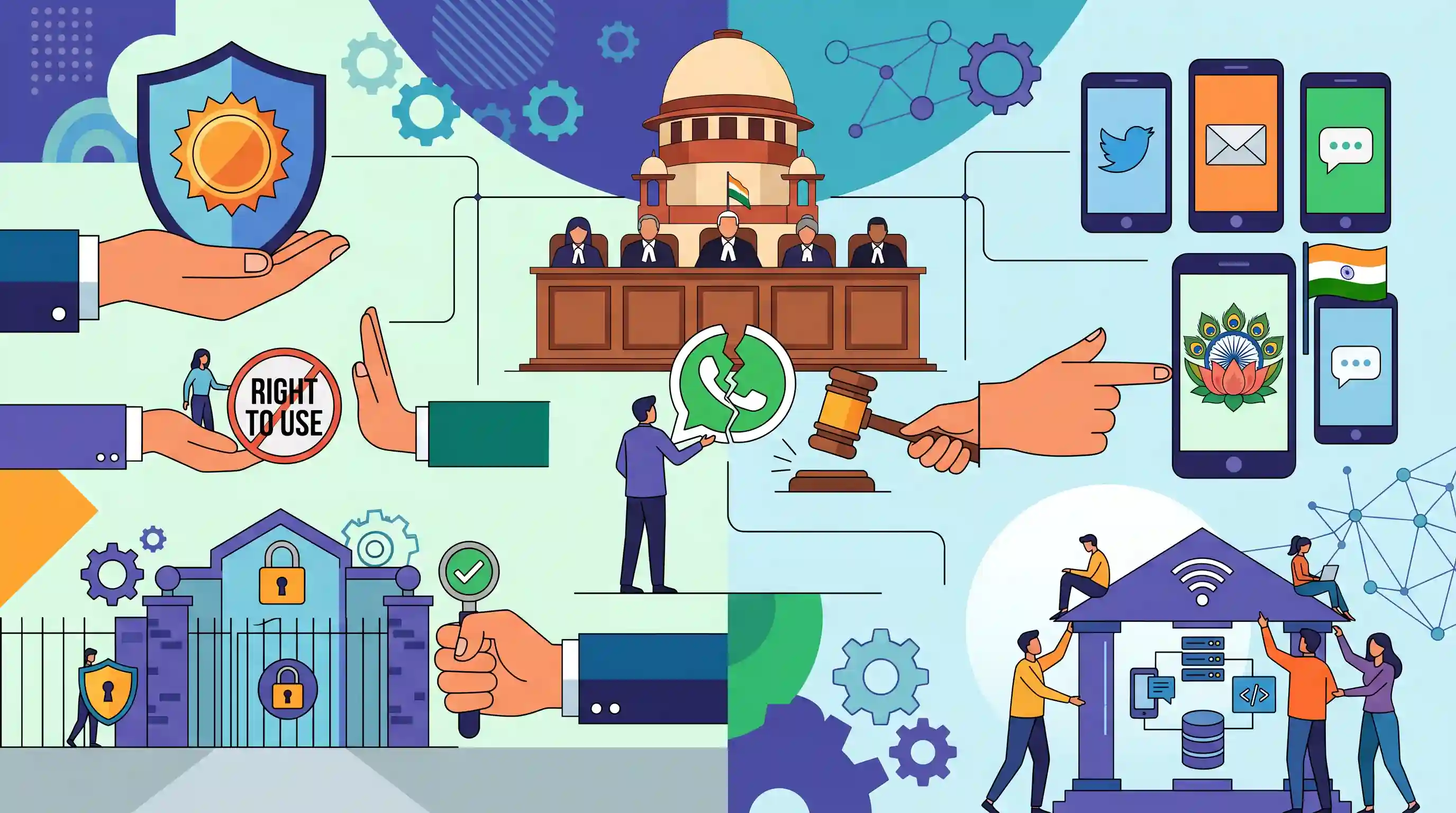
The Supreme Court has rejected a petition seeking the restoration of a blocked WhatsApp account, ruling that individuals do not possess a fundamental right to use the private messaging service. The petitioner had argued that the platform's action violated her fundamental rights. Dismissing the claim, the bench suggested the user switch to alternative messaging platforms, explicitly mentioning the Indian-made app 'Arattai', developed by Zoho Corporation. The decision underscores the legal distinction between fundamental rights enforceable against the State and the terms of service enforced by private social media and technology platforms.
Key Points
- The Supreme Court of India dismissed a plea seeking directions to restore a blocked WhatsApp account.
- The bench, comprising Justices Surya Kant and Ujjal Bhuyan, explicitly stated that there is no fundamental right to access or use a specific private application like WhatsApp.
- The Court dismissed the petitioner\'s argument that blocking her account violated her fundamental rights.
- The justices suggested the petitioner switch to alternative platforms, specifically recommending \'Arattai\', an indigenous messaging app developed by Zoho Corporation.
- The ruling reinforces the principle that constitutional fundamental rights generally apply against the State, not private tech companies governing user access on their platforms.
Important Terms
Fundamental Rights

Basic rights in Part III of the Constitution, primarily enforceable against the 'State' (Article 12). The Court ruled these do not mandate access to private messaging services like WhatsApp.
UPSC context
GS Paper II (Polity). Tests the distinction between public rights against the State and private contractual terms of service.
Supreme Court of India
India’s apex judicial body, which ruled that using private platforms is not a constitutional entitlement and suggested users adopt indigenous alternatives for personal or professional communication.
UPSC context
GS Paper II (Judiciary). Tests the Court's role in interpreting the scope of constitutional protections in the digital age.
Arattai
An indigenous, encrypted instant messaging application developed by Zoho Corporation. It is promoted as a secure, "Made in India" alternative to foreign platforms like WhatsApp and Telegram.
UPSC context
GS Paper III (Science & Tech). Relevant to the indigenization of technology and the "Atmanirbhar Bharat" initiative for digital infrastructure.
Writ Jurisdiction
The authority of the Supreme Court (Article 32) or High Courts (Article 226) to issue orders to enforce rights; here, the SC questioned its maintainability against a private entity.
UPSC context
GS Paper II (Polity). Tests understanding of when constitutional remedies can be invoked against non-state actors.
Zoho Corporation
An Indian multinational technology company specializing in SaaS and business tools. Its developer status for Arattai highlights the growth of India’s domestic tech ecosystem.
UPSC context
GS Paper III (Economy/Tech). Represents the role of domestic private enterprises in achieving technological self-reliance.
Digital Sovereignty
The principle that a nation should have control over its digital destiny, including its data, infrastructure, and software, to ensure security and independence from foreign tech giants.
UPSC context
GS Paper III (Internal Security). Tests strategic importance of promoting local digital solutions to reduce dependence on foreign intermediaries.
Social Media Intermediaries
Entities that facilitate online communication between users. The petitioner sought national guidelines for these intermediaries regarding the "transparency and proportionality" of account suspensions.
UPSC context
GS Paper II & III. Relevant to the regulation of Big Tech and the Information Technology (Intermediary Guidelines) Rules.
Prelims Trap
"Right to access major social media platforms is a fundamental right protected under Article 19."
While the right to internet access is fundamental (Anuradha Bhasin case), using a specific private app is governed by private contract, not Article 19, because these platforms are not the "State".
Static Concepts Connected
What constitutes the "State" under Article 12 of the Constitution?
- Executive & Legislature: The Union and State governments, Parliament, and State Legislatures.
- Local Authorities: Municipalities, Panchayats, Improvement Trusts, and other local government bodies.
- Other Authorities: Statutory or non-statutory bodies acting as instrumentalities of the State (e.g., LIC, ONGC).
- Private bodies: Only qualify if they perform a statutory public function or act as an agency of the State. Normal companies do not qualify.
When can a writ of Mandamus be issued against a private entity?
- Public duty requirement: It can only be issued if the private individual or body is performing a statutory or public duty.
- Private contracts excluded: Mandamus cannot be issued to enforce the terms of a purely private contract, such as an app's Terms of Service.
Cross-Topic Patterns
Article 12 + Digital monopolies
The debate over classifying Big Tech as 'State' due to their control over public discourse bridges Constitutional law (Article 12) and Information Technology regulation.
Digital Sovereignty + Indigenous Tech
The SC's explicit nod to 'Arattai' ties into India's Aatmanirbhar push to build localized digital infrastructure, reducing strategic dependence on foreign data silos.

Expect a 2026 prelims question testing the boundaries of Article 12 and whether private tech platforms discharge "public functions."
Linked PYQs · 3
Linked PYQs · 3
- 2017MainsGS2
Examine the scope of Fundamental Rights in the light of the latest judgement of the Supreme Court on Right to Privacy.
- 2024MainsGS3
Social media and encrypting messaging services pose a serious security challenge. What measures have been adopted at various levels to address the security implications of social media? Also suggest any other remedies to address the problem.
- 2024PrelimsGS1
Under which of the following Articles of the Constitution of India, has the Supreme Court of India placed the Right to Privacy ?
