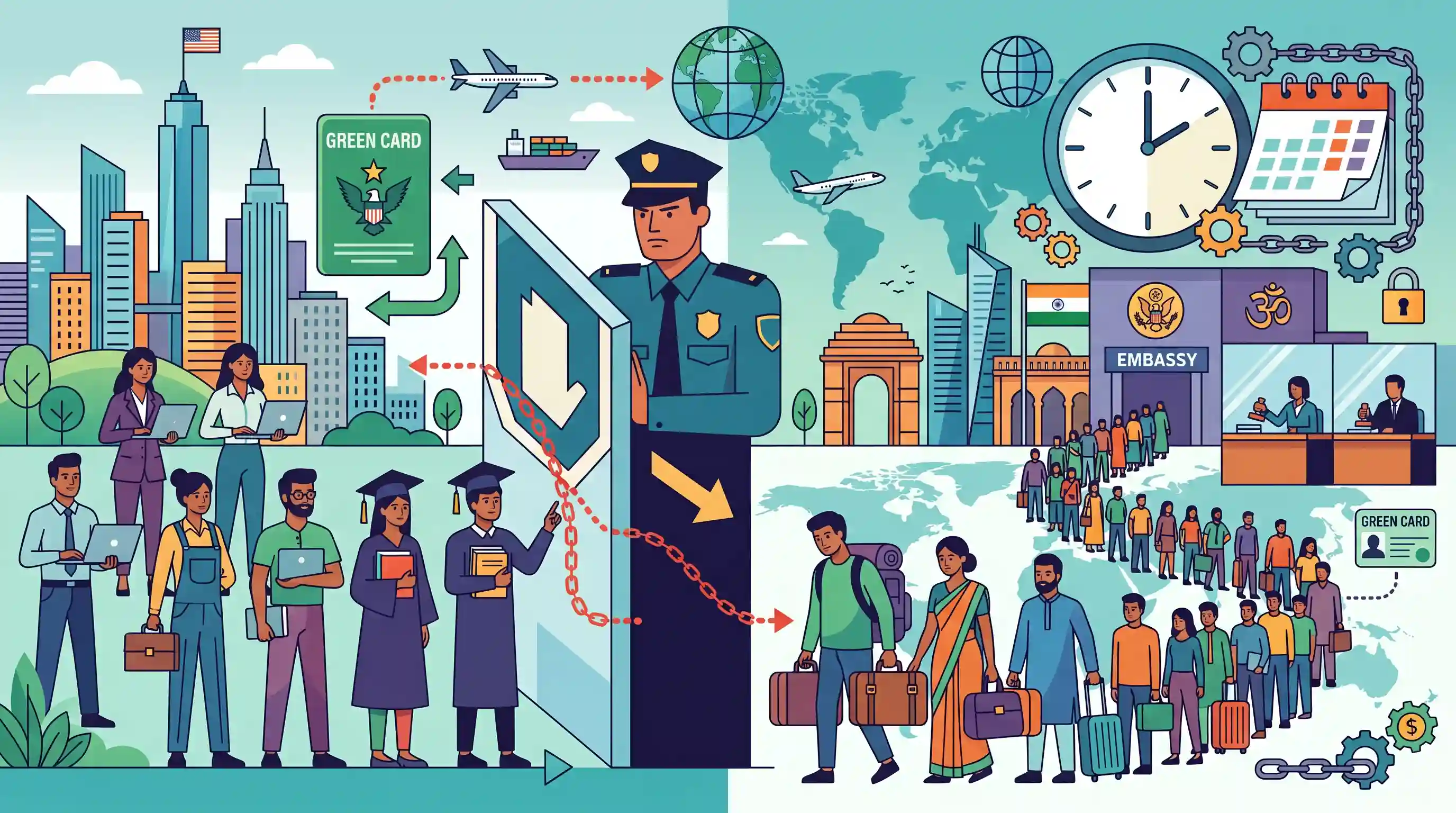
USCIS mandates home country consular processing for green cards
Source:Indian Express ↗
Why It Matters
Restrictive shifts in US immigration policies directly impact India's highly skilled workforce, international students, and the broader knowledge economy. It underscores the vulnerabilities of the Indian diaspora and serves as a key issue in India-US bilateral negotiations regarding global talent mobility.
Summary
The US Citizenship and Immigration Services (USCIS) has introduced a new policy mandating that foreign nationals on temporary visas—including H-1B workers, international students, and tourists—must return to their home countries for consular processing to apply for a Green Card. This effectively ends the widespread practice of 'adjustment of status' from within the United States. The Department of Homeland Security claims the change will curb misuse of the immigration system and shift the processing burden to overseas consular offices. The policy poses a major hurdle for the Indian diaspora, directly impacting thousands of Indian skilled professionals and students who face prolonged uncertainties and logistical challenges in securing permanent residency.
Key Points
- USCIS announced a new policy requiring non-immigrant visa holders (such as H-1B workers and students) to return to their home countries for consular processing when applying for a Green Card.
- The policy eliminates the common practice of 'adjustment of status' from within the US for temporary visa holders, barring exceptional circumstances.
- The Department of Homeland Security states the move is intended to reinforce the original intent of immigration laws, prevent systemic abuse, and reduce the processing burden on USCIS.
- This procedural shift will directly and severely impact thousands of Indian H-1B holders and international students who traditionally rely on in-country transitions to permanent residency.
Important Terms
H-1B Visa

A non-immigrant US visa allowing employers to hire foreign workers in specialty occupations (e.g., IT, STEM). Indians currently receive over 70% of these visas annually.
UPSC context
GS Paper II: Vital for analyzing skilled migration, the Indian diaspora's economic role, and India-US strategic partnerships.
Green Card
Officially the Permanent Resident Card, it allows a foreign national to live and work permanently in the US, serving as a precursor to US citizenship.
UPSC context
GS Paper II: Crucial for diaspora stability; policy changes impact remittances and India's "brain circulation" dynamics.
US Citizenship and Immigration Services (USCIS)
The US federal agency within the DHS responsible for administering the country's lawful immigration system, including processing visa petitions and naturalization applications.
UPSC context
GS Paper II: Understanding the administrative mechanisms and regulatory hurdles faced by Indian professionals in global labor markets.
Department of Homeland Security (DHS)
The US federal executive department responsible for public security, overseeing agencies like USCIS, ICE, and CBP to manage borders and immigration.
UPSC context
GS Paper II: Significant for studying how US national security priorities influence immigration policies and bilateral relations.
Adjustment of Status
A procedure allowing eligible foreign nationals already in the US to apply for permanent residency (Green Card) without returning to their home country.
UPSC context
GS Paper II: Relevant for assessing the logistical and legal barriers impacting Indian workers' mobility and residency security.
Consular Processing
The process of obtaining an immigrant visa at a US embassy or consulate abroad, typically mandatory for those outside the US or ineligible for adjustment.
UPSC context
GS Paper II: Key for understanding shifts in international migration pathways and the increasing role of consulates in visa adjudication.
US Department of State
The US executive department managing foreign policy, international relations, and visa issuance through embassies and consulates worldwide.
UPSC context
GS Paper II: Essential for India-US diplomatic engagement and managing the entry of Indian citizens into the US.
Prelims Trap
The US has halted the issuance of Green Cards for H-1B and temporary visa holders.
The policy does not halt Green Card issuance; it merely ends in-country 'adjustment of status', forcing applicants to undergo 'consular processing' in their home countries.
Static Concepts Connected
What are the key US work visa categories relevant to Indian professionals?
- H-1B Visa: A non-immigrant visa allowing US employers to temporarily employ foreign workers in specialty occupations (heavily used by IT).
- L-1 Visa: A non-immigrant visa used for intracompany transfers of executives, managers, or specialized knowledge personnel.
- Green Card: An immigrant visa authorizing a foreign national to live and work permanently in the United States.
How do WTO GATS modes relate to international talent mobility?
- Mode 4: Covers the temporary movement of natural persons supplying services abroad (e.g., Indian IT professionals working onsite in the US).
- Visa Linkage: Restrictive visa policies directly impede Mode 4 service exports, which remains a primary area of interest for India during WTO negotiations.
Cross-Topic Patterns
Protectionism & GATS Mode 4
Restrictions on H-1B and Green Card processing directly impact Mode 4 of the WTO General Agreement on Trade in Services (movement of natural persons).
Reverse Brain Drain & Innovation
Restrictive overseas immigration policies can inadvertently force "reverse brain drain," potentially catalyzing domestic start-up innovation in India as high-skilled tech professionals return home.

Expect a GS2 Mains question linking developed world immigration tightening to India's IT sector, GATS Mode 4, and remittance stability.
Linked PYQs · 2
Linked PYQs · 2
- 2020MainsGS2
Indian diaspora has a decisive role to play in the politics and economy of America and European Countries'. Comment with examples.
- 2023MainsGS2
Indian diaspora has scaled new heights in the West. Describe its economic and political benefits for India.
