Foreign Funding Allegations and Geopolitical Shift in Bangladesh
Source:Indian Express ↗
Why It Matters
The allegations of foreign-funded regime change in Bangladesh and the subsequent diplomatic pivot toward Pakistan underscore the vulnerabilities in India's neighborhood. It is critical for UPSC aspirants to understand the geopolitical implications of such instability on India's foreign policy and border security.
Summary
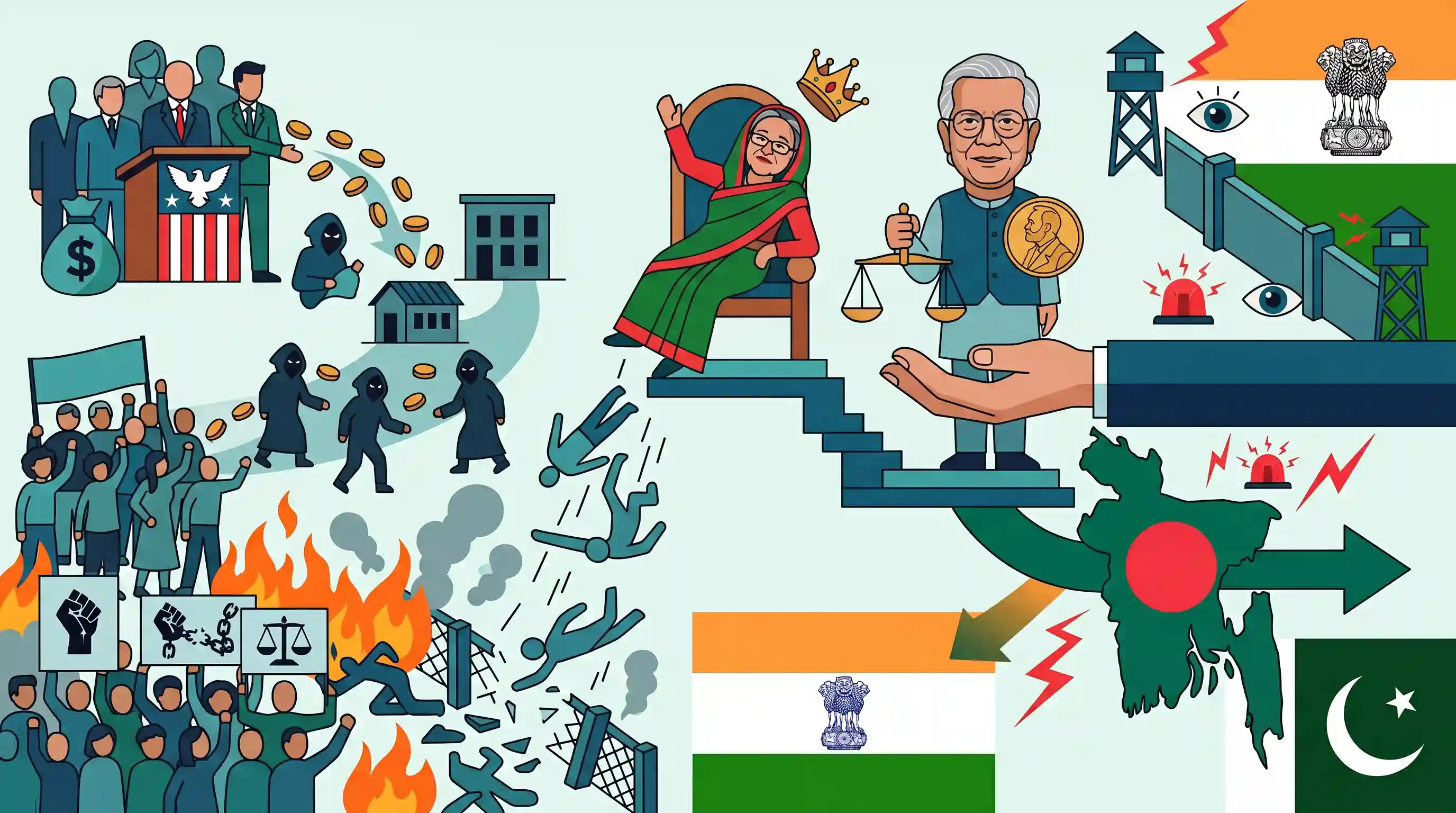
A former Bangladeshi minister has accused US organizations, including USAID, the International Republican Institute, and the Clinton family, of funding clandestine NGOs to orchestrate the 2024 ouster of Prime Minister Sheikh Hasina. The unrest, initially sparked by protests over job quotas, led to over 700 deaths. An interim government led by Nobel laureate Muhammad Yunus has since assumed power, reportedly pivoting Bangladesh's diplomatic focus from India to Pakistan, raising strategic and security concerns for New Delhi.
Key Points
- Former Bangladesh minister Mohibul Hasan Chowdhoury alleged that US-based entities (USAID, IRI) and the Clinton family funded clandestine NGOs to orchestrate the ouster of PM Sheikh Hasina.
- The 2024 unrest, triggered by student protests against job quotas, led to over 700 deaths and the collapse of the Awami League government.
- Following the regime change, the interim government led by Muhammad Yunus has shifted its diplomatic focus away from India toward Pakistan.
- The allegations highlight the potential role of foreign funding and international NGOs in destabilizing governments and influencing domestic politics.
Important Terms
Awami League

A prominent center-left political party in Bangladesh, historically led by Sheikh Hasina; it is recognized for its secularist platform and traditionally strong strategic and diplomatic ties with India.
UPSC context
GS Paper II (International Relations). Tests understanding of bilateral allies and the impact of regime changes on India's strategic security.
USAID
An independent United States federal agency providing civilian foreign aid; it is central to global debates regarding foreign developmental influence and the regulation of foreign-funded NGOs.
UPSC context
GS Paper II/III (Foreign Policy/Internal Security). Tests awareness of foreign aid's role in geopolitics and NGO funding.
Muhammad Yunus
A Nobel Peace Prize-winning economist and microfinance pioneer appointed as the Chief Adviser of Bangladesh's interim government in 2024 following the resignation of Sheikh Hasina.
UPSC context
GS Paper II (International Relations). Analyzes shifting neighborly leadership and its impact on regional cooperation and bilateral ties.
International Republican Institute (IRI)
A US-funded non-profit organization dedicated to advancing democracy worldwide; it has recently faced allegations of supporting political transitions and activist training in Bangladesh.
UPSC context
GS Paper II (International Relations). Evaluates the influence of international non-state actors on domestic political stability and national sovereignty.
Interim Government
A temporary non-partisan administrative body established to stabilize a nation and organize elections; in Bangladesh, it assumed power under the "doctrine of necessity" post-2024 unrest.
UPSC context
GS Paper II (Polity/International Relations). Focuses on constitutional transitions, neighborly democratic stability, and the doctrine of necessity.
Neighborhood First Policy
India’s strategic foreign policy prioritizing stable, prosperous, and mutually beneficial relations with its immediate neighbors to ensure regional security and connectivity.
UPSC context
GS Paper II (International Relations). Tests India's diplomatic agility and regional leadership amid neighborly political volatility.
Prelims Trap
All foreign intergovernmental agency and UN funds are strictly regulated under FCRA provisions.
Contributions from the UN and specific notified intergovernmental bodies are completely exempt from the definition of 'foreign contribution' under the FCRA.
Static Concepts Connected
What are the primary border security challenges along the India-Bangladesh border?
- Porous terrain: Riverine stretches and dense populations right up to the zero line make comprehensive physical fencing extremely difficult.
- Transnational crime: The border sees a high incidence of cattle smuggling, fake Indian currency notes (FICN) transit, and human trafficking.
- Siliguri Corridor vulnerability: A narrow stretch of land (Chicken's Neck) crucial for Northeast connectivity remains highly sensitive to surrounding regional instability.
What are the core regulatory mechanisms of the FCRA, 2010 for NGOs?
- Core mandate: It regulates foreign donations to ensure they do not adversely affect internal security, public interest, or national sovereignty.
- Prohibited recipients: It strictly bars election candidates, journalists, judges, MPs/MLAs, and government servants from receiving any foreign contributions.
- Financial routing: NGOs must register, open a designated SBI main branch account, and cannot transfer foreign funds to other unregistered NGOs.
Cross-Topic Patterns
Regime Change & Border Security
Instability in Bangladesh directly impacts India's border policing, exacerbating illegal migration, insurgency risks, and threats to the vulnerable Siliguri Corridor connecting the Northeast.
NGOs as Non-State Actors
Accusations of foreign-funded NGOs driving political coups contextualize India's stringent FCRA amendments, validating the securitization of foreign aid to protect national sovereignty.

Expect a 2026 question linking India's border security vulnerabilities (Siliguri) with FCRA norms amid neighborhood instability.
Linked PYQs · 3
Linked PYQs · 3
- 2015MainsGS2
Examine critically the recent changes in the rules governing foreign funding of NGOs under the Foreign Contribution (Regulation) Act (FCRA), 1976.
- 2022MainsGS2
India is an age-old friend of Sri Lanka.’ Discuss India's role in the recent crisis in Sri Lanka in the light of the preceding statement.
- 2020MainsGS3
Analyze internal security threats and transborder crimes along Myanmar, Bangladesh and Pakistan borders including Line of Control (LoC). Also discuss the role played by various security forces in this regard.
