United States targets dark fleet tankers in Venezuela blockade
Source:The Hindu ↗
Why It Matters
The incident highlights the geopolitical complexities of unilateral economic sanctions, the rise of the 'dark fleet' in global oil trade, and the intersection of maritime security with global energy supply chains, all of which indirectly affect India's energy security and foreign policy calculus regarding Iran and the US.
Summary
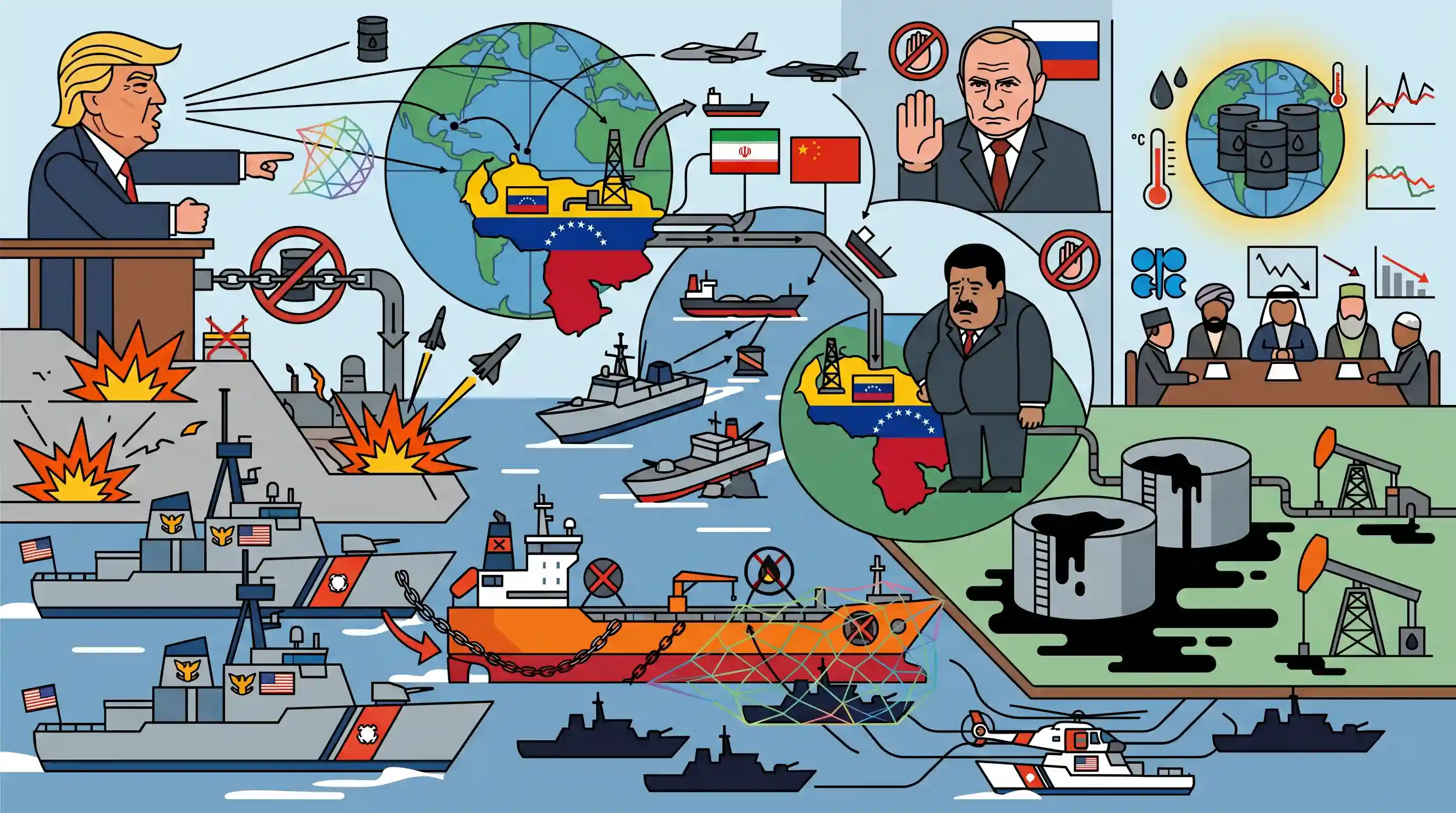
The US Coast Guard is actively pursuing a sanctioned oil tanker, believed to be the "Bella 1," off the coast of Venezuela. This marks the third such operation in a recent "blockade" campaign announced by Donald Trump, aimed at cutting off oil revenues to Nicolás Maduro's regime by targeting the 'dark fleet' of vessels evading US Treasury sanctions. These ships often facilitate clandestine crude trade involving Venezuela, Iran, and China. While the aggressive interdictions (including military strikes and vessel seizures) face condemnation from Russia, they have directly impacted Venezuela's export capacity, leading to domestic storage overflows and forcing OPEC production cuts, while mildly affecting global energy markets.
Key Points
- The US Coast Guard is intensifying its maritime interdiction campaign against the 'dark fleet' of oil tankers suspected of violating US sanctions on Venezuela and Iran.
- The latest target, the VLCC "Bella 1," has a documented history of conducting clandestine crude oil transfers involving Venezuela, Iran, and China, illustrating the complex networks used for sanctions evasion.
- This operation aligns with a de facto "blockade" strategy announced by Donald Trump to choke off oil revenues sustaining Nicolás Maduro's government, an approach that has drawn strong condemnation from Russia.
- The aggressive enforcement is disrupting global energy supply chains: it has crippled Venezuela's export capacity, caused domestic storage tanks to overflow, and forced OPEC production cuts, while potentially exerting upward pressure on global oil prices.
Important Terms
US Treasury Sanctions

Economic and trade penalties administered by the Office of Foreign Assets Control (OFAC) to achieve foreign policy goals, often by blocking assets or restricting trade with specific regimes.
UPSC context
GS Paper 2 (International Relations); tests understanding of economic diplomacy and its impact on global trade and India's energy imports.
OPEC (Organization of the Petroleum Exporting Countries)
An intergovernmental organization of oil-producing nations that coordinates petroleum policies to stabilize markets, ensure fair prices for producers, and steady supply for consumers.
UPSC context
GS Paper 3 (Energy Security); critical for analyzing global oil price volatility and India’s trade balance.
Dark Fleet (Shadow Fleet)
An armada of aging, often uninsured tankers using deceptive tactics like disabling tracking systems (AIS) to transport sanctioned oil from countries like Venezuela and Russia.
UPSC context
GS Paper 3 (Maritime Security); relevant for studying sanction-evasion mechanisms and environmental risks to global shipping lanes.
Maritime Interdiction
The naval practice of delaying, disrupting, or seizing vessels to enforce laws or sanctions, typically involving boarding operations in international or territorial waters.
UPSC context
GS Paper 2 (International Relations); tests understanding of maritime law enforcement and the legality of unilateral blockades under international law.
UNCLOS (United Nations Convention on the Law of the Sea)
An international treaty establishing a legal framework for all marine activities, defining maritime zones and the rights of nations regarding navigation and resource use.
UPSC context
GS Paper 2 (International Treaties); core concept for maritime disputes and the legal limits of vessel seizures on the high seas.
Energy Security
The uninterrupted availability of energy sources at an affordable price, involving physical availability, economic accessibility, and long-term sustainability.
UPSC context
GS Paper 3 (Infrastructure/Economy); central to discussions on India’s import dependency and vulnerability to global supply shocks.
Prelims Trap
Sanctions on the 'dark fleet' carrying Venezuelan oil are enforced under UN Security Council resolutions.
These are unilateral U.S. Treasury sanctions, not UN-backed. UPSC frequently tests the distinction between legally binding UN Security Council multilateral sanctions and unilateral Western sanctions.
Static Concepts Connected
What are the UNCLOS provisions regarding the interdiction of foreign ships on the high seas?
- Freedom of Navigation: Under UNCLOS Article 87, ships of all States enjoy freedom of navigation on the high seas, subject to international law.
- Right of Visit: Warships can only board foreign merchant vessels if there is reasonable ground suspecting piracy, slave trade, or unauthorized broadcasting (Article 110).
- Unilateral Sanctions: UNCLOS does not explicitly authorize maritime interdiction by states solely for enforcing unilateral economic sanctions, creating complex legal gray areas.
What is Venezuela's status within the Organization of the Petroleum Exporting Countries (OPEC)?
- Founding Member: Venezuela is one of the five founding members of OPEC, established during the 1960 Baghdad Conference alongside Iran, Iraq, Kuwait, and Saudi Arabia.
- Proven Reserves: Despite its crippled export capacity, Venezuela holds the world's largest proven crude oil reserves, surpassing major Gulf producers like Saudi Arabia.
- Quota Exemptions: Because their output is already severely constrained by Western sanctions, Venezuela and Iran are currently exempt from the production cuts mandated by OPEC+.
Cross-Topic Patterns
Shadow Fleet & Maritime Ecology
The 'dark fleet' relies on aging, under-insured vessels that disable AIS tracking. This heightens the risk of ecological disasters (oil spills) that evade standard International Maritime Organization (IMO) liability and compensation frameworks.
Unilateral Sanctions vs. India's Energy Security
Aggressive US unilateral sanctions on oil exporters (Venezuela, Iran, Russia) force developing nations like India to devise alternative trade mechanisms (rupee trade, non-dollar settlements) to ensure energy security without triggering secondary sanctions.

The 'Dark Fleet' concept, UNCLOS high-seas interdiction rules, and impacts of unilateral sanctions on global oil are prime 2026 targets.
Linked PYQs · 3
Linked PYQs · 3
- 2012MainsGS2
How have the US sanctions against Iran affected India's bilateral relations with Iran?
- 2014MainsGS2
With respect to the South China sea, maritime territorial disputes and rising tension affirm the need for safeguarding maritime security to ensure freedom of navigation and over flight throughout the region. In this context, discuss the bilateral issues between India and China.
- 2024PrelimsGS1
Consider the following statements : Statement-I : Recently, Venezuela has achieved a rapid recovery from its economic crisis and succeeded in preventing its people from fleeing/emigrating to other countries. Statement-II : Venezuela has the world's largest oil reserves. Which one of the following is correct in respect of the above statements?
