US Department of Energy Radiation Safety Policy Shifts
Source:The Hindu ↗
Why It Matters
As India expands its civilian nuclear program, maintaining stringent safety standards is critical for domestic stability and international cooperation. The U.S. decision to bypass traditional radiation paradigms (ALARA and LNT) creates a rift in global nuclear governance. Understanding these scientific models and the role of bodies like the IAEA and ICRP is highly relevant for GS3 Science & Tech and GS2 International Relations.
Summary
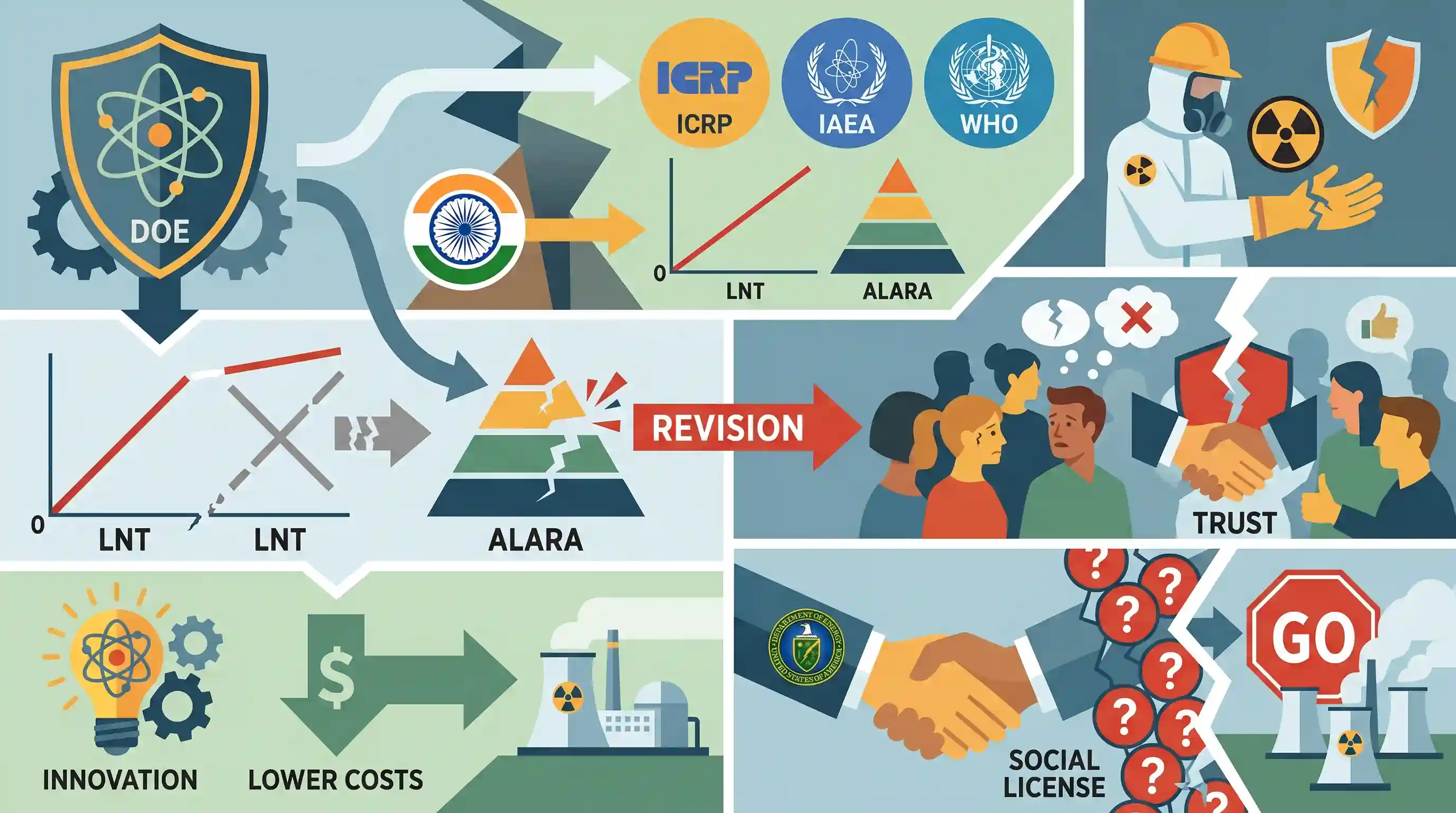
The U.S. Department of Energy (DOE) recently overhauled its radiation safety guidelines by eliminating the ALARA (As Low As Reasonably Achievable) philosophy and disputing the LNT (Linear No-Threshold) model. These shifts depart from globally recognized safety standards established by institutions like the ICRP, IAEA, and WHO, which India also follows. The DOE argues that removing these strict thresholds will foster nuclear innovation and lower costs. However, critics, including health and environmental advocates, argue the move threatens worker safety, diminishes public trust, and makes it harder to secure the "social license" needed for new nuclear infrastructure.
Key Points
- The U.S. Department of Energy (DOE) has eliminated the ALARA (As Low As Reasonably Achievable) philosophy from its radiation protection protocols to stimulate nuclear innovation.
- The DOE’s shift also challenges the LNT (Linear No-Threshold) model, an internationally accepted principle assuming that any level of ionizing radiation exposure carries health risks proportional to the dose.
- Critics caution that dismissing these standards may prioritize commercial interests over safety, undermining protections for nuclear workers and the broader public.
- Concepts like 'hormesis' (which suggests potential benefits from low-dose radiation) lack consistent human data and are rejected for regulatory use by major global bodies.
- Abandoning established safety standards risks eroding public trust and the crucial 'social license' required for developing future nuclear energy projects.
- India, alongside global organizations like the IAEA, ICRP, and WHO, currently adheres to the internationally established LNT and ALARA standards for radiation safety.
Important Terms
ALARA (As Low As Reasonably Achievable)

The 'optimization' principle of radiation safety, mandating that exposures be minimized using time, distance, and shielding, while balancing socio-economic feasibility.
UPSC context
GS Paper III: Science & Technology and Nuclear Safety. It is the cornerstone of India's AERB regulations.
Linear No-Threshold (LNT) model
A risk model assuming that any amount of ionizing radiation, however small, carries a proportional risk of causing cancer, with no 'safe' threshold.
UPSC context
GS Paper III: Health and S&T. It underpins the 'precautionary principle' in global radiation governance.
Radiation Hormesis (Hormesis)
The hypothesis that low-dose radiation might stimulate cellular repair mechanisms and provide health benefits, directly challenging the LNT model.
UPSC context
GS Paper III: S&T. Tests understanding of scientific debates impacting nuclear energy costs and safety policy.
International Commission on Radiological Protection (ICRP)
An independent international non-profit that provides recommendations and guidance on protection against ionizing radiation, forming the basis for most national laws.
UPSC context
GS Paper II: International Institutions. Provides the scientific benchmarks followed by India's Department of Atomic Energy.
International Atomic Energy Agency (IAEA)
An autonomous UN-related organization that promotes peaceful nuclear technology and establishes the Basic Safety Standards (BSS) for global radiological protection.
UPSC context
GS Paper II: International Relations. Essential for understanding India’s nuclear commitments and international safety compliance.
IAEA Basic Safety Standards (BSS)
The primary international framework (GSR Part 3) specifying requirements for protecting people and the environment from the harmful effects of ionizing radiation.
UPSC context
GS Paper III: Disaster Management. The global standard for radiological safety in medical, industrial, and nuclear sectors.
Prelims Trap
"The Linear No-Threshold (LNT) model establishes a minimum safe baseline for ionizing radiation exposure."
The term explicitly means there is NO safe minimum limit; risk increases linearly with any exposure amount, contradicting the 'Hormesis' hypothesis of beneficial low doses.
Static Concepts Connected
What regulates India's civilian nuclear and radiation safety?
- AERB Mandate: The Atomic Energy Regulatory Board (AERB) serves as the regulatory authority, deriving its powers from the Atomic Energy Act, 1962.
- Global Alignment: AERB strictly adheres to IAEA and ICRP guidelines, maintaining the ALARA principle and LNT model for all Indian nuclear facilities.
What are the operational pillars of the ALARA safety principle?
- Time: Minimizing the duration of exposure to reduce the total accumulated radiation dose.
- Distance: Maximizing distance from the source, as radiation intensity drops inversely with the square of the distance.
- Shielding: Utilizing appropriate absorbing materials (like lead or concrete) between the radiation source and individuals.
Cross-Topic Patterns
Nuclear Safety vs. Commercial Viability
The US DOE's shift highlights the GS3 dilemma of balancing strict safety protocols, which raise costs, against the urgent push for cheap nuclear energy innovation like Small Modular Reactors (SMRs).
Social License to Operate (SLO)
Links to GS4 ethics and GS3 infrastructure. Weakening safety norms risks public trust, showing why projects like Kudankulam faced massive local resistance despite having legal environmental clearances.

Expect a 2026 Prelims matching question on radiation terms (LNT, ALARA, Hormesis) or a GS3 question on nuclear regulatory divergences.
Linked PYQs · 3
Linked PYQs · 3
- 2020PrelimsGS1
In India, why are some nuclear reactors kept under "IAEA Safeguards" while others are not?
- 2018PrelimsGS1
In the Indian context, what is the implication of ratifying the 'Additional Protocol' with the 'International Atomic Energy Agency (IAEA)'?
- 2017MainsGS3
Give an account of the growth and development of nuclear science and technology in India. What is the advantage of fast breeder reactor programme in India?
