US Department of Energy Revises Radiation Safety Standards
Source:The Hindu ↗
Why It Matters
Nuclear safety and the regulatory principles governing it are central to India's energy transition. Understanding the shift in U.S. domestic policy helps candidates analyze the tension between accelerating nuclear energy expansion (for climate goals) and maintaining rigorous public and occupational health standards.
Summary
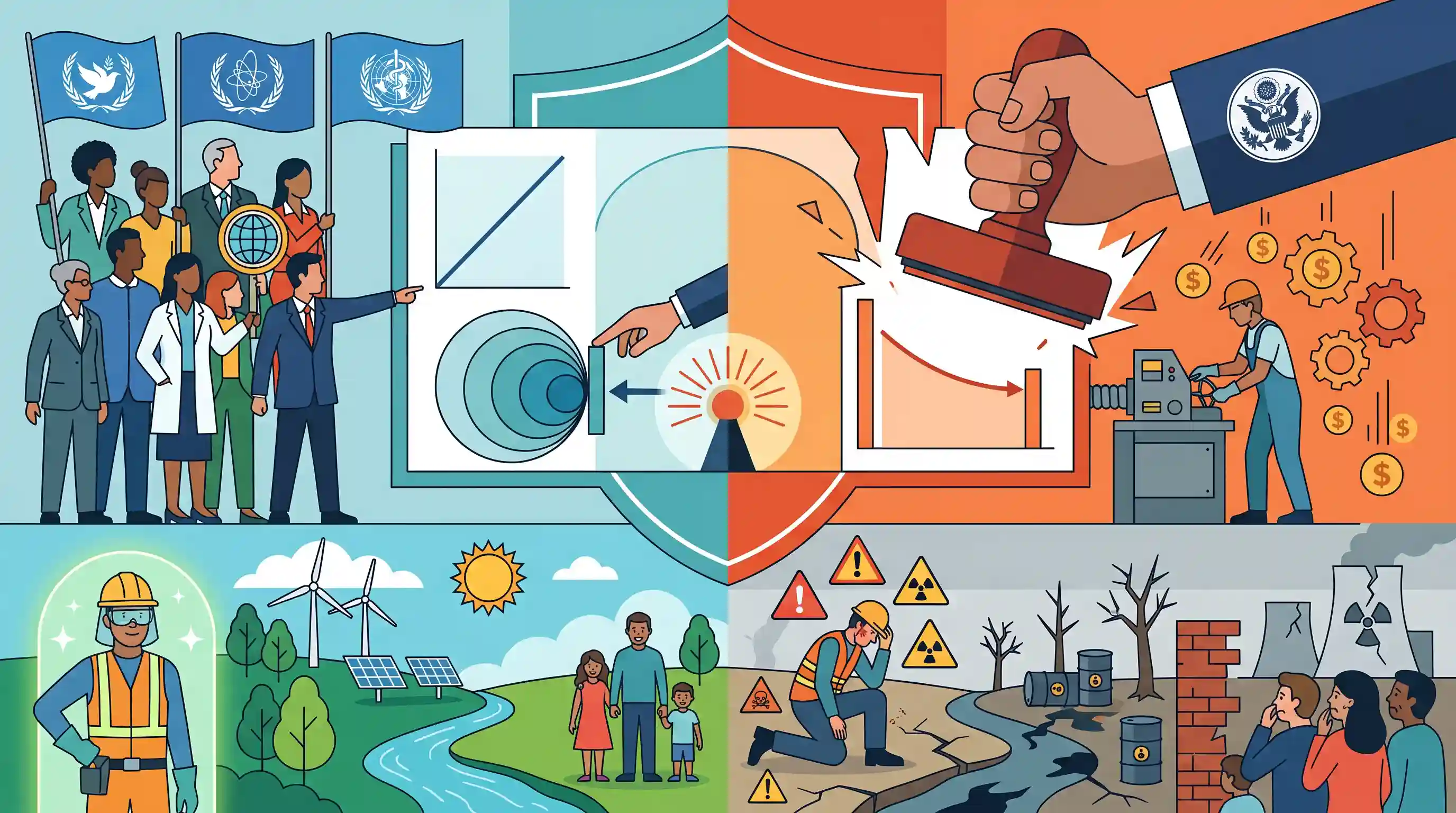
The U.S. Department of Energy (DOE) is controversially moving to discard the 'As Low As Reasonably Achievable' (ALARA) philosophy and the 'Linear No-Threshold' (LNT) model from its radiation protection regulations, opting instead for a less rigorous 'As Low As Practicable' (ALAP) standard. This departure from globally accepted safety norms—endorsed by the ICRP, IAEA, and WHO—aims to reduce costs and administrative burdens in the nuclear sector. However, critics and health experts argue this deregulation risks increasing occupational hazards for workers, eroding public trust, and compromising long-term environmental safety just as nuclear energy is being promoted as a climate solution.
Key Points
- The Linear No-Threshold (LNT) model and ALARA principle have historically governed global radiation safety, operating on the premise that any ionizing radiation exposure carries a health risk.
- The U.S. Department of Energy (DOE) is revising its internal safety regulations (Rule 10 CFR 835), replacing ALARA with a less stringent 'As Low As Practicable' (ALAP) approach.
- This policy shift breaks from established international norms upheld by the IAEA, ICRP, and WHO, prioritizing administrative and economic deregulation over rigorous worker protection.
- Health experts and critics warn this could expose nuclear workers to higher radiation doses and potentially pave the way for fast-tracking new, unproven nuclear technologies by bypassing robust safety standards.
Important Terms
Linear No-Threshold (LNT) model

A risk-assessment model assuming that any level of radiation exposure, no matter how small, increases the risk of cancer and genetic damage in a direct, proportional manner.
UPSC context
GS Paper 3: Science & Tech; understanding the scientific basis for nuclear safety regulations and environmental health.
ALARA (As Low As Reasonably Achievable) principle
A safety philosophy ensuring radiation exposure is minimized by balancing economic and social factors with technical feasibility. It focuses on three protective measures: time, distance, and shielding.
UPSC context
GS Paper 3: Environment/Disaster Management; core safety standard for Indian nuclear power plants and medical imaging.
International Atomic Energy Agency (IAEA)
An autonomous international organization within the UN system that promotes peaceful nuclear energy and implements safeguards to prevent the military use of nuclear material.
UPSC context
GS Paper 2: International Relations; critical for global nuclear governance, non-proliferation, and India-specific safeguards agreements.
International Commission on Radiological Protection (ICRP)
An independent international body that provides recommendations and guidelines on radiological protection. Its scientific frameworks form the baseline for national radiation safety laws worldwide.
UPSC context
GS Paper 3: Nuclear Safety; it sets global benchmarks adopted by agencies like India's Atomic Energy Regulatory Board.
UNSCEAR (United Nations Scientific Committee on the Effects of Atomic Radiation)
A UN committee that assesses and reports global levels and health effects of ionizing radiation, providing the scientific data used by the IAEA and ICRP.
UPSC context
GS Paper 3: Scientific developments; essential for authoritative data on nuclear accidents and environmental radiation impact.
As Low As Practicable (ALAP)
A less rigorous safety standard than ALARA, emphasizing what is feasible in practice (practicable) rather than what is reasonably achievable through comprehensive cost-benefit optimization.
UPSC context
GS Paper 3: Regulatory environment; represents a shift toward deregulation and potential dilution of occupational safety norms.
Prelims Trap
"The IAEA has replaced the ALARA principle with the ALAP model to fast-track global nuclear energy deployment."
Only the US DOE is shifting to ALAP. Global bodies like IAEA, WHO, and India's AERB still strictly mandate the ALARA principle.
Static Concepts Connected
What is the mandate of India's Atomic Energy Regulatory Board (AERB)?
- Statutory Body: Established in 1983 under the Atomic Energy Act, 1962, to carry out regulatory and safety functions for nuclear facilities.
- Independence: Reports to the Atomic Energy Commission (AEC), maintaining functional independence from operators like NPCIL and BARC.
- Safety Standards: Strictly enforces the ALARA (As Low As Reasonably Achievable) principle for occupational and public radiation exposure.
What is the Linear No-Threshold (LNT) model in radiation physics?
- Core Premise: Assumes any exposure to ionizing radiation, no matter how small, carries a proportional health risk (like DNA damage).
- No Safe Level: Contradicts the idea of a 'safe minimum threshold', forming the scientific baseline for global radiation protection standards.
Cross-Topic Patterns
Nuclear energy as a climate solution
As nuclear power is promoted at COP summits for decarbonization, regulatory dilutions reflect the growing tension between rapid tech deployment and stringent environmental safeguards.
Global vs. Domestic Safety Standards
The US divergence highlights regulatory fragmentation. UPSC often tests how domestic bodies (like AERB) align with or deviate from international norms (like IAEA/ICRP).

Expect Prelims statements testing AERB's adherence to ALARA and the LNT model, framed alongside IAEA's global mandate for radiation safety.
Linked PYQs · 4
Linked PYQs · 4
- 2017MainsGS3
Give an account of the growth and development of nuclear science and technology in India. What is the advantage of fast breeder reactor programme in India?
- 2020PrelimsGS1
In India, why are some nuclear reactors kept under "IAEA Safeguards" while others are not?
- 2018PrelimsGS1
In the Indian context, what is the implication of ratifying the 'Additional Protocol' with the 'International Atomic Energy Agency (IAEA)'?
- 2023PrelimsGS1
Consider the following statements regarding mercury pollution: 1. Gold mining activity is a source of mercury pollution in the world. 2. Coal-based thermal power plants cause mercury pollution. 3. There is no known safe level of exposure to mercury. How many of the above statements are correct?
