India United States Strategic Partnership and Counter Terrorism
Source:The Hindu ↗
Why It Matters
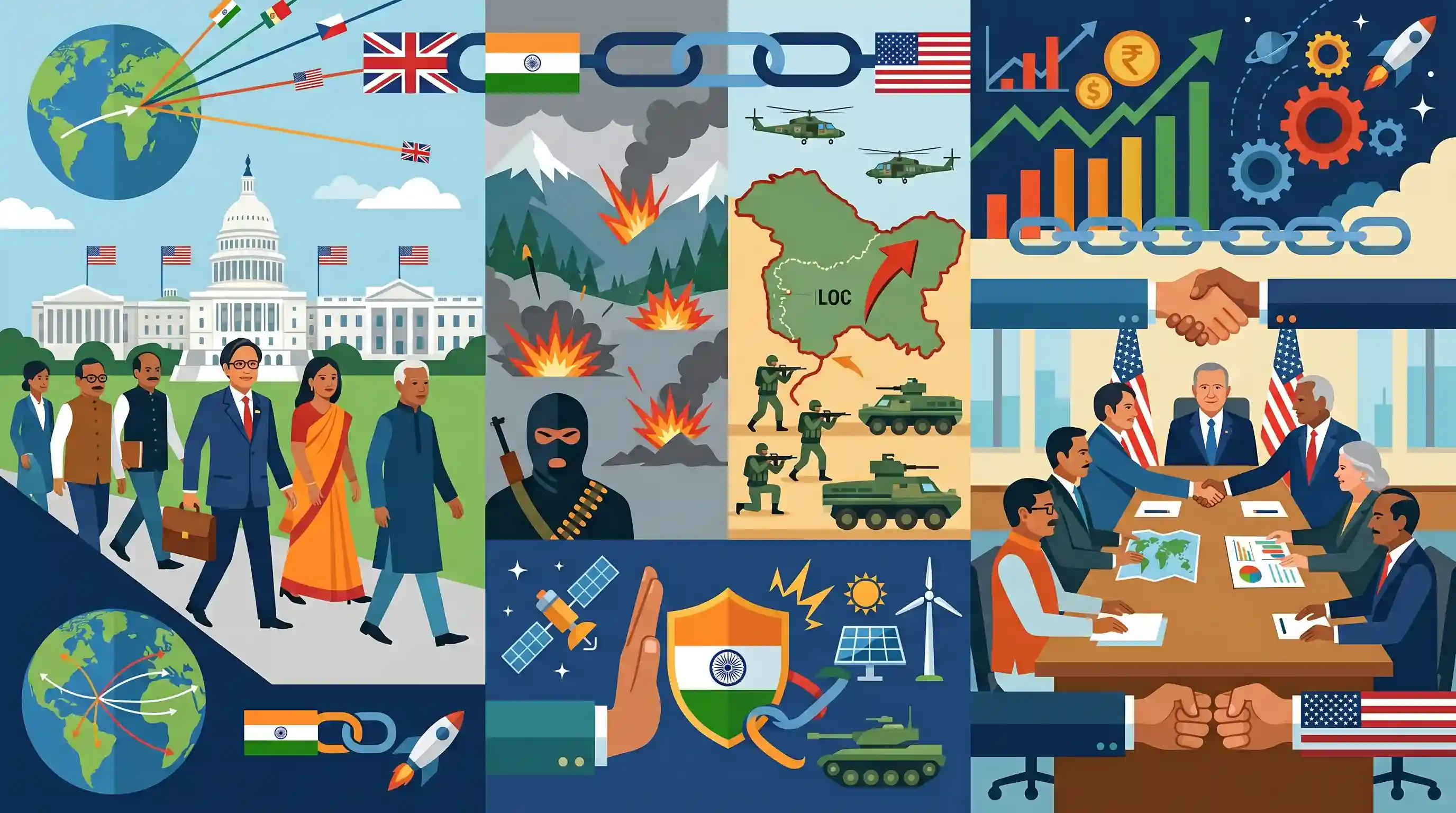
It illustrates the strategic utilization of multi-party parliamentary diplomacy to project domestic unity on national security issues globally. It also highlights the continued deepening of the Indo-US strategic alliance, particularly regarding shared concerns over state-sponsored terrorism and regional stability in South Asia.
Summary
An all-party Indian parliamentary delegation led by Congress MP Shashi Tharoor engaged in key diplomatic meetings in Washington, including with U.S. Deputy Secretary of State Christopher Landau, Vice-President J.D. Vance, and several prominent Senators. The primary agenda was to brief the U.S. leadership on the devastating April 2025 Pahalgam terror attack and India's subsequent cross-border military response, Operation Sindoor. U.S. officials strongly reaffirmed their support for India's fight against terrorism and recognized its right to self-defense. Additionally, the meetings focused on advancing the comprehensive U.S.-India strategic partnership, particularly in trade and economic cooperation. The visit highlights the growing role of parliamentary diplomacy in building global consensus around India's national security imperatives.
Key Points
- An all-party Indian parliamentary delegation led by Shashi Tharoor met with U.S. Deputy Secretary of State Christopher Landau and Vice-President J.D. Vance in Washington.
- The delegation briefed U.S. officials on the recent Pahalgam terror attack and India's subsequent retaliatory strikes against terror infrastructure in Pakistan, termed Operation Sindoor.
- The U.S. reaffirmed its unequivocal support for India in combating cross-border terrorism, acknowledging India's right to self-defense.
- Discussions also encompassed expanding the India-U.S. strategic partnership, emphasizing commercial ties, bilateral trade, and shared economic prosperity.
- The multi-party composition of the delegation demonstrated a unified domestic political front regarding national security and robust parliamentary diplomacy.
Important Terms
Operation Sindoor

A 2025 Indian military campaign involving precision missile and drone strikes against terror infrastructure in Pakistan. It was a direct response to the Pahalgam massacre, marking a shift toward 'preventive dominance'.
UPSC context
GS Paper III (Internal Security/Border Management); tests understanding of India's evolving counter-terrorism doctrine and 'non-contact warfare' strategies.
Parliamentary Diplomacy
The use of legislative delegations to conduct international relations, building global consensus and peer-level political support. It complements traditional executive-led diplomacy, as seen in the 2026 all-party visit to Washington.
UPSC context
GS Paper II (International Relations); relevant for questions on 'soft power' and the multifaceted nature of Indian foreign policy.
U.S. State Department
The federal executive department responsible for carrying out U.S. foreign policy and international relations. It manages diplomatic missions and coordinates with foreign governments on security and trade.
UPSC context
GS Paper II (International Relations); essential for analyzing bilateral engagement and the institutional framework of Indo-US ties.
Pahalgam Terror Attack (2025)
The 22 April 2025 massacre of 26 civilians, primarily tourists, in Jammu and Kashmir. Attributed to the 'Falcon Squad' (TRF), it served as the casus belli for Operation Sindoor.
UPSC context
GS Paper III (Internal Security); tests knowledge of major security flashpoints and their impact on regional stability and foreign policy.
India-US Strategic Partnership
A multi-faceted alliance between New Delhi and Washington focusing on defense, critical technologies (iCET), and counter-terrorism. It is characterized by high-level institutional engagement and shared democratic values.
UPSC context
GS Paper II (Bilateral Relations); a core syllabus topic regarding 'Global South' leadership and great power dynamics.
U.S. Senate Foreign Relations Committee
A powerful standing committee of the U.S. Senate that leads foreign-policy legislation and debate. It oversees foreign aid, arms sales, and the confirmation of diplomatic appointments.
UPSC context
GS Paper II (International Relations); relevant for understanding the role of the U.S. legislature in shaping bilateral treaties and sanctions.
Prelims Trap
"Article 51 of the UN Charter explicitly authorizes military self-defense against non-state terrorist groups."
Article 51 only mentions an "armed attack." Its application to justify strikes against non-state actors in foreign territory is an evolving interpretation, not explicit text.
Static Concepts Connected
What is Article 51 of the UN Charter?
- Inherent right: Recognizes the inherent right of individual or collective self-defense if an armed attack occurs against a UN member state.
- UNSC reporting: Any military measures taken by a state in self-defense must be immediately reported to the United Nations Security Council.
- Evolving application: Increasingly invoked by nations, including India and the US, to justify strikes against terrorist infrastructure in unwilling or unable host nations.
What is the strategic role of Parliamentary Diplomacy?
- Alternative channel: Engagement between legislators of different nations, serving as a vital soft-power tool that complements traditional executive-led foreign policy.
- Unified front: Deploying multi-party delegations projects a unified domestic consensus, mitigating diplomatic fallout during sensitive national security actions.
- Strategic flexibility: Allows for flexible, frank dialogue and consensus-building without the strict legal constraints of binding executive negotiations.
Cross-Topic Patterns
Deterrence by punishment vs. denial
Operation Sindoor cements India's shift from defensive containment (deterrence by denial) to proactive retaliation (deterrence by punishment) in its cross-border security posture.
Article 51 and non-state actors
Links GS2 (IR) with GS3 (Security). India’s invocation of UN Charter Article 51 for counter-terror strikes directly mirrors post-9/11 US diplomatic precedents, securing Western backing.

Expect a GS2/GS3 Mains question assessing how India combines military 'deterrence by punishment' with soft-power 'parliamentary diplomacy'.
Linked PYQs · 3
Linked PYQs · 3
- 2020MainsGS2
What is the significance of Indo-US defence deals over Indo-Russian defence deals? Discuss with reference to stability in the Indo-Pacific region.
- 2025MainsGS3
Terrorism is a global scourge. How has it manifested in India? Elaborate with contemporary examples. What are the counter measures adopted by the State? Explain.
- 2020MainsGS3
Analyze internal security threats and transborder crimes along Myanmar, Bangladesh and Pakistan borders including Line of Control (LoC). Also discuss the role played by various security forces in this regard.
