US Indo Pacific Strategy and Third Party Mediation Stance
Source:The Hindu ↗
Why It Matters
The article underscores the evolving U.S. defense posture in the Indo-Pacific region aimed at countering China, while revealing persistent diplomatic friction regarding U.S. claims of third-party mediation in India-Pakistan bilateral affairs, a sensitive issue for India's foreign policy.
Summary
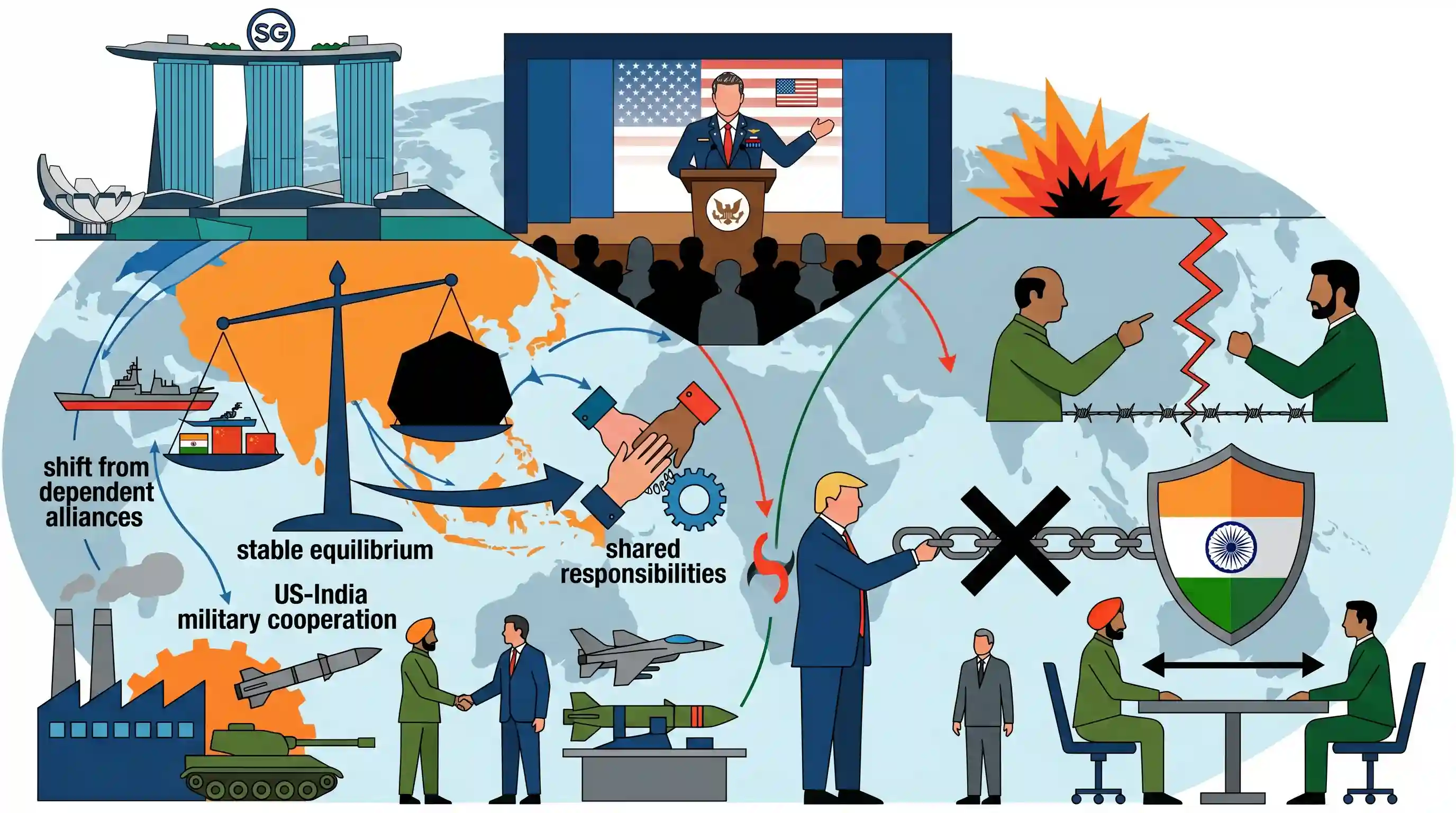
At the 2026 Shangri-La Dialogue in Singapore, U.S. Secretary of War Pete Hegseth outlined the U.S. Indo-Pacific strategy, emphasizing a "stable equilibrium" to prevent any single power—alluding to China—from dominating the region. Hegseth highlighted a shift from dependency-based alliances to shared responsibilities, commending India's efforts to bolster its military industrial capacity. Controversially, he reiterated President Donald Trump's claim of having brokered a ceasefire between India and Pakistan following the 2025 Pahalgam terror attack confrontation. India has steadfastly denied any third-party mediation, adhering to its core policy that all disputes with Pakistan must be resolved bilaterally.
Key Points
- U.S. Secretary of War Pete Hegseth outlined the U.S. Indo-Pacific strategy at the 2026 Shangri-La Dialogue, advocating for a 'stable equilibrium' to prevent dominance by any single power (specifically China).
- Hegseth backed President Donald Trump's claim of mediating a ceasefire between India and Pakistan following the 2025 military confrontation triggered by the Pahalgam terror attack.
- India officially denies any third-party mediation in the ceasefire, maintaining its traditional stance that disputes with Pakistan are strictly bilateral.
- The U.S. defense strategy emphasizes shifting alliances from dependency to shared responsibilities, praising India's modernization of its military and industrial capacity to sustain operations.
Important Terms
Shangri-La Dialogue

Asia’s premier defense summit held annually in Singapore. Organized by the IISS, it provides a "Track One" platform for defense ministers to discuss regional security, maritime order, and great-power competition.
UPSC context
GS-II (International Relations). Tests knowledge of regional security architecture and India’s strategic engagement in Southeast Asia.
Indo-Pacific Strategy
A geopolitical framework linking the Indian and Pacific Oceans. It emphasizes a "Free and Open" region, maritime security, and a rules-based order, often serving as a strategic counter-balance to China’s regional influence.
UPSC context
GS-II (Bilateral & Regional Groupings). Vital for understanding the Quad, maritime strategy, and US-India cooperation.
Simla Agreement
The 1972 post-war pact where India and Pakistan committed to resolving disputes "through peaceful means and bilateral negotiations," legally formalizing India’s rejection of any third-party or international mediation.
UPSC context
GS-II (India and its Neighborhood). The fundamental legal reference for India’s "bilateralism" policy regarding Pakistan.
Stable Equilibrium
A geopolitical state where no single power can achieve hegemony or dictate terms. It implies a durable balance of power designed to maintain regional peace and prevent unilateral dominance.
UPSC context
GS-II (International Relations). Relates to concepts of "Strategic Autonomy" and a "Multipolar Asia."
Military Industrial Capacity
The domestic ecosystem of R&D, manufacturing, and supply chains required to produce military hardware. Bolstering this is central to India’s "Atmanirbhar Bharat" (Self-Reliant India) initiative.
UPSC context
GS-III (Internal Security/Defense). Tests understanding of indigenization, defense exports, and strategic self-reliance.
Third-party Mediation
Intervention by a neutral external actor to resolve a conflict. India steadfastly opposes this for bilateral disputes with Pakistan, viewing it as a violation of sovereignty and the Simla Agreement.
UPSC context
GS-II (International Relations). Crucial for questions on India-Pakistan relations and diplomatic red lines.
Prelims Trap
The Shangri-La Dialogue is an annual defense summit hosted by ASEAN.
While it serves as Asia's premier inter-governmental (Track One) defense summit, it is organized by the International Institute for Strategic Studies (IISS), an independent think tank, not ASEAN.
Static Concepts Connected
What legal frameworks mandate strict bilateralism between India and Pakistan?
- Shimla Agreement (1972): Signed after the 1971 war, it legally binds both nations to resolve their differences through bilateral negotiations, strictly excluding any third-party mediation.
- Lahore Declaration (1999): Reaffirmed the Shimla framework, emphasizing that direct bilateral dialogue is the only acceptable mechanism to resolve all disputes, including Jammu and Kashmir.
What are the distinct tracks of diplomacy in international relations?
- Track 1 (Official): Formal, direct government-to-government interaction between official state representatives, such as defense ministers meeting at the Shangri-La Dialogue.
- Track 2 (Unofficial): Informal, non-governmental dialogue involving academics, civil society, or retired officials designed to build trust outside official state constraints.
- Track 1.5: A hybrid approach where official state representatives and non-official actors collaborate to explore policy solutions without binding formal commitments.
Cross-Topic Patterns
Defense indigenization as a geopolitical anchor
The U.S. shift towards "shared responsibility" directly relies on India's 'Make in India' defense indigenization policies and the operationalization of foundational pacts (LEMOA, COMCASA) to ensure resilient Indo-Pacific supply chains.
Sovereignty red-lines and strict bilateralism
India's swift rejection of U.S. mediation claims mirrors its historical refusal to let China or the OIC internationalize the Kashmir issue at the UN Security Council, consistently citing strict bilateralism.

Shangri-La Dialogue (IISS) vs ADMM-Plus (ASEAN) and the nuances of Track-1 diplomacy are highly probable in the 2026 Prelims.
Linked PYQs · 3
Linked PYQs · 3
- 2020MainsGS2
What is the significance of Indo-US defence deals over Indo-Russian defence deals? Discuss with reference to stability in the Indo-Pacific region.
- 2024MainsGS2
‘The West is fostering India as an alternative to reduce dependence on China's supply chain and as a strategic ally to counter China's political and economic dominance.’ Explain this statement with examples.
- 2015MainsGS2
Terrorist activities and mutual distrust have clouded India-Pakistan relations. To what extent the use of soft power like sports and cultural exchanges could help generate goodwill between the two countries? Discuss with suitable examples.
