Critical minerals supply chain security and global trade blocs
Source:Indian Express ↗
Why It Matters
The supply chain security of critical minerals is a vital national security priority that directly impacts green energy transitions, defense hardware manufacturing, and high-tech industries. For India—which has launched its own National Critical Mineral Mission and joined the Minerals Security Partnership (MSP)—the creation of exclusive, price-controlled trading blocs by Western allies reshape global market access, commodity pricing, and strategic foreign policy alignments.
Summary
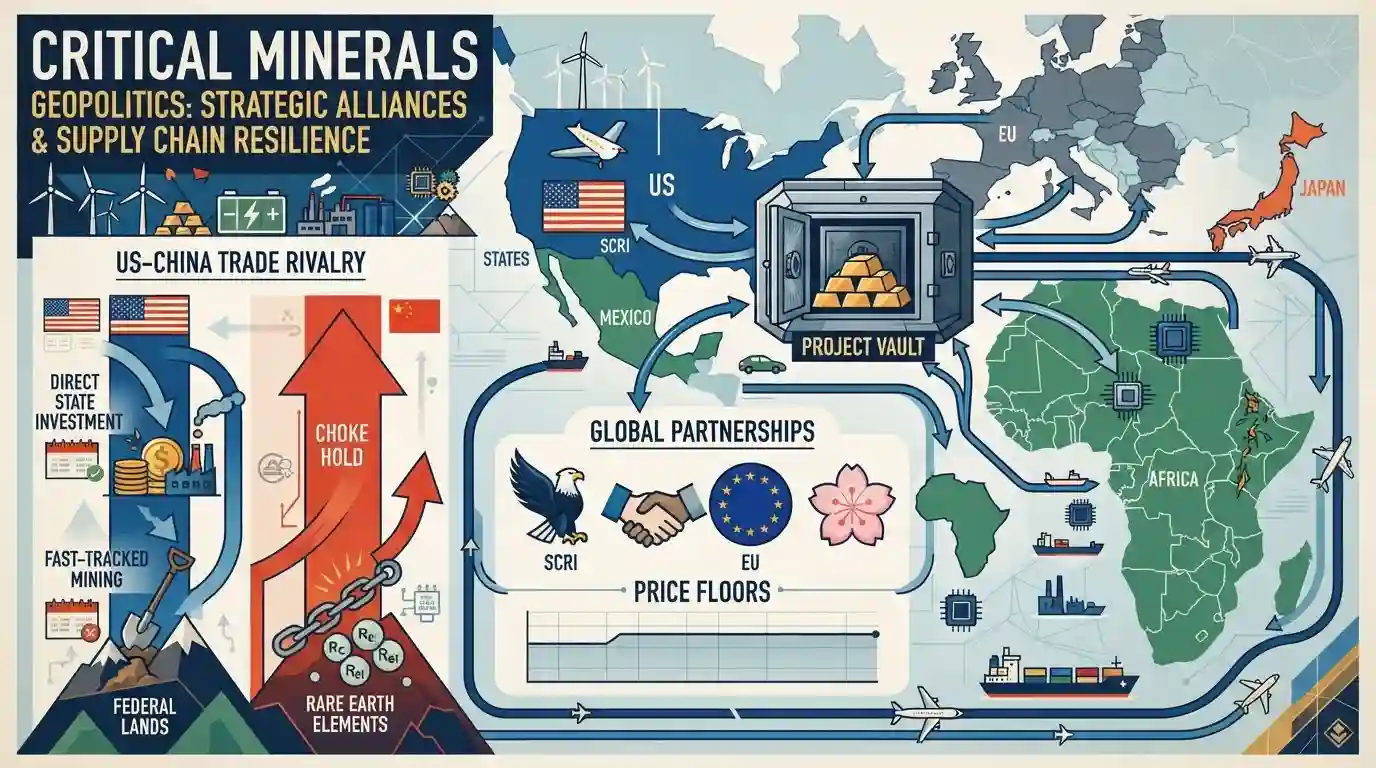
The United States, led by the Trump administration, is pushing to establish a strategic critical minerals trading bloc with global allies (including European, Asian, and African nations) to challenge China's chokehold on rare earth elements and critical minerals. To support this, the US has unveiled 'Project Vault' (a $10 billion strategic stockpile), made direct state investments in domestic mines, and coordinated with partners like Japan, the EU, and Mexico to introduce price floors. Additionally, legislative efforts are underway in the US to fast-track mining on federal lands.
Key Points
- The US Trump administration has proposed creating a critical minerals trading bloc with international allies to counter China's dominance in the mining (70%) and processing (90%) of critical minerals and rare earth elements.
- The proposed trading bloc would utilize tariffs and coordinated trade policies to establish minimum price floors, preventing China from executing its strategy of predatory pricing (cheap dumping to kill global competition, followed by price hikes).
- The US has introduced 'Project Vault', a strategic domestic stockpile of rare earth elements, supported by a $10 billion loan from the US Export-Import Bank and nearly $1.67 billion in private capital.
- Major allies, including the European Union, Japan, and Mexico, have agreed to work with the US to develop coordinated trade policies to ensure supply chain resilience outside of China's control.
- The US administration has extended direct financial support, including a $1.6 billion stake in USA Rare Earth, while the Pentagon has spent nearly $5 billion over the past year to stimulate domestic extraction.
- Domestically, the US House of Representatives passed a bill to accelerate mining and processing of critical minerals on federal land, despite environmental concerns.
Important Terms
Project Vault

A $12 billion US public-private initiative launched in 2026 to build a commercial critical minerals stockpile, aiming to shield domestic industries from supply chain disruptions and reduce strategic dependence on China.
UPSC context
GS Paper III (Infrastructure & Economy); tests resource security, supply chain resilience, and global strategic mineral policies.
US Export-Import Bank
The official export credit agency of the United States government, facilitating trade and financing strategic global infrastructure, including providing a $10 billion loan to seed Project Vault.
UPSC context
GS Paper II & III (Economic Policy); tests international financial institutions and trade diplomacy tools used to build resilient supply chains.
European Union
A major politico-economic union of 27 European nations coordinating global trade policies, currently partnering with the US on critical minerals price floors to counter monopolistic market concentrations.
UPSC context
GS Paper II (Global Groupings); tests multilateral alliances, economic cooperation, and strategic trade partnerships that influence global supply networks.
USA Rare Earth
An emerging US-based critical minerals extraction company that received a $1.6 billion government funding package in 2026 to build a domestic heavy rare earth mine-to-magnet platform.
UPSC context
GS Paper III (Technology & Resource Security); tests public-private initiatives to reduce import reliance on critical minerals and build domestic manufacturing capability.
Pentagon
The headquarters of the United States Department of Defense, actively funding foreign and domestic extraction projects to safeguard defense-critical elements like gallium and rare earths.
UPSC context
GS Paper II (Security Challenges); tests geopolitical conflicts over resource control and defense sector vulnerability to critical material supply disruptions.
Prelims Trap
The Minerals Security Partnership (MSP) is a G7-exclusive initiative, and India remains an invitee/observer rather than a full member.
India joined the MSP in 2023 as a full member and is notably the only developing nation in this 14-member critical minerals alliance.
Static Concepts Connected
What are Rare Earth Elements (REEs) and why is processing their main bottleneck?
- 17 Key Elements: Consist of 15 lanthanides plus scandium and yttrium, essential for high-tech defense systems, electronics, and green energy applications.
- Geological Abundance: Despite their name, they are relatively abundant in Earth's crust but are rarely found in concentrated, economically extractable deposits.
- Processing Monopoly: Refining is highly toxic and energy-intensive. China controls nearly 90% of processing due to decades of state support and relaxed environmental regulations.
What is the Minerals Security Partnership (MSP) and India's role in it?
- US-led Coalition: Launched in 2022 to secure robust, sustainable supply chains for critical minerals needed for clean energy transition.
- Diverse Membership: Comprises 14 partners including the EU, US, Japan, and Australia; India is the sole developing country member.
- Strategic Finance: Coordinates public-private investments, mining technology sharing, and export credit agencies to build alternative supply networks independent of Chinese dominance.
Cross-Topic Patterns
WTO rules vs. Critical Mineral Subsidies
Unilateral price floors and strategic stockpiles like Project Vault test the limits of WTO’s non-discrimination principles and the Agreement on Subsidies and Countervailing Measures (ASCM).
Resource Nationalism + Quad Strategy
India’s NCMM budget and overseas KABIL acquisitions in South America align with the Quad's security paradigm to counter China's maritime and resource hegemony.

MSP membership, India's NCMM funding, and the properties of Rare Earths are highly likely to form an integrated 2026 Prelims question.
Linked PYQs · 4
Linked PYQs · 4
- 2026PrelimsGS1
Which of the following statements about Rare Earth Elements (REEs) and Critical Minerals is/are correct ? 1. Modern technological innovations including Artificial Intelligence, robotics and space exploration extensively utilise Rare Earth Elements (REEs). 2. China has the highest share in mining of REEs followed by India. 3. The Government of India launched the National Critical Mineral Mission (NCMM) in 2025 to establish a robust framework for self-reliance in the critical mineral sector. 4. Rare Earth Elements are a set of 13 metallic elements. Select the answer using the code given below :
- 2025PrelimsGS1
Consider the following statements : Statement I: Some rare earth elements are used in the manufacture of flat television screens and computer monitors. Statement II : Some rare earth elements have phosphorescent properties. Which one of the following is correct in respect of the above statements?
- 2021MainsGS2
“The USA is facing an existential threat in the form of a China, that is much more challenging than the erstwhile Soviet Union.” Explain.
- 2025MainsGS2
"With the waning of globalization, post-Cold War world is becoming a site of sovereign nationalism.” Elucidate.
