US Visa Social Media Vetting Raises Re-Entry Concerns for Students
Source:Indian Express ↗
Why It Matters
It highlights how shifting immigration policies and enhanced state surveillance in Western countries affect Indian students and professionals, impacting the Indian diaspora's prospects and bringing digital privacy debates to the forefront of international mobility.
Summary
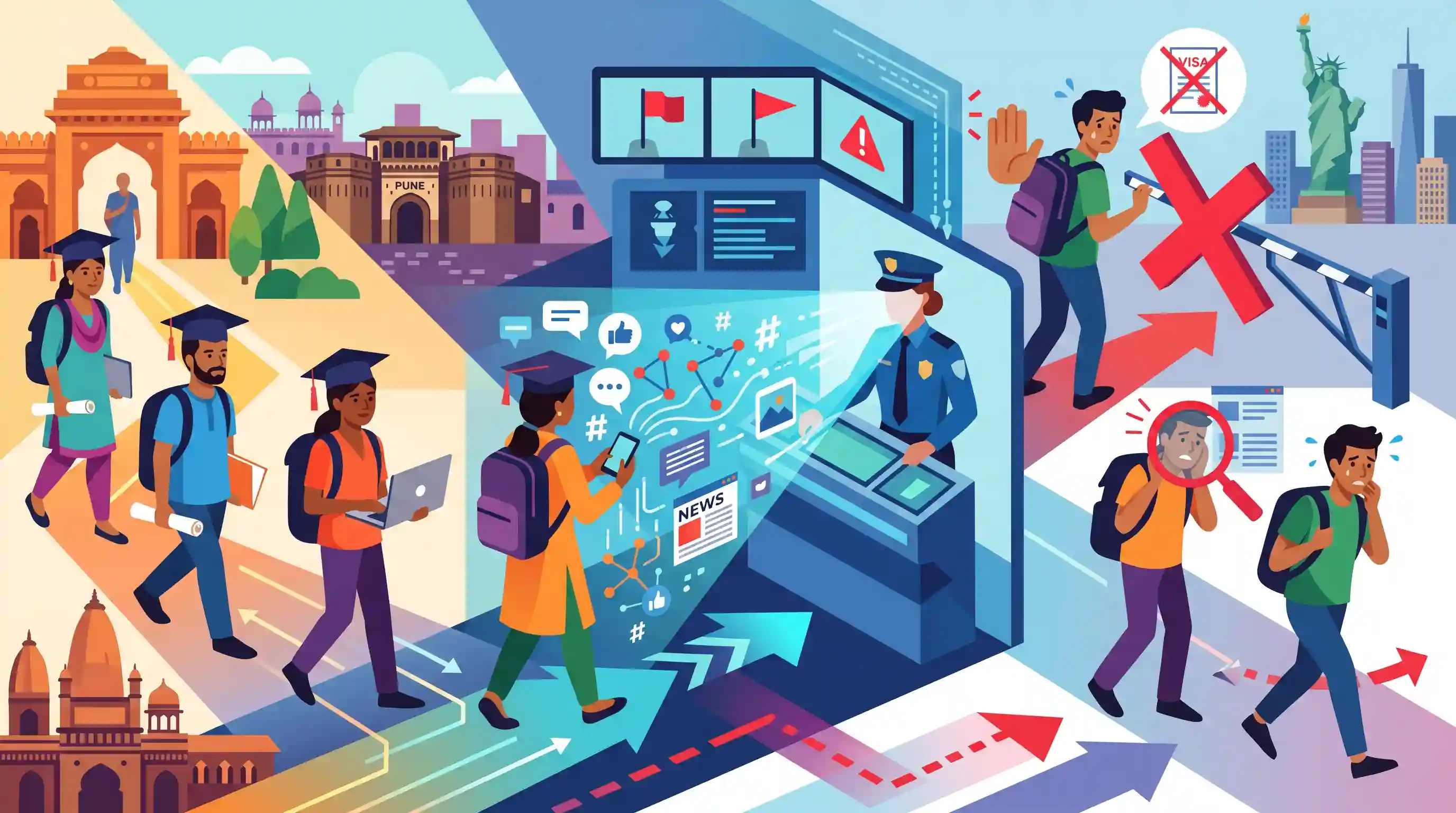
Recent changes in US visa policies and the implementation of stringent social media vetting by immigration authorities have raised significant concerns among Indian students, particularly from Pune, regarding their re-entry into the United States. Authorities are increasingly inspecting the digital footprints of international students at ports of entry, leading to anxieties over potential visa cancellations or deportations based on online affiliations or posts. This development highlights the challenges faced by the Indian student diaspora and touches upon the broader intersections of global mobility, state surveillance, and digital privacy.
Key Points
- Indian students face rising anxiety regarding their return to the US after vacations due to more stringent visa policies and border checks.
- US immigration authorities are increasingly vetting the social media accounts of international students to scrutinize political views, affiliations, and activities.
- The intense social media scrutiny poses severe risks of visa cancellations, deportation, or denial of entry at US ports for minor inconsistencies.
- The issue reflects broader global debates on student mobility, digital privacy rights, and the challenges encountered by the Indian diaspora pursuing education in Western nations.
Important Terms
F-1 Visa

A non-immigrant visa category for international students pursuing full-time academic degrees at US colleges or universities. It requires proof of enrollment in a SEVP-certified institution and financial self-sufficiency.
UPSC context
GS Paper II: International Relations and Indian Diaspora; tests understanding of global student mobility and bilateral people-to-people ties.
H-1B Visa
A non-immigrant visa allowing US employers to temporarily hire foreign workers in "specialty occupations" requiring specialized knowledge and a bachelor’s degree, widely used by Indian IT professionals.
UPSC context
GS Paper II: Effect of foreign policies on India's interests; tests impact of US immigration changes on Indian professionals.
US Customs and Border Protection (CBP)
The unified border authority of the United States responsible for managing international arrivals, enforcing immigration laws, and conducting inspections, including digital footprint checks, at ports of entry.
UPSC context
GS Paper III: Internal Security/Cyber Security; relates to state surveillance, data privacy, and cross-border movement protocols.
US Department of State
The executive department responsible for US foreign policy and visa issuance. It recently implemented mandatory social media disclosure for applicants to identify potential security risks or "hostile" attitudes.
UPSC context
GS Paper II: Bilateral relations; highlights the diplomatic and administrative frameworks governing India-US mobility and security vetting.
Indian Diaspora
The global community of people of Indian origin living outside India. In the US, it is a significant stakeholder in bilateral ties, contributing to both economies and cultures.
UPSC context
GS Paper II: Indian Diaspora; tests the role of overseas Indians in enhancing India's "soft power" and strategic interests.
Social Media Vetting
The mandatory disclosure and inspection of an applicant's social media history (typically five years) to assess identity, admissibility, and potential threats to national security during the visa process.
UPSC context
GS Paper III: Data Privacy and Security; examines the intersection of digital privacy rights and state-mandated security screening.
Prelims Trap
India's DPDP Act, 2023 protects the social media data of Indian citizens globally, restricting foreign border authorities from arbitrary vetting.
The DPDP Act regulates data fiduciaries operating within India or offering services to Indians. It has no jurisdiction over foreign sovereign states enforcing their own border/immigration laws.
Static Concepts Connected
How does Indian law treat extraterritorial data privacy and foreign surveillance?
- DPDP Act 2023: The Act applies to data processing in India, or abroad only if offering goods/services to individuals in India. It cannot regulate foreign immigration checks.
- Article 21 limitations: The fundamental Right to Privacy (Puttaswamy) protects individuals from arbitrary actions by the Indian State, not foreign border agencies enforcing their own sovereign laws.
What are the primary US visa categories affecting the Indian diaspora?
- F-1 Visa: Issued to full-time international students. Intense social media vetting here threatens the largest segment of the Indian student diaspora.
- H-1B Visa: A non-immigrant work visa for specialized occupations. Many F-1 students transition to H-1B via the Optional Practical Training (OPT) program.
- J-1 Visa: Covers work-and-study-based exchange visitor programs, including research scholars and professors.
Cross-Topic Patterns
Data Sovereignty vs. Global Mobility
Friction between domestic privacy frameworks (like the DPDP Act) and extraterritorial digital surveillance at Western borders creates new non-tariff barriers, challenging the seamless flow of India's tech-talent diaspora.
Soft Power + Demographic Dividend
India displacing China as the top student source in the US is a soft-power triumph, but stringent visa vetting exposes the vulnerabilities of relying on Western education ecosystems.

Expect a GS2 Mains question linking extraterritorial data privacy challenges with the protection of Indian diaspora interests abroad in 2026.
Linked PYQs · 4
Linked PYQs · 4
- 2020MainsGS2
Indian diaspora has a decisive role to play in the politics and economy of America and European Countries'. Comment with examples.
- 2023MainsGS2
Indian diaspora has scaled new heights in the West. Describe its economic and political benefits for India.
- 2024MainsGS3
Social media and encrypting messaging services pose a serious security challenge. What measures have been adopted at various levels to address the security implications of social media? Also suggest any other remedies to address the problem.
- 2024MainsGS3
Describe the context and salient features of the Digital Personal Data Protection Act, 2023.
