US Visa Social Media Vetting and Digital Privacy Concerns
Source:Indian Express ↗
Why It Matters
The US remains a primary destination for Indian professionals and students. Stricter visa policies directly affect India's 'brain bank' and bilateral mobility agreements. Furthermore, the mandatory screening of social media introduces critical debates around digital privacy, data surveillance, and human rights, which are key themes in both GS Paper 2 (International Relations/Diaspora) and GS Paper 3 (Cyber Security/Technology).
Summary
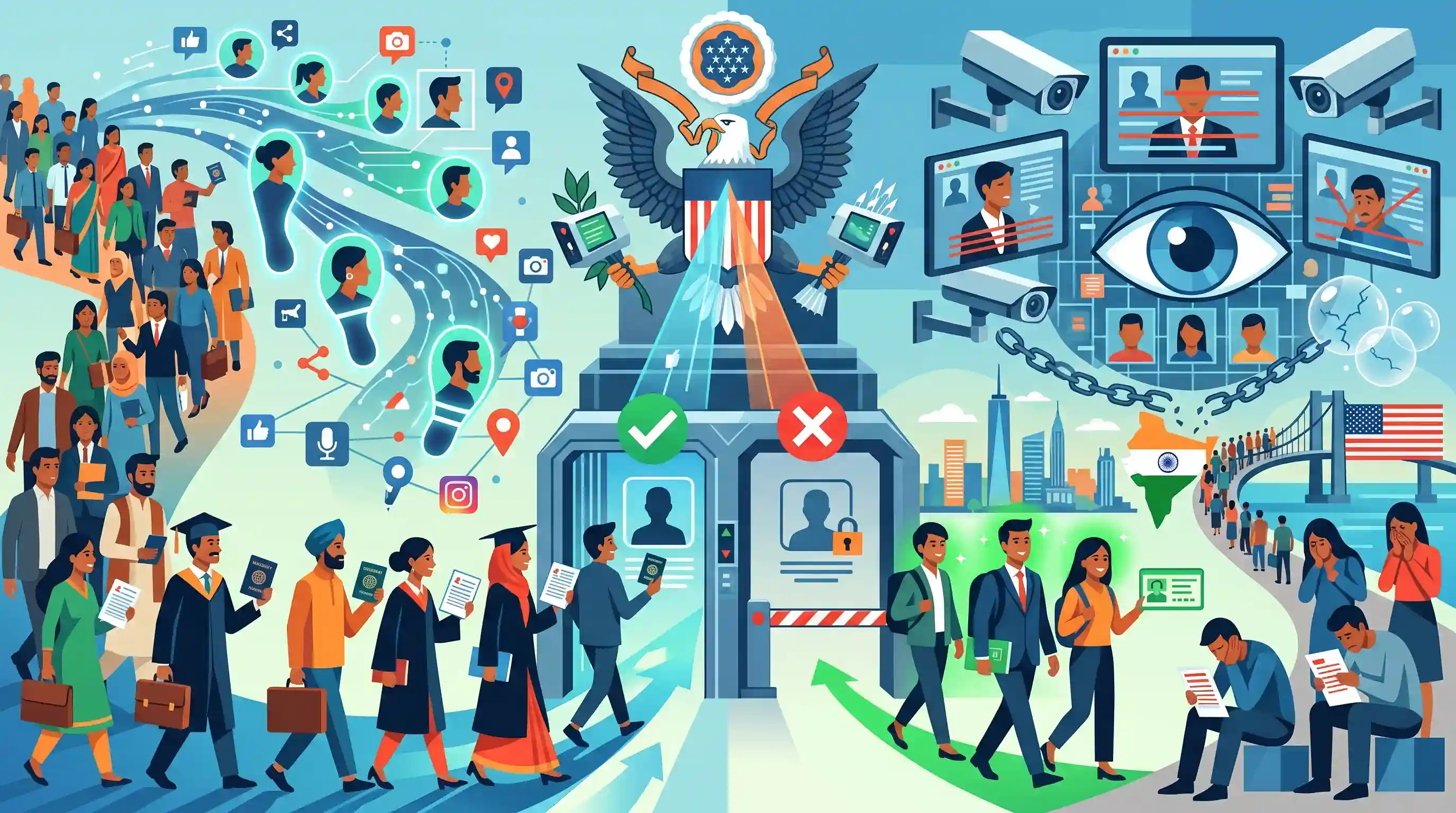
Starting March 30, 2026, the United States is enforcing sweeping new visa vetting rules that extend well beyond H-1B applicants to include a broader range of visa categories like K-1. The new mandate effectively establishes a 'No Public Social Media, No Visa' policy, requiring applicants to maintain a public social media profile to allow authorities to screen their digital footprints. While the US government frames this as a necessary step for national security and background verification, the policy raises significant concerns regarding digital privacy, surveillance, and freedom of speech. Given that India is one of the largest beneficiaries of US visas, this stringent vetting process is expected to have a profound impact on Indian professionals, students, and prospective immigrants, potentially complicating their mobility and altering their online behavior.
Key Points
- Starting March 30, 2026, the US is implementing stringent new visa vetting rules expanding beyond H-1B applicants.
- Under a 'No Public Social Media, No Visa' policy, applicants are mandated to maintain a public social media presence to facilitate background screening.
- The policy utilizes digital footprints and online public profiles to assess security risks, indicating a significant shift toward digital surveillance in immigration procedures.
- This move raises profound concerns regarding digital privacy, freedom of expression, and the potential for algorithmic biases or misinterpretation of social media activity.
- The stringent scrutiny will heavily impact the Indian diaspora, including professionals, students, and tourists, potentially leading to delays and higher visa rejection rates.
Important Terms
H-1B Visa

A non-immigrant visa allowing U.S. companies to employ foreign workers in 'specialty occupations' requiring technical expertise. Indian professionals constitute approximately 70% of all H-1B beneficiaries annually.
UPSC context
GS Paper 2 (International Relations/Indian Diaspora); tests policy impacts on Indian skilled migration and economic interests.
K-1 Visa
A 'fiancé visa' permitting a foreign national to enter the United States to marry their U.S. citizen sponsor within 90 days, often serving as a pathway to permanent residency.
UPSC context
GS Paper 2 (Indian Diaspora); relevant for family-based migration and people-to-people links between India and the U.S.
US Citizenship and Immigration Services (USCIS)
The federal agency within the U.S. Department of Homeland Security responsible for processing immigration and naturalization applications and managing domestic immigration benefits.
UPSC context
GS Paper 2 (Effect of policies of developed countries); tests awareness of institutional frameworks governing global mobility.
US Department of State
The U.S. federal executive department responsible for international relations and the issuance of visas through embassies and consulates worldwide.
UPSC context
GS Paper 2 (International Relations); focuses on the role of foreign departments in shaping global vetting standards.
Social Media Vetting
A security protocol (Online Presence Review) requiring visa applicants to disclose five years of social media handles and maintain public profiles for national security screening.
UPSC context
GS Paper 2 (Right to Privacy/Digital Surveillance); explores the intersection of national security and individual privacy.
Indian Diaspora
The community of Indian citizens living abroad and persons of Indian origin. As major visa recipients, they are directly impacted by changes in U.S. immigration vetting.
UPSC context
GS Paper 2 (Indian Diaspora); focuses on the welfare and interests of Indians settled abroad.
Prelims Trap
Mandatory social media screening of Indian citizens by the US violates their Right to Privacy under Article 21.
Fundamental Rights under the Indian Constitution are enforceable against the Indian State, not against foreign sovereign governments implementing their own domestic immigration laws.
Static Concepts Connected
What are the 4 modes of services trade under WTO GATS?
- Mode 1 (Cross-Border): Services supplied from one country to another without physical movement (e.g., telehealth, software services).
- Mode 2 (Consumption Abroad): Consumers traveling to another country to use a service (e.g., medical tourism, foreign education).
- Mode 3 (Commercial Presence): A service provider establishing a subsidiary or branch in another country (e.g., foreign bank branch).
- Mode 4 (Movement of Persons): Individuals temporarily traveling to another country to provide a service (e.g., IT professionals on H-1B).
What are the three tests for state restriction on privacy (Puttaswamy)?
- Legality: The restriction must be backed by a valid, existing legislative mandate.
- Need & Proportionality: It must serve a legitimate state aim, and the extent of interference must be proportionate to that aim.
- Procedural Safeguards: There must be adequate procedural mechanisms to prevent the abuse of state power.
Cross-Topic Patterns
GATS Mode 4 vs. National Security
Security vetting tools act as de facto non-tariff barriers, countering India's consistent WTO push for the frictionless movement of natural persons (Mode 4).
Algorithmic Bias in State Governance
Using AI for automated sentiment analysis bridges GS-3 technology concerns with GS-2 human rights, as algorithms can encode cultural or linguistic prejudices against applicants.

Expect a GS-2 question on how digital surveillance by developed nations acts as a non-tariff barrier for India's IT diaspora mobility.
Linked PYQs · 4
Linked PYQs · 4
- 2023MainsGS2
Indian diaspora has scaled new heights in the West. Describe its economic and political benefits for India.
- 2020MainsGS2
Indian diaspora has a decisive role to play in the politics and economy of America and European Countries'. Comment with examples.
- 2024MainsGS3
Social media and encrypting messaging services pose a serious security challenge. What measures have been adopted at various levels to address the security implications of social media? Also suggest any other remedies to address the problem.
- 2016MainsGS3
Use of Internet and social media by non-state actors for subversive activities is a major security concern. How have these been misused in the recent past? Suggest effective guidelines to curb the above threat.
