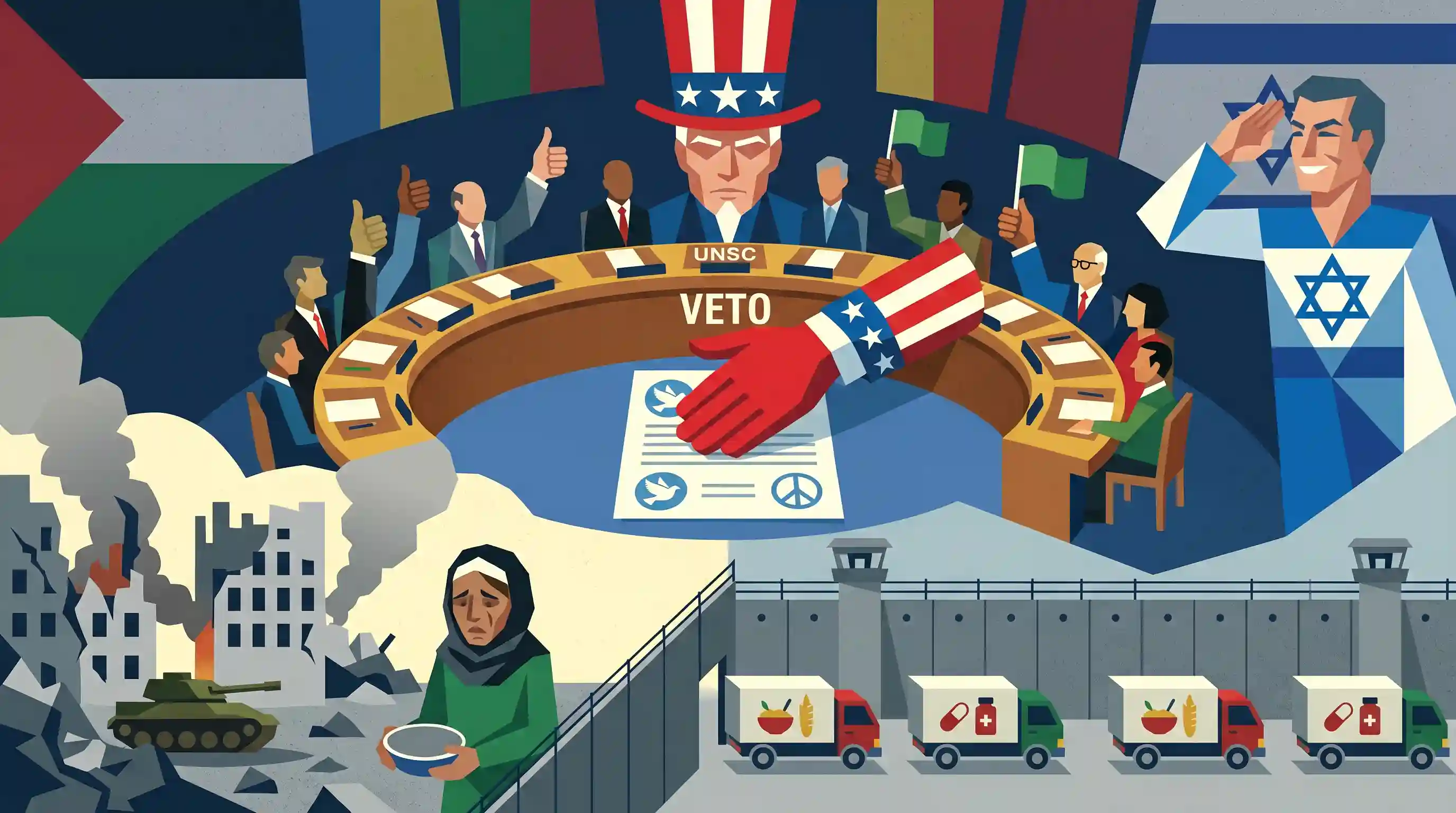
US vetoes UN Security Council resolution for immediate Gaza ceasefire
Source:Indian Express ↗
Why It Matters
The incident highlights the structural constraints of the United Nations Security Council, where the veto power of P5 nations often paralyses international peacekeeping and humanitarian efforts. This is directly relevant to UPSC discussions on UN structural reforms, the geopolitical divide shaping global diplomacy, and the ongoing complexities of the Israel-Palestine conflict.
Summary
The United States vetoed a UN Security Council resolution demanding an immediate and permanent ceasefire in the Israel-Hamas war in Gaza. Despite 14 other UNSC members voting in favor, the US cited the resolution's failure to demand the release of hostages or condemn Hamas as the reason for its veto. Israel welcomed the move, while the humanitarian crisis in Gaza continues to deteriorate amid blockades and ongoing military offensives.
Key Points
- The US vetoed a UN Security Council draft resolution calling for an immediate, unconditional, and permanent ceasefire in Gaza, while the other 14 member states voted in favor.
- US officials justified the veto by stating the resolution failed to link the ceasefire to the release of hostages and did not explicitly condemn Hamas or demand they disarm.
- Israel welcomed the US veto, with its envoy stating that an unconditional ceasefire would amount to a betrayal.
- The humanitarian situation in Gaza remains catastrophic, with nearly 2 million people facing famine following a recent 11-week Israeli blockade.
Important Terms
United Nations Security Council (UNSC)

A principal UN organ responsible for maintaining international peace and security. It consists of 15 members, including five permanent members (P5) and ten non-permanent members elected for two-year terms.
UPSC context
GS Paper-II: Important International institutions, agencies and fora—their structure, mandate. Tests understanding of global governance.
Veto Power
The power of any of the five permanent UNSC members to unilaterally block substantive resolutions. Originating from UN Charter Article 27, it requires 'concurring votes' for decision-making.
UPSC context
GS Paper-II: Issues related to UN reforms and India's claim for a permanent seat in the Council.
Hamas
A Palestinian Sunni-Islamic fundamentalist and militant organization that has governed the Gaza Strip since 2007. It is classified as a terrorist group by several nations, including the US and Israel.
UPSC context
GS Paper-II: International Relations; regional conflicts affecting global stability and India's interests in West Asia.
International Humanitarian Law (IHL)
A set of international rules, primarily the Geneva Conventions, established to limit the effects of armed conflict by protecting non-combatants and restricting methods of warfare.
UPSC context
GS Paper-II/IV: International law, human rights, and ethical conduct during war. Relevant for essay and ethics papers.
Two-State Solution
A proposed framework for resolving the Israel-Palestine conflict by establishing two independent states—Israel and Palestine—living side-by-side, typically based on the pre-1967 borders.
UPSC context
GS Paper-II: Bilateral and regional groupings; India’s long-standing foreign policy position on the Middle East peace process.
Prelims Trap
The UNGA can override a UNSC veto and pass binding resolutions using the Uniting for Peace resolution.
UNGA resolutions, even under Uniting for Peace, are strictly recommendatory. Only UNSC resolutions adopted under Chapter VII of the UN Charter are legally binding.
Static Concepts Connected
What is the UN General Assembly's 'Uniting for Peace' resolution?
- Origin: Passed in 1950 (Resolution 377 A) to bypass Soviet vetoes during the Korean War.
- Trigger: Invoked when the UNSC fails to exercise its primary responsibility for international peace due to a lack of unanimity among the P5.
- Authority: Empowers the UNGA to recommend collective measures, including armed force, though these recommendations remain legally non-binding.
How does the UN General Assembly's 'Veto Initiative' operate?
- Mandate: Adopted in 2022 (Resolution 76/262) to increase the transparency and accountability of permanent members.
- Mechanism: Automatically triggers a UNGA meeting within 10 working days of any veto being cast in the UNSC.
- Obligation: Forces the vetoing state to publicly explain its decision, though it does not give the UNGA power to overturn the veto itself.
Cross-Topic Patterns
P5 Gridlock & India's G4 Agenda
The recurring paralysis of the UNSC over Gaza and Ukraine directly bolsters the G4 demand (India, Japan, Brazil, Germany) for urgent UN structural reforms to reflect contemporary geopolitical realities.
IHL vs. Security Council Politics
Blockades leading to famine invoke the Fourth Geneva Convention, contrasting legally mandated civilian protection under IHL against the geopolitical realities of P5 vetoes in the UN Security Council.

Expect a 2026 Prelims statement contrasting binding UNSC resolutions with recommendatory UNGA 'Uniting for Peace' interventions.
Linked PYQs · 2
Linked PYQs · 2
- 2025MainsGS2
"The reform process in the United Nations remains unresolved, because of the delicate imbalance of East and West and entanglement of the USA vs. Russo-Chinese alliance.” Examine and critically evaluate the East-West policy confrontations in this regard.
- 2009PrelimsGS1
The Security Council of UN consists of 5 permanent members, and the remaining 10 members are elected by the General Assembly for a term of
