Geopolitical Impact of US Sanctions on India Venezuela Trade
Source:The Hindu ↗
Why It Matters
This highlights how unilateral US sanctions and secondary sanction threats (like CAATSA, or Venezuela-specific sanctions) directly reshape India's energy procurement and bilateral trade strategies. It also provides crucial factual data for Prelims regarding global oil reserve distribution (Venezuela holding the world's largest reserves).
Summary
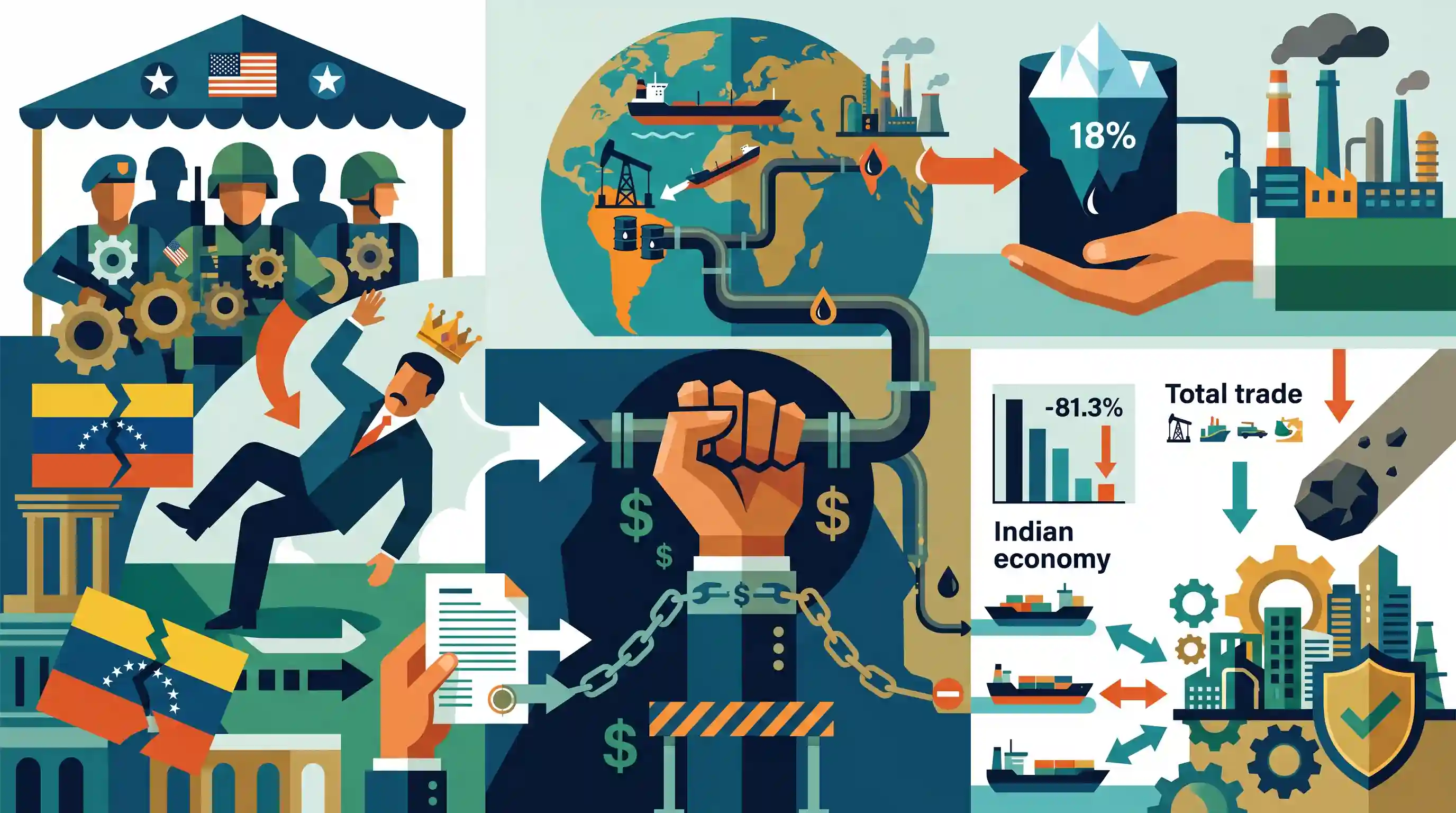
A recent report by the Global Trade Research Initiative (GTRI) stated that the recent US military action in Venezuela, resulting in the capture of President Nicolas Maduro, will not significantly affect India's trade or energy security. Historically a major buyer of Venezuelan oil—which constitutes 18% of the world's proven reserves—India scaled back its imports dramatically since 2019 to avoid US secondary sanctions. Consequently, crude imports plunged by 81.3% in FY2025, bringing the total bilateral trade down to negligible levels and insulating the Indian economy from the current political shock in Caracas.
Key Points
- The Global Trade Research Initiative (GTRI) noted that the US military intervention in Venezuela and capture of President Nicolas Maduro will have negligible impact on India's overall trade.
- India's bilateral trade with Venezuela had already collapsed largely due to US sanctions; in FY2025, India's crude oil imports from Venezuela dropped by 81.3%.
- Although Venezuela possesses roughly 18% of the world's proven oil reserves—surpassing Saudi Arabia—fears of US secondary sanctions led Indian refiners to drastically scale down purchases since 2019.
- In FY2025, India's total imports from Venezuela were minimal at $364.5 million, while exports to Venezuela, predominantly pharmaceuticals, stood at $95.3 million.
Important Terms
Global Trade Research Initiative (GTRI)

A New Delhi-based trade think tank providing data-driven analysis on India's export-import trends, trade policy, and the geopolitical impact on national economic interests.
UPSC context
GS-III (Economy): Tests knowledge of influential domestic institutions analyzing trade and economic trends affecting India's external sector.
Energy Security
The uninterrupted availability of energy sources at an affordable price, ensuring that national development and social stability are not disrupted by global supply shocks.
UPSC context
GS-III (Infrastructure/Energy): A core theme regarding India's dependence on crude imports and the importance of source diversification.
Secondary Sanctions
Extraterritorial penalties imposed by a nation (e.g., USA) on third-party foreign entities to discourage them from transacting with a country already under primary sanctions.
UPSC context
GS-II (International Relations): Crucial for analyzing challenges to India's strategic autonomy and the impact of Western policy on Indian trade.
US Sanctions
Economic and trade penalties used by the U.S. government to achieve foreign policy goals, often impacting global trade routes and Indian energy procurement.
UPSC context
GS-II (International Relations): Important for understanding how the domestic policies of developed nations affect India's bilateral interests.
Proven Reserves
The estimated quantity of natural resources that geological and engineering data demonstrate with reasonable certainty to be recoverable under existing economic conditions.
UPSC context
GS-I (Geography): Relevant for understanding the global distribution of resources and the geopolitics of energy-rich nations.
Strategic Autonomy
A nation's ability to pursue its own national interests and foreign policy without being constrained or coerced by other global powers.
UPSC context
GS-II (Foreign Policy): A central pillar of Indian diplomacy, particularly when balancing relations with the US and sanctioned energy partners.
Prelims Trap
Saudi Arabia holds the world's largest proven crude oil reserves.
Venezuela actually holds the largest proven oil reserves globally (~18%), surpassing Saudi Arabia, even though its actual production is severely limited by infrastructure decay and sanctions.
Static Concepts Connected
What are "Secondary Sanctions" and how do they function globally?
- Extraterritoriality: They apply extraterritorially to non-US citizens or entities that trade with a sanctioned country, essentially penalizing third parties.
- Financial Leverage: They work by threatening to cut off the violating foreign entity from the US financial system and access to the US dollar.
- Impact on India: These sanctions forced India to drastically cut or halt its oil imports from nations like Iran (post-JCPOA withdrawal) and Venezuela.
Why is Venezuela's oil production low despite having the largest reserves?
- Heavy Crude: Most of its reserves in the Orinoco belt are extra-heavy crude, requiring specialized, expensive refining and imported diluents to process and transport.
- Sanctions: US secondary sanctions have severely restricted access to modern extraction technology, global markets, and necessary foreign investment.
- Domestic Crisis: Hyperinflation and the mismanagement of the state-owned oil company (PDVSA) led to massive capital flight and infrastructure decay.
Cross-Topic Patterns
Russian vs. Venezuelan Sanctions
While India defied pressure to buy Russian oil post-Ukraine, it complied with US sanctions on Venezuela and Iran, highlighting selective strategic autonomy based on alternative payment mechanisms.
Pharma as a resilient export
Even amidst collapsing hydrocarbon trade and severe US sanctions, Indian generic pharmaceuticals remain the dominant, resilient export to crisis-hit Latin American nations like Venezuela.

Expect a geography matching question on global oil reserves (Venezuela > Saudi Arabia) paired with a statement on secondary sanctions.
Linked PYQs · 2
Linked PYQs · 2
- 2024PrelimsGS1
Consider the following statements : Statement-I : Recently, Venezuela has achieved a rapid recovery from its economic crisis and succeeded in preventing its people from fleeing/emigrating to other countries. Statement-II : Venezuela has the world's largest oil reserves. Which one of the following is correct in respect of the above statements?
- 2012MainsGS2
How have the US sanctions against Iran affected India's bilateral relations with Iran?
