तेल की भू-राजनीति और विदेशी सत्ता परिवर्तन अभियानों की सीमाएं
स्रोत:इंडियन एक्सप्रेस ↗
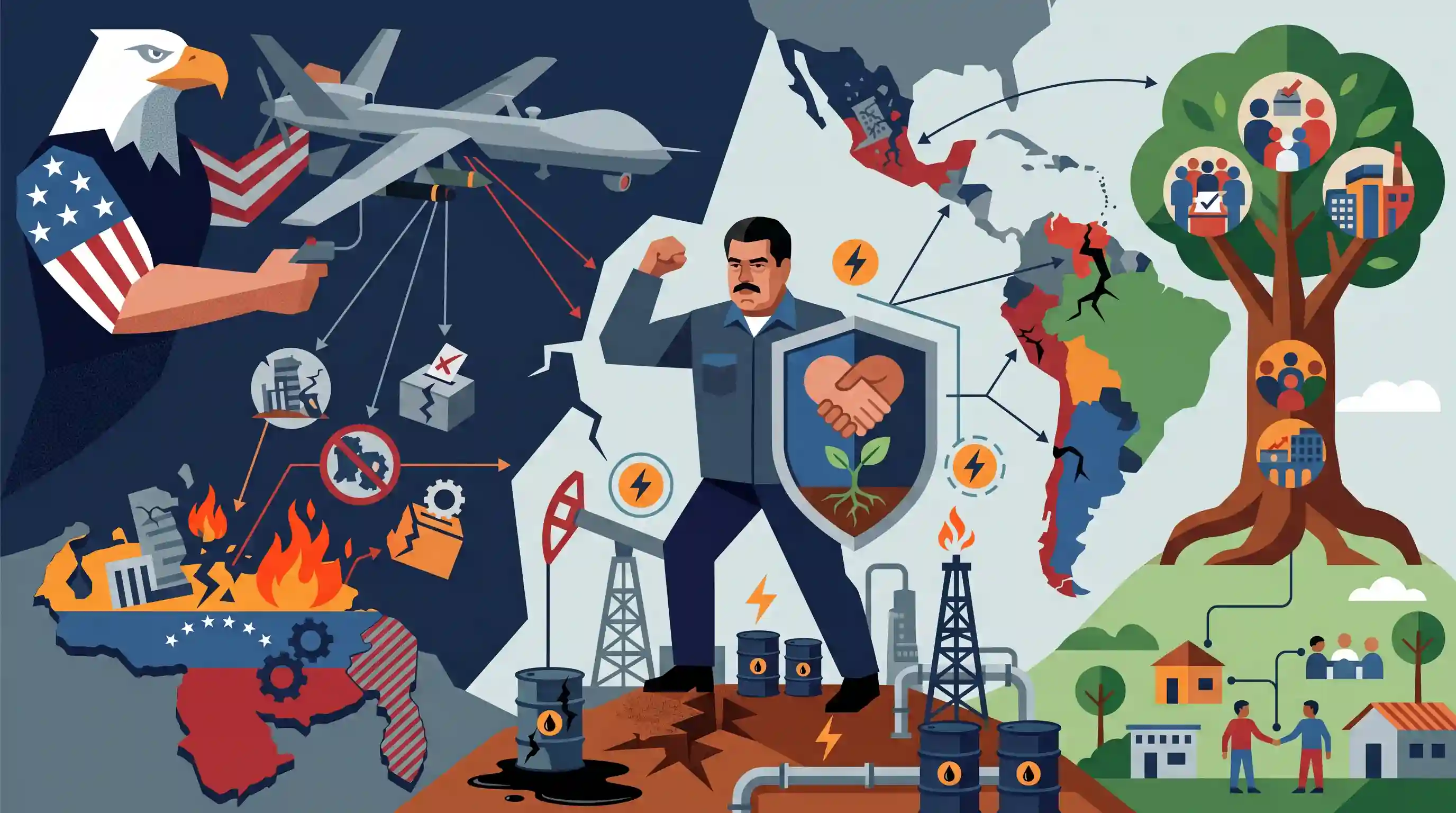
क्यों मायने रखता है
अमेरिकी हस्तक्षेपवादी नीतियों और लोकतंत्रीकरण जैसे राजनीतिक परिणामों को प्राप्त करने में 'हार्ड पावर'/तकनीक की सीमाओं का आलोचनात्मक मूल्यांकन प्रदान करता है। यह अंतर्राष्ट्रीय संबंधों (International Relations) के उत्तरों के लिए एक प्रमुख केस स्टडी के रूप में कार्य करता है, जो मानवाधिकारों/लोकतंत्र के प्रसार, संप्रभु राष्ट्रवाद और ऊर्जा भू-राजनीति (energy geopolitics) के बीच टकराव का विश्लेषण करते हैं।
सारांश
The article critiques the US's continued reliance on military technology and covert operations, such as drone strikes, to force regime change and promote democracy abroad, specifically analyzing the context of US-Venezuela relations under the Trump administration and Nicolas Maduro. It argues that external military coercion fails to establish genuine democratic institutions and often exacerbates instability, especially in resource-rich nations like Venezuela where oil geopolitics complicate diplomatic relations. The persistence of the Maduro regime illustrates the limits of US interventionism and the necessity of internal political processes over external force.
मुख्य बिंदु
- The article critiques the US's historical and ongoing reliance on military technology, such as drone strikes or covert actions, to force regime change under the guise of democracy promotion.
- अमेरिका के तीव्र दबाव और प्रतिबंधों के बावजूद—विशेष रूप से ट्रंप प्रशासन के दौरान—निकोलस मदुरो ने वेनेजुएला में सत्ता बरकरार रखी है, जो बाहरी दबाव (external coercion) की अप्रभावीता को रेखांकित करता है।
- Venezuela remains a crucial geopolitical hotspot primarily due to its status as possessing the world's largest proven oil reserves, complicating the motives behind foreign intervention.
- वास्तविक लोकतांत्रिक संक्रमण के लिए ऊपर से थोपे गए, बाहरी सैन्य या तकनीकी हस्तक्षेप के बजाय आंतरिक, जमीनी स्तर की राजनीतिक प्रक्रियाओं और आम सहमति की आवश्यकता होती है।
- The resilience of the Maduro regime underscores the limits of US interventionism and points to a global shift toward sovereign nationalism resisting foreign interference.
महत्वपूर्ण शब्द
मोनरो सिद्धांत

19वीं शताब्दी की एक अमेरिकी नीति जो अमेरिकी महाद्वीप में यूरोपीय उपनिवेशवाद का विरोध करती थी; ऐतिहासिक रूप से इसका उपयोग लातिन अमेरिकी मामलों में अमेरिकी हस्तक्षेपवाद और क्षेत्रीय प्रभुत्व को न्यायोचित ठहराने के लिए किया गया है।
UPSC context
GS-II (International Relations); relevant for understanding the historical underpinnings of US foreign policy in the Western Hemisphere.
सत्ता परिवर्तन
The replacement of one government or administration by another, often through external military, political, or covert intervention rather than internal democratic processes.
UPSC context
GS-II (International Relations); tests understanding of global power dynamics, interventionism, and the limits of external democratic promotion.
Economic Sanctions
Commercial and financial penalties applied by one or more countries against a target state, group, or individual to influence policy or coerce behavioral change.
UPSC context
GS-II (International Relations); essential for analyzing non-military coercion and its impact on bilateral relations and global trade.
Geopolitics of Energy
ऊर्जा संसाधनों—विशेष रूप से तेल और गैस—के उत्पादन, वितरण और उपभोग किस प्रकार अंतरराष्ट्रीय राजनीति, शक्ति संरचनाओं और सुरक्षा को प्रभावित करते हैं, इसका अध्ययन।
UPSC context
GS-I (Resources) and GS-II (IR); crucial for understanding conflicts and diplomatic strategies in resource-rich regions.
पेट्रो-राज्य
A nation whose economy and government revenue are heavily dependent on the export of oil or natural gas, often characterized by centralized power and economic volatility.
UPSC context
GS-I (Resources) and GS-III (Economy); relates to the "resource curse" and economic vulnerabilities of resource-dependent nations.
Sovereignty
The supreme authority of a state to govern its territory and people without external interference; a foundational principle of modern international law and the UN Charter.
UPSC context
GS-II (राजव्यवस्था और IR); अहस्तक्षेप बनाम मानवीय हस्तक्षेप से संबंधित बहसों के लिए महत्वपूर्ण।
प्रारंभिक ट्रैप
Venezuela is the largest producer of crude oil globally due to its massive reserves.
Aspirants confuse reserves with production. Venezuela holds the largest proven reserves (Orinoco Belt) but accounts for less than 1% of actual global production due to crippling sanctions and domestic instability.
संबंधित अवधारणाएँ
वेनेजुएला के पेट्रोलियम भूविज्ञान और भूगोल को क्या अद्वितीय रूप से महत्वपूर्ण बनाता है?
- ओरिनोको बेल्ट: A massive territory in central Venezuela holding the world's largest deposits of extra-heavy crude and bitumen, requiring complex, capital-intensive refining.
- Geostrategic Borders: Bounded by the Caribbean Sea (north), Colombia (west), Brazil (south), and Guyana (east), making it a strategic maritime and continental choke point in Latin America.
How do unilateral sanctions differ from UN sanctions in International Law?
- Unilateral Sanctions: Coercive economic measures deployed by individual states (like the US) without a UN Security Council mandate, often criticized as infringing on sovereignty.
- संयुक्त राष्ट्र का जनादेश: Only sanctions authorized under Chapter VII of the UN Charter are universally binding under international law, whereas unilateral sanctions rely on the enforcer's financial hegemony.
अंतर-विषय पैटर्न
संसाधन अभिशाप और लोकतांत्रिक अभाव
Venezuela exemplifies the paradox of plenty, where abundant oil wealth centralizes state power, undermines democratic institutions, and invites intervention, creating deep economic fragility.
Sanctions driving De-dollarization networks
Heavy US sanctions on energy-rich nations (Venezuela, Iran, Russia) inadvertently accelerate the Global South's push towards de-dollarization and alternate payment mechanisms to protect sovereign trade.

Expect a 2026 Prelims map question on Venezuela's borders (Caribbean, Essequibo dispute) or a Mains Q on the energy resource curse.
संबद्ध PYQ · 3
संबद्ध PYQ · 3
- 2024PrelimsGS1
Consider the following statements : Statement-I : Recently, Venezuela has achieved a rapid recovery from its economic crisis and succeeded in preventing its people from fleeing/emigrating to other countries. Statement-II : Venezuela has the world's largest oil reserves. Which one of the following is correct in respect of the above statements?
- 2025MainsGS2
"With the waning of globalization, post-Cold War world is becoming a site of sovereign nationalism.” Elucidate.
- 2025MainsGS2
"Energy security constitutes the dominant kingpin of India's foreign policy, and is linked with India's overarching influence in Middle Eastern countries.” How would you integrate energy security with India's foreign policy trajectories in the coming years?
