United States Energy Security Objectives and Intervention in Venezuela
Source:Indian Express ↗
Why It Matters
Provides a clear, real-world example of energy security and the Monroe Doctrine driving great power interventionism. It is highly relevant for GS2 IR answers concerning changing US foreign policy, global energy geopolitics, and the shift toward hard realism in international relations.
Summary
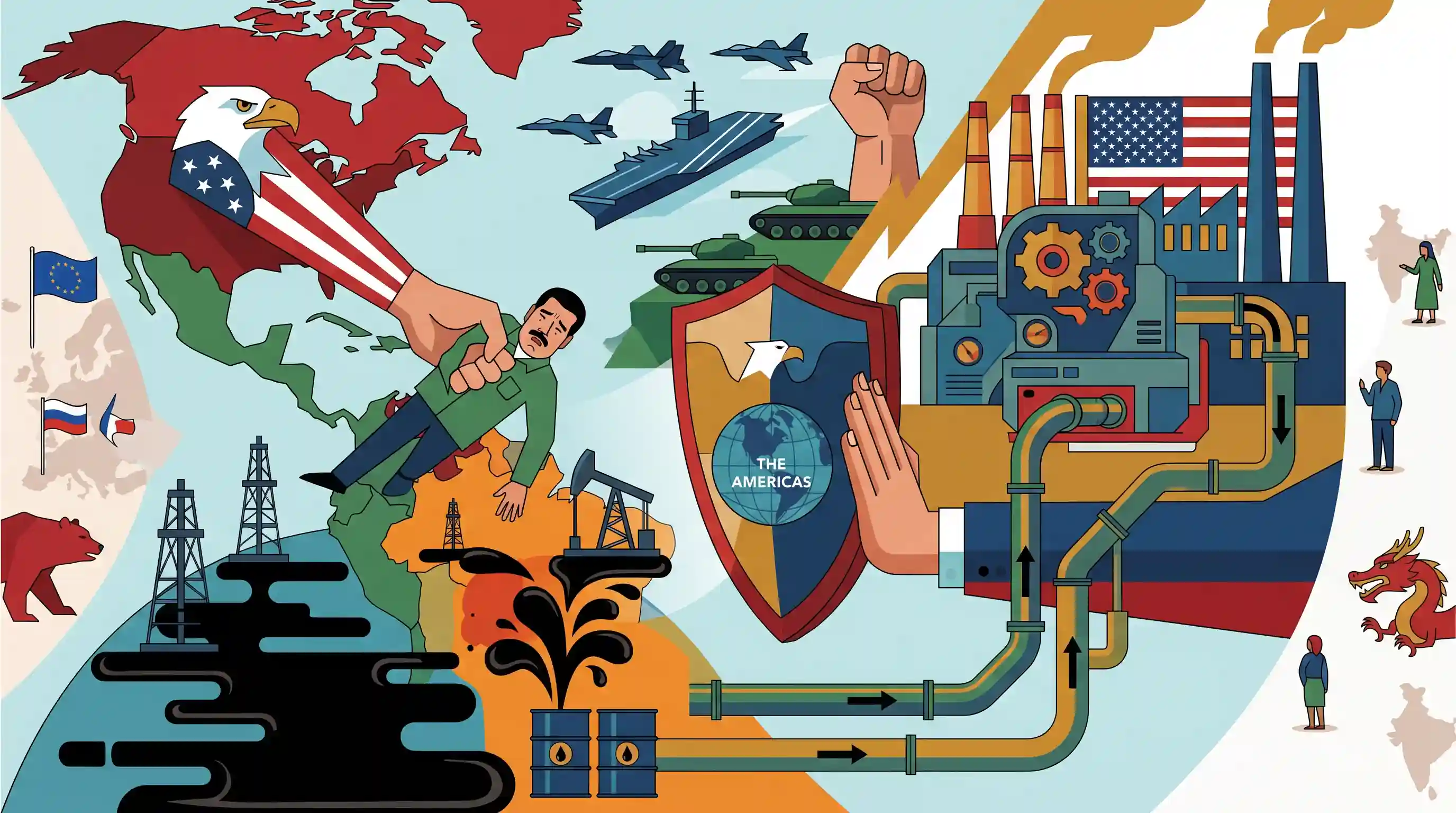
US Vice President JD Vance linked the capture of Venezuelan President Nicolas Maduro to the objective of securing control over Venezuela's extensive natural resources, particularly its oil reserves. Emphasizing the necessity of high-quality, low-cost energy for American industry, Vance highlighted energy security as a core driver of US foreign policy. His remarks implicitly revived the Monroe Doctrine by asserting absolute US dominance in Latin America. The intervention is framed not just as regime change, but as a demonstration of American military strength and an assertion of unipolar regional hegemony.
Key Points
- US Vice President JD Vance explicitly stated that a primary motivation for capturing Venezuelan President Nicolas Maduro is to secure control over Venezuela's vast natural resources, particularly its oil reserves.
- Vance highlighted the critical role of energy security, arguing that the US needs access to high-quality, low-cost energy to maintain its economic and industrial dominance.
- The remarks implicitly invoked the 200-year-old Monroe Doctrine, asserting that the United States must 'call the shots' in its own neighbourhood.
- The statements reflect a highly realist and transactional shift in US foreign policy, prioritizing resource extraction and regional hegemony over ideological narratives of democracy promotion.
Important Terms
Monroe Doctrine

A 1823 US policy opposing European colonialism and interference in the Americas. It asserts the Western Hemisphere as a distinct US sphere of influence, often cited to justify regional interventions.
UPSC context
GS-II: International Relations. Tests understanding of historical US foreign policy and its contemporary application in regional geopolitics and hegemony.
Energy Security
The uninterrupted availability of energy sources at an affordable price. It includes physical availability, infrastructure accessibility, and economic affordability, often serving as a primary driver of modern foreign policy.
UPSC context
GS-II/III: International Relations & Energy. Tests awareness of resource geopolitics and the impact of energy dependencies on national interests.
Regime Change
The forcible or coercive replacement of a sovereign government with another, typically by an external power. It often involves the transformation of a nation's political, administrative, and institutional structures.
UPSC context
GS-II: International Relations. Relevant for analyzing sovereignty, international law violations, and the impacts of foreign intervention on global stability.
Unipolarity
A global distribution of power where a single nation exercises dominant military, economic, and cultural influence. It implies a lack of significant competitors to the leading superpower's hegemony.
UPSC context
GS-II: International Relations. Tests knowledge of world order shifts, hegemonic stability theory, and the transition toward multipolarity in modern geopolitics.
Oil Nationalization
The process by which a government takes control of privately owned petroleum assets. In Venezuela, this involved transferring US corporate oil infrastructure to state ownership under Hugo Chávez.
UPSC context
GS-III: Economy & Investment. Tests understanding of sovereign risks, resource nationalism, and the impact of asset expropriation on international trade relations.
Narcoterrorism
The use of drug trafficking profits to fund terrorist activities or maintain political power through violence. US officials cited this as a legal justification for intervening in Venezuela.
UPSC context
GS-III: Internal Security. Relevant for studying the nexus between organized crime and terrorism and its role in justifying international interventions.
Prelims Trap
"Venezuela is the largest producer of crude oil in the world."
Venezuela holds the world's largest *proven reserves*, but its actual *production* is extremely low due to sanctions and economic collapse. The US is the top producer.
Static Concepts Connected
What is the Monroe Doctrine and how does it shape US foreign policy?
- 1823 Origin: Declared in 1823, it warned European powers against colonizing or interfering in the Western Hemisphere, establishing it as a US sphere of influence.
- Roosevelt Corollary: Added later to justify direct US military intervention in Latin American nations to maintain regional stability and protect American economic interests.
- Regional Hegemony: Modern US administrations periodically revive its underlying premise to counter extra-regional influence (like China or Russia) in the Americas.
What is the 'Resource Curse' (Paradox of Plenty) in economic geography?
- The Paradox: A paradox where countries with abundant natural resources (like oil) experience slower economic growth, worse governance, and less stability than resource-poor countries.
- Dutch Disease: Resource exports inflate the local currency, making other sectors like agriculture and manufacturing uncompetitive on the global market.
- Venezuelan Example: Massive oil wealth led to extreme over-reliance, making the economy highly vulnerable to oil price crashes and institutional mismanagement.
Cross-Topic Patterns
US Sanctions & India's Energy Pivot
India's oil imports from Venezuela plummeted after 2019 US sanctions. This forced India to pivot to Russia and the Middle East, highlighting developing nations' vulnerability to unilateral extraterritorial sanctions.
Return of Realpolitik in US Policy
Vance's open admission of resource-capture marks a sharp shift from liberal interventionism (democracy promotion) to classical realism and transactional diplomacy, impacting how middle powers negotiate with the US.

Expect a 2026 Prelims multi-statement question contrasting top global oil 'reserves' (Venezuela) versus top 'producers' (USA/Saudi Arabia).
Linked PYQs · 3
Linked PYQs · 3
- 2024PrelimsGS1
Consider the following statements : Statement-I : Recently, Venezuela has achieved a rapid recovery from its economic crisis and succeeded in preventing its people from fleeing/emigrating to other countries. Statement-II : Venezuela has the world's largest oil reserves. Which one of the following is correct in respect of the above statements?
- 2025MainsGS2
"Energy security constitutes the dominant kingpin of India's foreign policy, and is linked with India's overarching influence in Middle Eastern countries.” How would you integrate energy security with India's foreign policy trajectories in the coming years?
- 2025MainsGS2
"The reform process in the United Nations remains unresolved, because of the delicate imbalance of East and West and entanglement of the USA vs. Russo-Chinese alliance.” Examine and critically evaluate the East-West policy confrontations in this regard.
