US Diplomatic Intervention in India Pakistan Border Tensions
Source:The Hindu ↗
Why It Matters
This event underscores the enduring volatility of India-Pakistan relations driven by cross-border terrorism. It also highlights the geopolitical dynamics of South Asia, specifically the role of external powers like the United States in crisis mediation, which is a frequent theme in UPSC GS2 (International Relations) and GS3 (Internal Security).
Summary
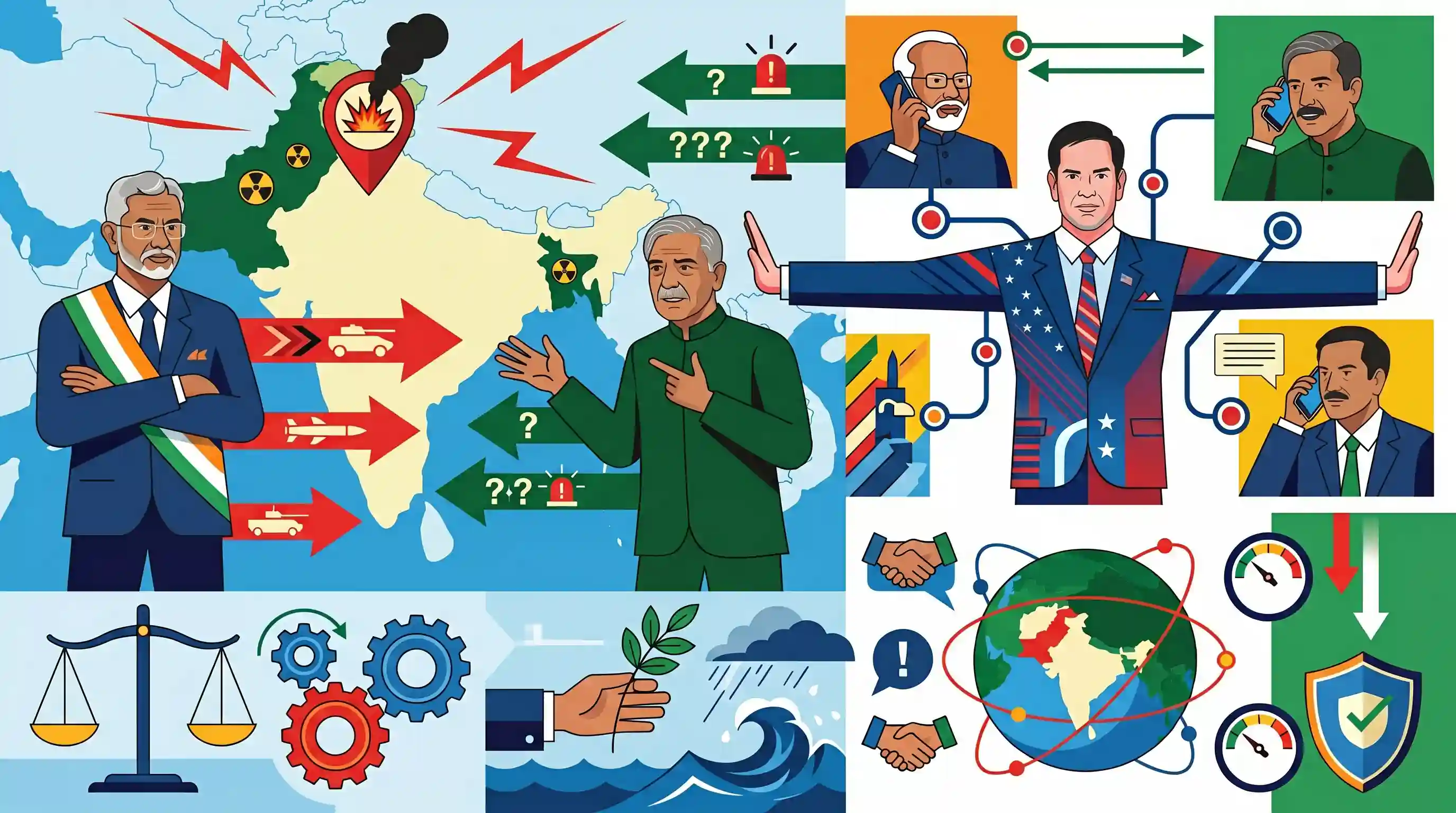
Following the deadly terror attack in Pahalgam, the United States has intervened diplomatically to prevent military escalation between India and Pakistan. U.S. Secretary of State Marco Rubio engaged directly with India's EAM S. Jaishankar and Pakistan's PM Shehbaz Sharif. The intervention came amidst claims by Pakistani officials of an impending Indian military strike. The U.S. State Department reiterated its focus on diplomacy and crisis management, highlighting the strategic role of the U.S. in maintaining stability in nuclear-armed South Asia.
Key Points
- The United States initiated high-level diplomatic efforts to de-escalate tensions between India and Pakistan following the Pahalgam terror attack.
- U.S. Secretary of State Marco Rubio held direct talks with India's External Affairs Minister S. Jaishankar and Pakistan's Prime Minister Shehbaz Sharif.
- Tensions escalated after Pakistan's Defence and Information Ministers claimed intelligence inputs of an imminent military strike by India.
- The U.S. State Department emphasized the importance of diplomacy and keeping lines of communication open to prevent a regional conflict in South Asia.
Important Terms
De-escalation

The reduction of intensity or magnitude of a military or political conflict through diplomatic interventions, communication, or reciprocal actions to prevent all-out war.
UPSC context
GS Paper 2: International Relations. Tests understanding of conflict resolution and peace-building mechanisms in regional security.
Track I Diplomacy
Conducting formal, official government-to-government interactions, such as talks between foreign ministers, to manage international relations and resolve high-stakes crises.
UPSC context
GS Paper 2: International Relations. Crucial for understanding formal diplomatic channels and executive-level engagement.
Strategic Autonomy
The ability of a nation to pursue its own foreign policy and national interests without being forced into alliances or dictated to by external powers.
UPSC context
GS Paper 2. Core tenet of India's foreign policy; tests knowledge of India's stance against third-party mediation.
U.S. State Department
The federal executive department responsible for carrying out U.S. foreign policy and international relations, often acting as a mediator in South Asian geopolitical crises.
UPSC context
GS Paper 2: Effect of policies of developed countries. Tests understanding of external state actors' influence on Indian interests.
Ministry of External Affairs (MEA)
The Indian government agency responsible for the conduct of foreign relations, implementing the 'Neighbourhood First' policy and managing bilateral ties with Pakistan.
UPSC context
GS Paper 2: Institutional framework. Fundamental for questions on India's diplomatic architecture and foreign policy execution.
Crisis Management
Systematic efforts to defuse sudden, high-intensity tensions between states, especially nuclear-armed ones, to prevent unintended escalation to conventional or nuclear warfare.
UPSC context
GS Paper 2 & 3: International Relations and Security. Tests ability to analyze stability in volatile regions like South Asia.
Cross-border Terrorism
The act of a state or non-state actor based in one country carrying out terrorist activities in another, frequently involving infiltration across international borders.
UPSC context
GS Paper 3: Internal Security. Central to India-Pakistan relations and challenges to internal security in J&K.
Prelims Trap
"The UN or third parties are mandated to mediate if bilateral negotiations fail."
The 1972 Shimla Agreement binds India and Pakistan to resolve differences strictly through bilateral negotiations, legally rejecting formal third-party or UN mediation.
Static Concepts Connected
What is the significance of the 1972 Shimla Agreement in Indo-Pak relations?
- Strict Bilateralism: Commits both countries to resolve disputes peacefully and exclusively through bilateral negotiations, rejecting external mediation.
- LoC Formalization: Converted the 1949 UN Ceasefire Line in Jammu and Kashmir into the officially recognized Line of Control (LoC).
- Mutual Respect: Obligates both nations to respect each other's territorial integrity and abstain from the threat or use of force.
How does 'brokered bargaining' function in South Asian nuclear deterrence?
- Manufactured Escalation: A state intentionally raises the risk of conventional or nuclear escalation during a crisis to alarm the international community.
- Catalyzing Intervention: The primary goal is to force global powers (like the US) to intervene diplomatically and restrain the adversary.
Cross-Topic Patterns
Info-warfare as a crisis catalyst
State-sponsored disinformation (like faking an imminent strike) is increasingly weaponized to force international mediation, linking GS-3 cyber/media threats directly to GS-2 geopolitics.
US "De-hyphenation" policy tested
While the US officially de-hyphenates India and Pakistan in broad foreign policy, active military standoffs often force a temporary re-hyphenation to maintain regional nuclear stability.

2026 prelims will likely test the Shimla Agreement's bilateralism clause against US/UN mediation roles in a multi-statement IR question.
Linked PYQs · 4
Linked PYQs · 4
- 2015MainsGS2
Terrorist activities and mutual distrust have clouded India-Pakistan relations. To what extent the use of soft power like sports and cultural exchanges could help generate goodwill between the two countries? Discuss with suitable examples.
- 2016MainsGS2
Increasing cross-border terrorist attacks in India and growing interference in the internal affairs of several member-states by Pakistan are not conducive for the future of SAARC (South Asian Association for Regional Cooperation)." Explain with suitable examples.
- 2019MainsGS2
‘What introduces friction into the ties between India and the United States is that Washington is still unable to find for India a position in its global strategy, which would satisfy India's national self-esteem and ambitions.’ Explain with suitable examples.
- 2021MainsGS3
Analyse the complexity and intensity of terrorism, its causes, linkages and obnoxious nexus. Also suggest measures required to be taken to eradicate the menace of terrorism.
