Geneva Talks and the Evolving Russia-Ukraine Peace Framework
Source:The Hindu ↗
Why It Matters
The evolution of the Russia-Ukraine peace plan highlights the complex diplomatic negotiations required to balance territorial sovereignty against geopolitical realities. Understanding these peace frameworks, the U.S.'s mediation role, and the implications of NATO expansion is critical for analyzing modern conflict resolution and its impact on the global security architecture.
Summary
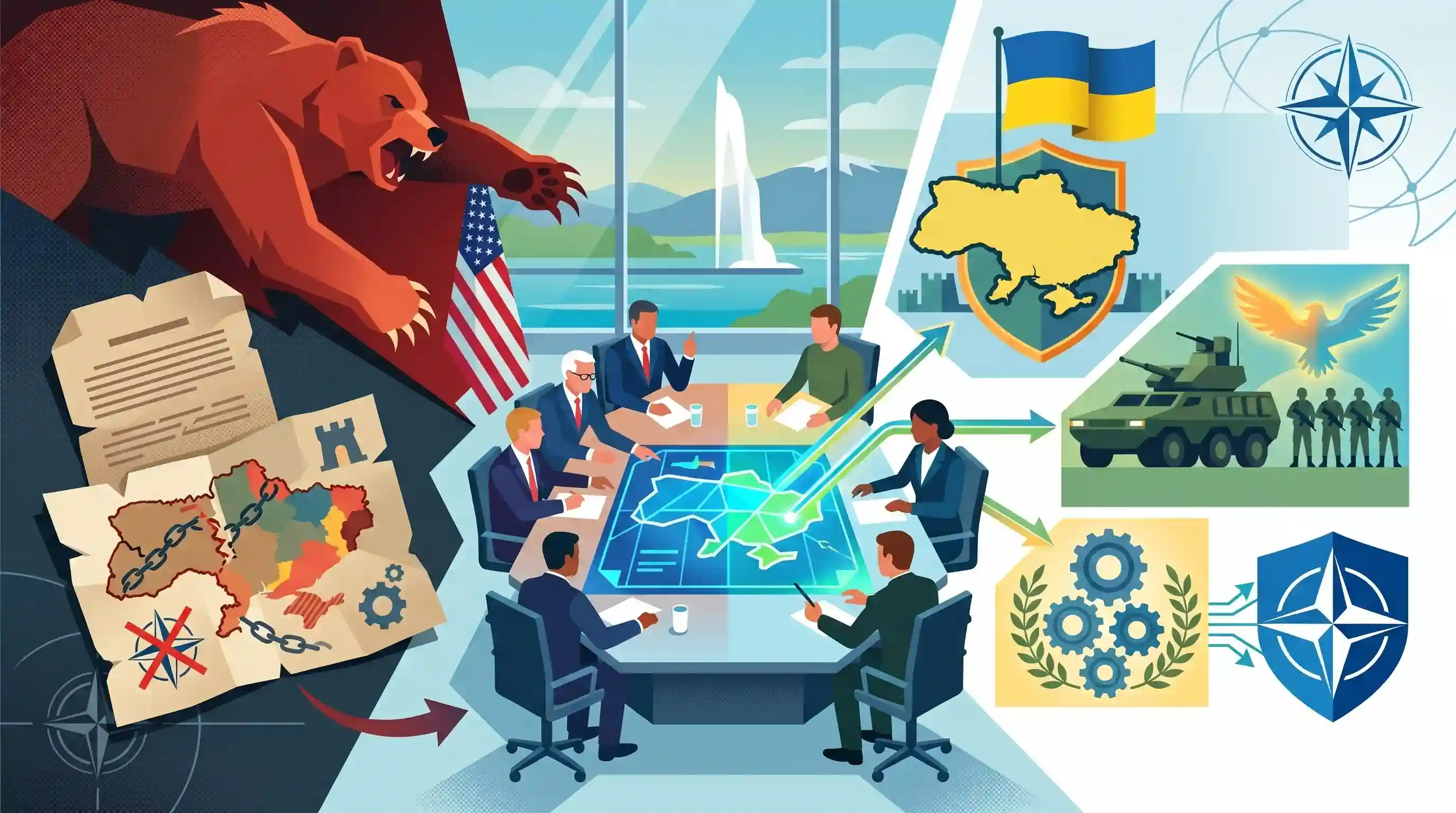
U.S. and Ukrainian officials met in Geneva to refine a 'peace framework' aimed at ending the Russia-Ukraine war. The diplomatic discussions updated a controversial 28-point draft plan that initially favored Russian demands, including Ukraine ceding territory, reducing its military, and abandoning NATO aspirations. Both sides described the meeting as a significant step forward, emphasizing that any final agreement must deliver a sustainable peace and fully uphold Ukraine's sovereignty and security.
Key Points
- U.S. Secretary of State Marco Rubio and Ukrainian Chief of Staff Andriy Yermak led talks in Geneva to negotiate a peace framework for the Russia-Ukraine war.
- The discussions successfully updated an initial 28-point draft that had controversially included major concessions to Moscow.
- The original hardline Russian demands involved Ukraine ceding territory, reducing its armed forces, and pledging never to join NATO.
- Both U.S. and Ukrainian delegations emphasized meaningful progress toward a just agreement that upholds Ukraine's sovereignty and territorial integrity.
- The U.S. reaffirmed its commitment to keeping Ukraine's security and future prosperity central to the diplomatic process.
Important Terms
28-Point Peace Plan

A 2025 US-proposed framework aimed at ending the Russia-Ukraine war; initially controversial for requiring Ukrainian territorial concessions, military caps, and NATO exclusion.
UPSC context
GS Paper 2: International Relations. Relevant for understanding diplomatic conflict resolution and the role of major powers in regional security frameworks.
Geneva Peace Framework
The diplomatic process involving US, Ukrainian, and European officials in Geneva to refine peace terms, balancing Russian demands with Ukraine's national security and sovereignty.
UPSC context
GS Paper 2: International Relations. Illustrates multilateral diplomacy and the use of neutral venues for conflict mediation.
Sovereignty and Territorial Integrity
The legal principle that a state has exclusive authority over its territory; a core Ukrainian demand in peace negotiations to prevent permanent loss of occupied regions.
UPSC context
GS Paper 2: International Relations. Fundamental concept in international law and the UN Charter often tested regarding global conflicts.
Security Guarantees
Legally binding commitments by powerful nations to protect a state from future aggression; a critical requirement for Ukraine in exchange for staying out of NATO.
UPSC context
GS Paper 2: International Relations. Relates to security alliances, collective defense mechanisms, and post-war reconstruction strategies.
NATO Neutrality
The policy of a state not joining military alliances (like NATO); a central Russian demand and a significant point of negotiation in the Ukraine peace process.
UPSC context
GS Paper 2: International Relations. Focuses on geopolitical strategies, buffer states, and the expansion of military blocs.
Demilitarized Zone (DMZ)
A specific area where military forces and activities are prohibited; proposed in various peace drafts to separate Ukrainian and Russian forces along a ceasefire line.
UPSC context
GS Paper 2: International Relations. Relevant for conflict management techniques and the history of partitioned or frozen conflict zones.
Prelims Trap
"The 28-point peace plan was originally proposed by Ukrainian President Zelenskyy at the G20."
Aspirants often confuse the recent 28-point Geneva draft with Zelenskyy's original 10-point peace formula or the older Minsk Agreements. They are distinct frameworks.
Static Concepts Connected
What is NATO's "Open Door Policy"?
- Treaty Basis: It is based on Article 10 of the 1949 North Atlantic Treaty (Washington Treaty).
- Eligibility: Any European state capable of furthering the principles of the Treaty and contributing to North Atlantic security can be invited to join.
- Unanimous Consent: Admitting a new member requires the unanimous agreement of all existing NATO member states.
What does Article 2(4) of the UN Charter mandate?
- Prohibition of Force: Members must refrain from the threat or use of force against the territorial integrity or political independence of any state.
- Core Principle: It forms the bedrock of modern international law, heavily cited in the context of Russia's invasion of Ukraine.
Cross-Topic Patterns
Changing US administrations & European security
The shift from previous unconditional support to a structured negotiation highlights how US domestic political changes directly shape European security architecture and the future of NATO expansion.
India's "Vishwabandhu" mediation role
While the US anchors the Geneva talks, India’s parallel shuttle diplomacy (visits to Kyiv and Moscow) showcases New Delhi's rising profile as a neutral "Vishwabandhu" or global peacemaker.

Prelims 2026 will likely test the distinctions between historical peace frameworks (Minsk, 10-point formula, and the Geneva plan).
Linked PYQs · 2
Linked PYQs · 2
- 2023MainsGS2
‘The expansion and strengthening of NATO and a stronger US-Europe strategic partnership works well for India.’ What is your opinion about this statement ? Give reasons and examples to support your answer.
- 2025MainsGS2
"With the waning of globalization, post-Cold War world is becoming a site of sovereign nationalism.” Elucidate.
