United States Supreme Court Tariff Ruling and Multilateral Trade
Source:The Hindu ↗
Why It Matters
The persistence of unilateral tariffs by the US presents significant challenges to the rules-based multilateral trading system (WTO) and signals a shift toward protectionism. This impacts India's exports and necessitates strategic recalibration to navigate an increasingly volatile global trade environment.
Summary
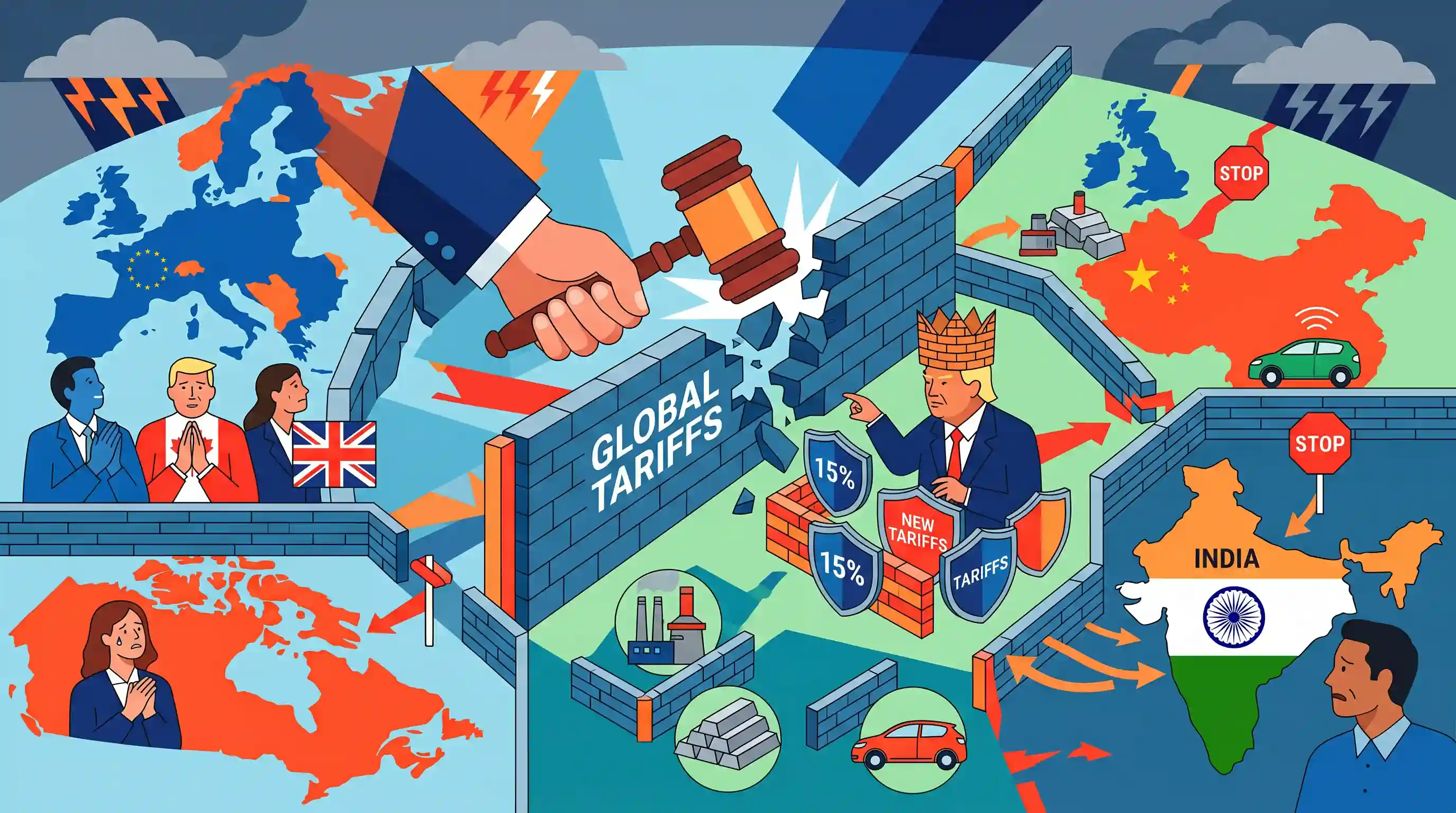
The US Supreme Court has struck down President Donald Trump's sweeping global tariffs imposed under the International Emergency Economic Powers Act (IEEPA), a move cautiously welcomed by US trading partners. However, trade tensions remain high as Trump immediately announced a 15% across-the-board tariff on imports using alternative trade authorities. Sector-specific duties on items like steel, aluminum, and Chinese EVs remain intact. The ongoing developments underscore the continued volatility in US trade policy and the broader trend of protectionism, keeping major trading partners like the EU, Canada, and the UK vigilant against potential trade wars.
Key Points
- The US Supreme Court struck down a blanket 25% global tariff imposed by President Donald Trump under the International Emergency Economic Powers Act (IEEPA).
- Despite the legal setback, Trump announced a new 15% across-the-board tariff on all imported goods, leveraging Section 301 of the Trade Act of 1974 and Section 232 of the Trade Expansion Act of 1962.
- US trading partners, including the UK, Canada, and the EU, welcomed the Supreme Court ruling but remain cautious due to the newly announced 15% tariff.
- Sector-specific tariffs, such as duties on steel, aluminum, and Chinese electric vehicles, are unaffected by the court's decision.
- The persistent use of unilateral tariffs by the US highlights ongoing global trade uncertainties and a continuing shift toward protectionism.
Important Terms
International Emergency Economic Powers Act (IEEPA)

A 1977 US law authorizing the President to regulate commerce and freeze assets during declared national emergencies involving extraordinary external threats to national security or the economy.
UPSC context
GS Paper II (IR); critical for understanding US executive power's impact on global trade and India’s economic interests.
Section 301 of the Trade Act of 1974
A US law provision empowering the Trade Representative to investigate and retaliate against foreign trade practices deemed "unreasonable, discriminatory, or unjustifiable" that burden US commerce.
UPSC context
GS Paper III (Economy); relevant for analyzing unilateral trade barriers and US probes into India's trade policies.
Section 232 of the Trade Expansion Act of 1962
A US law authorizing the President to restrict imports through tariffs or quotas if they are found to threaten or "impair the national security" of the United States.
UPSC context
GS Paper III (Economy); tests knowledge of protectionist measures and their effects on Indian exports like steel.
US Supreme Court
The highest US court, which in 2026 curtailed presidential tariff authority by ruling that emergency powers (IEEPA) do not include the power to impose revenue-raising duties.
UPSC context
GS Paper II (IR/Polity); highlights separation of powers and judicial oversight on global economic policies.
World Trade Organization (WTO)
An international body regulating trade between nations. Its dispute settlement function is currently hampered by a non-functional Appellate Body due to a lack of judge appointments.
UPSC context
GS Paper II (International Institutions); vital for discussing the crisis in multilateralism and global trade governance.
USMCA
The free trade agreement between the US, Mexico, and Canada that replaced NAFTA; it includes a 6-year mandatory joint review mechanism starting in 2026.
UPSC context
GS Paper II (IR); essential for understanding regional trade blocs and evolving North American economic integration.
Prelims Trap
Section 301 and Section 232 are WTO-sanctioned trade remedy mechanisms.
These are domestic US trade statutes used to unilaterally bypass the WTO. Aspirants frequently confuse domestic tools with multilateral WTO trade remedies.
Static Concepts Connected
What are the three primary trade remedy measures permitted under WTO rules?
- Anti-dumping duties: Levied on imported goods that are sold below their normal domestic market price, causing material injury to the importing country's industry.
- Countervailing duties (CVD): Imposed to neutralize the negative trade effects of specific financial subsidies provided by the exporting country's government to its producers.
- Safeguard measures: Temporary restrictions or tariffs applied to protect a specific domestic industry from a sudden, unforeseen surge in imports.
How do unilateral tariffs structurally impact developing economies like India?
- Export competitiveness: Blanket tariffs increase the landing cost of Indian exports (e.g., steel, textiles), directly threatening export-driven domestic manufacturing programs.
- Supply chain realignment: Triggers 'trade diversion' where global supply chains frantically shift to avoid tariffs, creating both opportunities (China-Plus-One) and macroeconomic volatility.
- Retaliatory spirals: Provokes tit-for-tat trade wars, resulting in elevated global input inflation and slowing down aggregate global economic growth.
Cross-Topic Patterns
Protectionism vs. Make in India
Rising US tariff walls threaten the export-led assumptions of India's PLI schemes, forcing India to urgently seek new FTA markets to sustain manufacturing growth.
Unilateralism and WTO paralysis
The aggressive use of US domestic trade laws reflects the ongoing paralysis of the WTO's dispute settlement mechanism and its defunct Appellate Body.

Expect a Prelims statement contrasting WTO-sanctioned trade remedies (anti-dumping) with unilateral domestic statutes like US Section 301.
Linked PYQs · 5
Linked PYQs · 5
- 2018MainsGS2
What are the key areas of reform if the WTO has to survive in the present context of "Trade War', especially keeping in mind the interest of India?
- 2025MainsGS3
What are the challenges before the Indian economy when the world is moving away from free trade and multilateralism to protectionism and bilateralism? How can these challenges be met?
- 2018MainsGS3
How would the recent phenomena of protectionism and currency manipulations in world trade affect macroeconomic stability of India?
- 2025MainsGS2
"With the waning of globalization, post-Cold War world is becoming a site of sovereign nationalism.” Elucidate.
- 2012MainsGS2
Discuss the likely negative impact of the protectionist measures proposed by the US on India's software industry.
