Global Trade Implications of United States Tariff Decisions
Source:The Hindu ↗
Why It Matters
The persistence of protectionist trade policies by the world's largest economy significantly impacts global supply chains, tests the relevance of multilateral institutions like the WTO, and creates macroeconomic challenges for emerging economies including India.
Summary
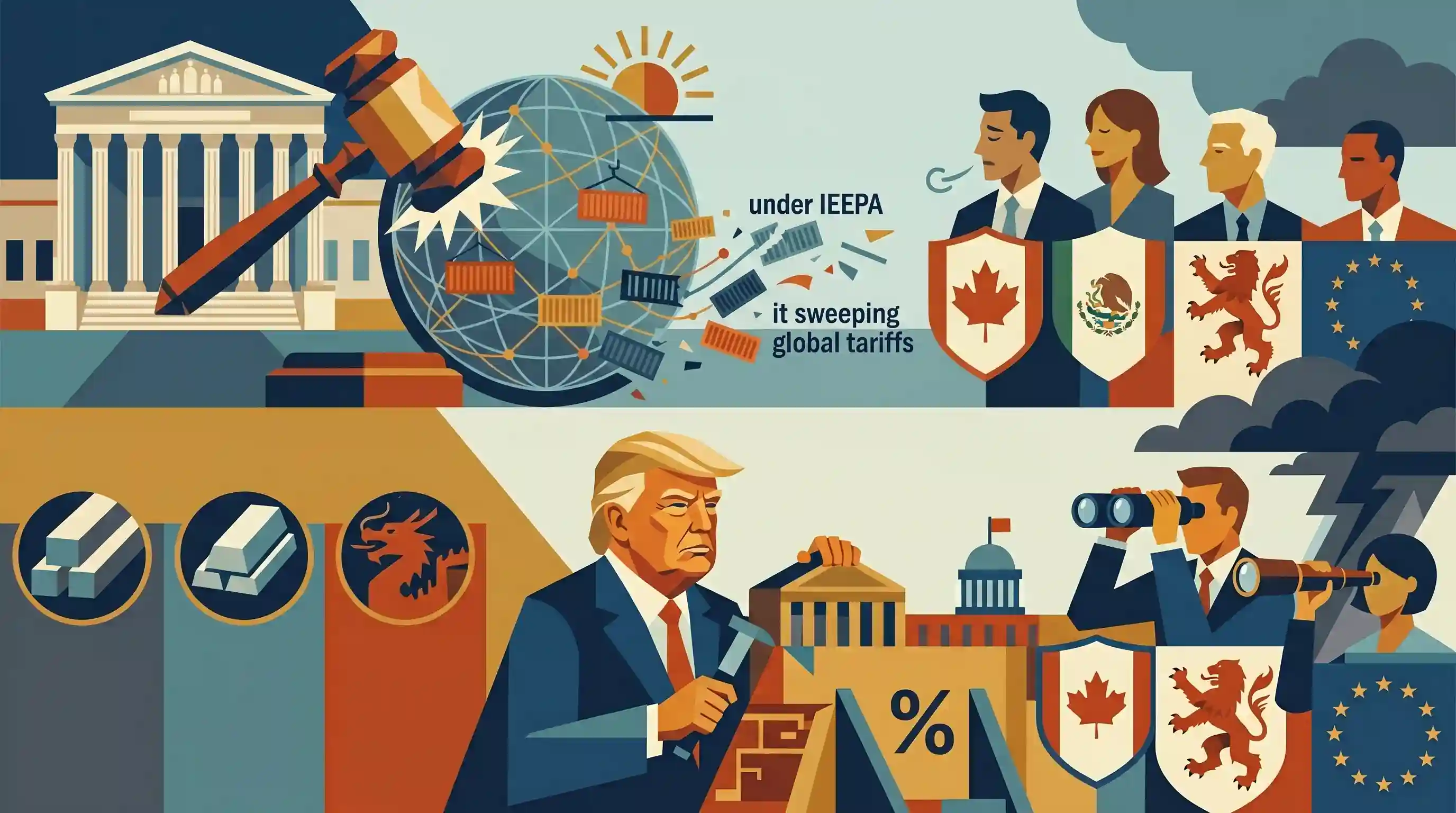
The US Supreme Court has struck down the sweeping global tariffs imposed by President Donald Trump under the International Emergency Economic Powers Act (IEEPA), bringing cautious relief to global trade partners. However, the ruling does not affect earlier targeted tariffs on steel, aluminum, and Chinese imports. Undeterred, Trump has pledged to quickly impose a new 10% to 15% across-the-board tariff using alternative executive authority. Trade partners like Canada, Mexico, the UK, and the EU welcomed the court's decision but remain vigilant against the enduring threat of US protectionism and the resulting unpredictability in international trade.
Key Points
- The US Supreme Court struck down President Donald Trump's comprehensive global tariffs that were initially imposed under the International Emergency Economic Powers Act (IEEPA).
- The court's ruling does not eliminate previously established sector-specific tariffs, such as those on steel, aluminum, and various Chinese goods.
- In response to the ruling, Trump announced intentions to invoke alternative statutory authorities to impose a new across-the-board tariff of 10% to 15%.
- Major US trading partners, including Canada, Mexico, the EU, and the UK, responded with cautious relief, continuing to brace for persistent protectionist policies and trade uncertainties from the US administration.
Important Terms
International Emergency Economic Powers Act (IEEPA)

A 1977 U.S. law authorizing the President to regulate international commerce and impose sanctions during a declared national emergency. A 2026 Supreme Court ruling restricted its use for imposing broad tariffs.
UPSC context
GS Paper 2 (International Relations); tests understanding of executive authority, global sanctions, and legal frameworks governing international trade.
United States-Mexico-Canada Agreement (USMCA)
A trade agreement between the U.S., Mexico, and Canada (effective 2020) that replaced NAFTA. It introduced stricter rules for automobile production, labor standards, and digital trade.
UPSC context
GS Paper 2 (Bilateral and regional agreements); relevant for understanding regional trade blocs and their impact on global supply chains.
World Trade Organization (WTO)
The only global international organization dealing with the rules of trade between nations. It aims to reduce trade barriers and settle disputes through its rules-based multilateral system.
UPSC context
GS Paper 2 (Important International institutions); tests knowledge of multilateral trade governance and the challenges of dispute resolution.
Protectionism
An economic policy of restricting imports from other countries through methods such as tariffs, quotas, and subsidies to shield domestic industries and workers from foreign competition.
UPSC context
GS Paper 3 (Indian Economy); critical for analyzing global trade wars, de-globalization, and their effects on India's export-oriented growth.
Tariff
A tax or duty imposed by a government on imported goods. It is used to protect domestic producers by making foreign products more expensive and to generate government revenue.
UPSC context
GS Paper 3 (Economy); fundamental concept for questions on trade policy, fiscal measures, and international economic relations.
Prelims Trap
The US Supreme Court ruling struck down all existing US protectionist tariffs, including those on Chinese imports.
The ruling only invalidated broad global tariffs invoked under IEEPA. Targeted tariffs like Section 232 (steel/aluminum) and Section 301 (Chinese goods) remain strictly intact.
Static Concepts Connected
What are the core trade remedy measures permitted by the WTO?
- Anti-dumping duties: Imposed when a country exports a product at a price significantly lower than its normal commercial value in its home market.
- Countervailing duties: Designed to offset the negative impact of specific export subsidies provided by a foreign government to its domestic producers.
- Safeguard measures: Temporary trade restrictions (like quotas or higher tariffs) utilized to protect a specific domestic industry from a sudden, unforeseen surge in imports.
What is the 'National Security Exception' under international trade law?
- GATT Article XXI: Allows member countries to breach their WTO commitments if they deem it necessary to protect their essential security interests (e.g., during war or weapons trafficking).
- Contemporary Misuse: Increasingly invoked by nations (like US Section 232 tariffs on steel) to justify purely economic protectionist measures, bypassing standard WTO dispute resolution mechanisms.
Cross-Topic Patterns
Protectionism driving currency wars
Unilateral tariff hikes often prompt export-oriented economies to strategically devalue their currencies to maintain export competitiveness, risking global competitive devaluation.
National security exception & WTO crisis
Invoking 'national security' for economic tariffs exploits GATT Article XXI, deepening the crisis of multilateralism while the WTO dispute settlement body remains paralyzed.
Deglobalization and friend-shoring trend
Arbitrary tariffs accelerate "friend-shoring," pushing global supply chains away from multilateral trade frameworks toward bilateral and plurilateral trusted partnerships like IPEF.

GATT's 'national security' exception and unilateral tariffs will likely merge into a single GS2 Mains question on the WTO crisis in 2026.
Linked PYQs · 3
Linked PYQs · 3
- 2018MainsGS3
How would the recent phenomena of protectionism and currency manipulations in world trade affect macroeconomic stability of India?
- 2025MainsGS3
What are the challenges before the Indian economy when the world is moving away from free trade and multilateralism to protectionism and bilateralism? How can these challenges be met?
- 2018MainsGS2
What are the key areas of reform if the WTO has to survive in the present context of "Trade War', especially keeping in mind the interest of India?
