US trade delegation visits India for bilateral commerce talks
Source:Indian Express ↗
Why It Matters
Bilateral trade dynamics between India and the US directly impact India's export potential, foreign direct investment inflows, and broader strategic partnership in the Indo-Pacific region. Trade forums are vital mechanisms for resolving non-tariff barriers and harmonizing regulations.
Summary
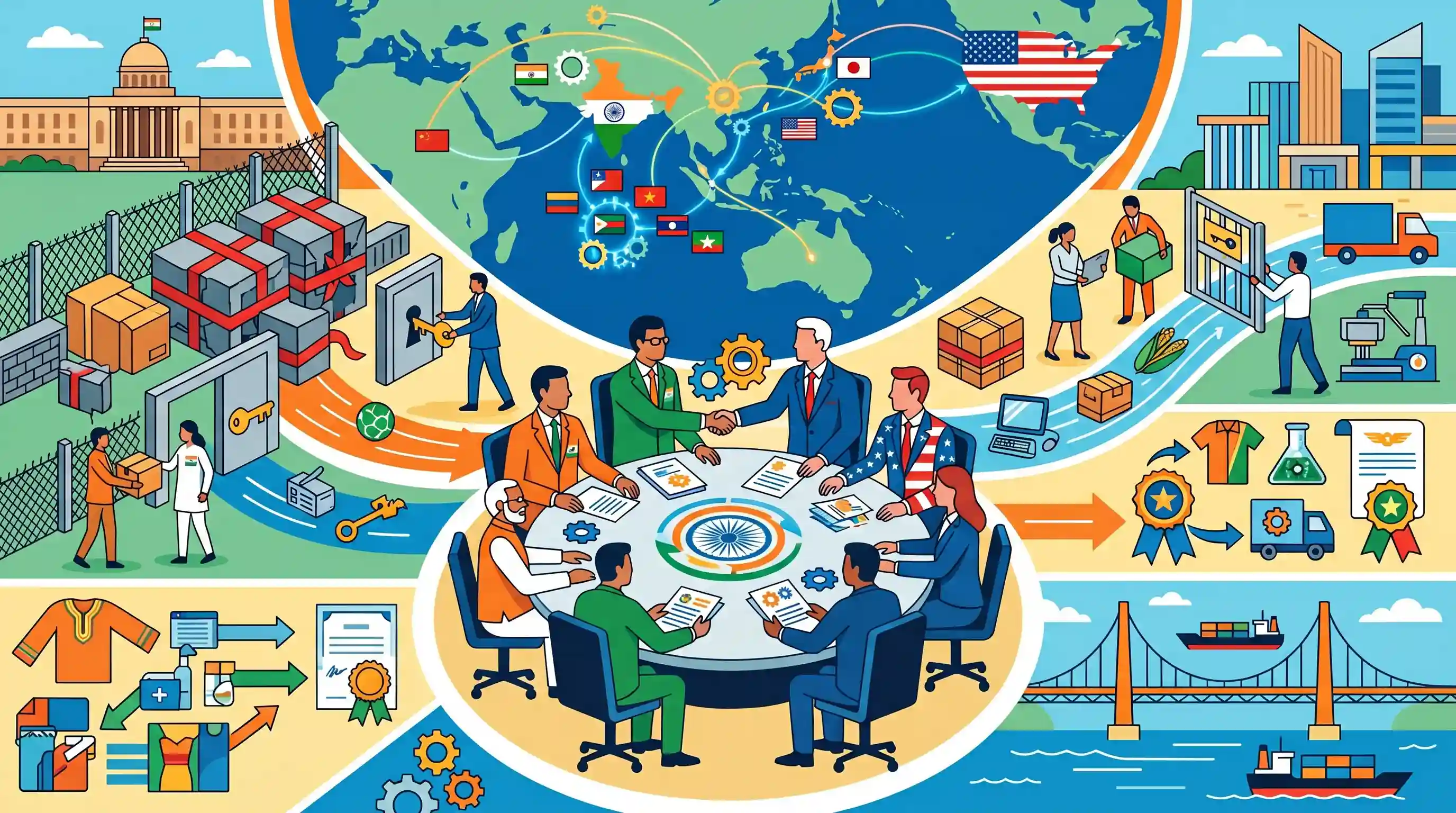
US trade negotiators are scheduled to visit India for high-level meetings with the Commerce Ministry. The visit aims to address bilateral trade issues, potentially including market access, non-tariff barriers, the Generalized System of Preferences (GSP), and discussions related to the Indo-Pacific Economic Framework for Prosperity (IPEF). This interaction is a continuation of the ongoing India-US Trade Policy Forum (TPF) dialogues aimed at strengthening economic ties and resolving outstanding trade disputes.
Key Points
- A delegation of US trade negotiators is visiting India for bilateral meetings with the Ministry of Commerce and Industry.
- The discussions are likely to focus on enhancing market access, reducing non-tariff barriers, and addressing ongoing trade issues under the India-US Trade Policy Forum (TPF).
- Restoring benefits under the Generalized System of Preferences (GSP) for Indian exporters remains a key point of interest for India.
- The visit may also include deliberations on India's participation in the Indo-Pacific Economic Framework for Prosperity (IPEF).
- These meetings underscore the continuous effort to resolve trade friction and deepen economic cooperation between the two strategic partners.
Important Terms
Generalized System of Preferences (GSP)

A US trade program providing duty-free market access to developing nations. India was its largest beneficiary until its status was withdrawn in 2019 over market access issues.
UPSC context
GS Paper II & III; tests knowledge of trade preferences, bilateral disputes, and their impact on Indian exports.
Indo-Pacific Economic Framework for Prosperity (IPEF)
A 14-nation US-led economic initiative launched in 2022 to enhance regional supply chains, clean energy, and fair trade. India participates in all pillars except the Trade pillar.
UPSC context
GS Paper II (Regional Groupings); critical for Indo-Pacific strategy, economic diplomacy, and balancing China's regional influence.
Trade Policy Forum (TPF)
The premier bilateral platform for India and the US to resolve trade and investment disputes, co-chaired by the Indian Commerce Minister and the US Trade Representative.
UPSC context
GS Paper II (Bilateral Relations); tests understanding of institutional mechanisms facilitating economic ties between India and the US.
Ministry of Commerce and Industry
The nodal Union ministry responsible for India's foreign trade policy, industrial development, and FDI. It operates through the Department of Commerce and the DPIIT.
UPSC context
GS Paper II & III; relevant for governance, industrial policy, and India's position in international trade negotiations.
United States Trade Representative (USTR)
The US government agency responsible for developing trade policy and conducting negotiations. It represents the US in the Trade Policy Forum and publishes the Special 301 Report.
UPSC context
GS Paper II (International Relations); essential for understanding the executive actors in US trade diplomacy affecting Indian interests.
Prelims Trap
"IPEF is a comprehensive Free Trade Agreement offering tariff reductions and market access to member countries."
IPEF explicitly excludes tariff reductions and traditional market access commitments, functioning instead as a framework for supply chain, clean energy, and regulatory cooperation.
Static Concepts Connected
How does the Generalized System of Preferences (GSP) comply with WTO rules?
- MFN Exception: GSP acts as an exception to the WTO's Most Favored Nation (MFN) principle, allowing developed nations to offer preferential tariffs.
- Enabling Clause: It is legally protected under the 1979 GATT Enabling Clause, which permits permanent differential treatment for developing nations.
- Non-reciprocal: Beneficiary countries are not required to reciprocate with equivalent tariff cuts for the donor country.
What distinguishes SPS measures from Technical Barriers to Trade (TBT)?
- SPS Measures: Focus purely on food safety and protecting human, animal, or plant health from pests, diseases, or contaminants.
- TBTs: Cover all other technical regulations, product standards, and packaging rules that are not specifically related to health/sanitary risks.
Cross-Topic Patterns
IPEF vs. RCEP strategic alignment
India's active role in IPEF while exiting RCEP highlights a strategic shift toward US-led supply chains to reduce structural dependencies on Chinese manufacturing and trade blocs.
NTBs masking agricultural protectionism
Non-tariff barriers discussed at the TPF directly link to India's agricultural export challenges, where developed nations increasingly use sanitary (SPS) standards as de-facto protectionism.

Expect a multi-statement Prelims question contrasting IPEF's 'supply-chain focus without market access' against traditional FTAs like RCEP.
Linked PYQs · 3
Linked PYQs · 3
- 2019MainsGS2
‘What introduces friction into the ties between India and the United States is that Washington is still unable to find for India a position in its global strategy, which would satisfy India's national self-esteem and ambitions.’ Explain with suitable examples.
- 2016MainsGS2
The broader aims and objectives of WTO are to manage and promote international trade in the era of globalization. But the Doha round of negotiations seem doomed due to differences between the developed and the developing countries." Discuss in the Indian perspective.
- 2020PrelimsGS1
With reference to Foreign Direct Investment in India, which one of the following is considered its major characteristic?
