Indo-US Trade Deal Impact on Domestic Agriculture and Farmers
Source:The Hindu ↗
Why It Matters
Highlights the domestic economic vulnerabilities associated with bilateral free trade agreements, especially in the agricultural sector. It also demonstrates how international judicial rulings on protectionist measures (like the US Supreme Court striking down tariffs) can alter the leverage and context of ongoing bilateral trade negotiations.
Summary
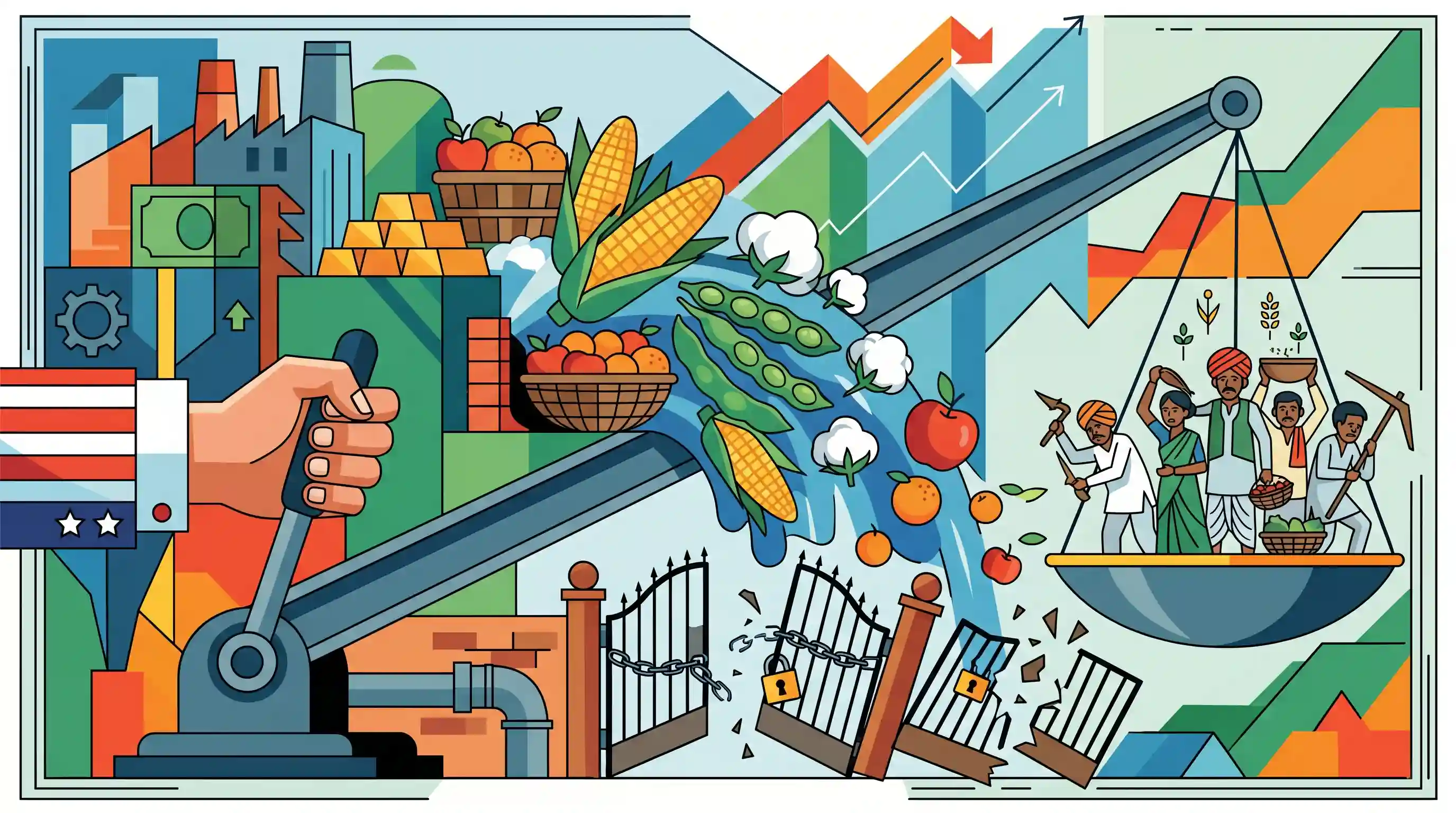
Following a US Supreme Court ruling that deemed President Donald Trump’s global tariffs illegal, the Congress party has criticized the Indian government's approach to the Indo-US interim trade deal, dubbing it "Abki baar Trump se haar." Congress leader Jairam Ramesh urged the government to put the agreement on hold and renegotiate its terms, particularly the clause committing India to drastically cut or eliminate import duties on American agricultural and industrial products. He argued that liberalizing agricultural imports would devastate Indian farmers across various states who grow crops like soyabean, maize, cotton, and fruits, leaving them unable to compete with subsidized US produce.
Key Points
- Following a US Supreme Court ruling that struck down Donald Trump's global tariffs as illegal, the Congress party has demanded the Indian government halt the Indo-US interim trade deal.
- Congress leader Jairam Ramesh criticized the deal, stating it would force India to eliminate or reduce import duties on US industrial goods and a wide range of agricultural products.
- The proposed import liberalization of agricultural goods risks severely harming Indian farmers producing soyabean, maize, fruits, nuts, and cotton across several states.
- The opposition insists on renegotiating the agreement to scrap clauses that expose domestic agriculture to heavily subsidized American imports.
Important Terms
Indo-US Interim Trade Deal

A framework (Feb 2026) for reciprocal tariff reductions; India agreed to cut duties on U.S. agricultural/industrial goods in exchange for lower U.S. tariffs and relief from Russian oil-related penalties.
UPSC context
GS Paper II (International Relations) and GS Paper III (Economy). Tests understanding of bilateral trade dynamics and "Early Harvest" agreements.
IEEPA (International Emergency Economic Powers Act)
A 1977 U.S. law granting the President emergency economic powers. In Feb 2026, the U.S. Supreme Court ruled it cannot be used to bypass Congress to impose tariffs.
UPSC context
GS Paper II (Separation of Powers). Relevant for comparative constitutional law and executive versus legislative authority in global trade.
Reciprocal Tariffs
A trade policy where a country matches the tariff rates of its trading partner. It challenges the MFN (Most Favored Nation) principle of the WTO.
UPSC context
GS Paper III (Economy). Tests concepts of protectionism, trade wars, and WTO-compliant versus power-based trade regimes.
Agricultural Subsidies
Financial aid given by governments to farmers. A major point of Indo-U.S. contention due to the U.S.'s high direct payments (Green Box) versus India's input/price supports.
UPSC context
GS Paper III (Agriculture). Focuses on WTO boxes (Amber, Blue, Green) and the impact of global trade on smallholder farmers.
Strategic Autonomy
India's policy of pursuing national interests and making independent decisions without being constrained by alliances, notably regarding Russian oil imports amid U.S. pressure.
UPSC context
GS Paper II (Foreign Policy). A foundational concept for India's role in a multipolar world and balancing relations with major powers.
Import Liberalization
The reduction of trade barriers (tariffs/quotas) to allow freer flow of goods. In agriculture, it raises concerns about "dumping" of subsidized foreign produce on domestic markets.
UPSC context
GS Paper III (Economy). Critical for understanding the socio-economic impact of Free Trade Agreements (FTAs) on the primary sector.
Prelims Trap
"Under a bilateral interim trade deal, India must formally reduce its WTO bound tariff rates."
Bilateral trade agreements reduce applied or preferential tariffs for the specific partner country. India's official WTO bound rates remain legally unchanged globally.
Static Concepts Connected
How does the WTO classify domestic agricultural subsidies?
- Amber Box: Trade-distorting subsidies like MSP or fertilizer support. Subject to reduction limits (De Minimis level of 10% for developing nations).
- Green Box: Minimal trade distortion, such as R&D, disease control, and environmental protection. Not subjected to reduction limits.
- Blue Box: Trade-distorting subsidies that require farmers to limit agricultural production. No reduction limits currently apply to this box.
What are Tariff-Rate Quotas (TRQs) used in trade agreements?
- Two-tier tariff: A lower applied tariff rate is charged on imports up to a specific, pre-determined volume (the quota).
- Over-quota penalty: Any imports exceeding the quota limit face a significantly higher, prohibitive tariff rate to protect domestic producers.
- Strategic balance: Allows targeted market access for trade partners without causing sudden, unlimited supply gluts that crash domestic farm prices.
Cross-Topic Patterns
FTAs bypassing WTO multilateral deadlock
Advanced economies use bilateral deals to secure market access (zero-duty agriculture, TRIPS-plus norms) that developing nations successfully resisted at the stalled multilateral WTO forums.
Food Security vs Free Trade rules
The domestic pressure to protect farmers via high tariffs mirrors India’s ongoing WTO battle for a permanent solution on public stockholding and Minimum Support Price (MSP).

Expect a 2026 Prelims multi-statement question contrasting India's applied vs bound agricultural tariffs and WTO Amber Box subsidy limits.
Linked PYQs · 3
Linked PYQs · 3
- 2025MainsGS3
What are the challenges before the Indian economy when the world is moving away from free trade and multilateralism to protectionism and bilateralism? How can these challenges be met?
- 2014MainsGS2
The aim of Information Technology Agreements (ITAs) is to lower all taxes and tariffs on information technology products by signatories to zero. What impact would such agreements have on India's interests?
- 2023MainsGS3
What are the direct and indirect subsidies provided to farm sector in India? Discuss the issues raised by the World Trade Organization (WTO) in relation to agricultural subsidies.
