India US Trade Agreement Targets July Deadline Amid Sticking Points
Source:The Hindu ↗
Why It Matters
Understanding these trade negotiations is essential for UPSC aspirants as it highlights the intersection of international relations, economic diplomacy, and domestic agricultural sensitivities. It provides a contemporary example of how global protectionism and bilateralism impact India's macroeconomic interests and strategic ties with major powers like the US.
Summary
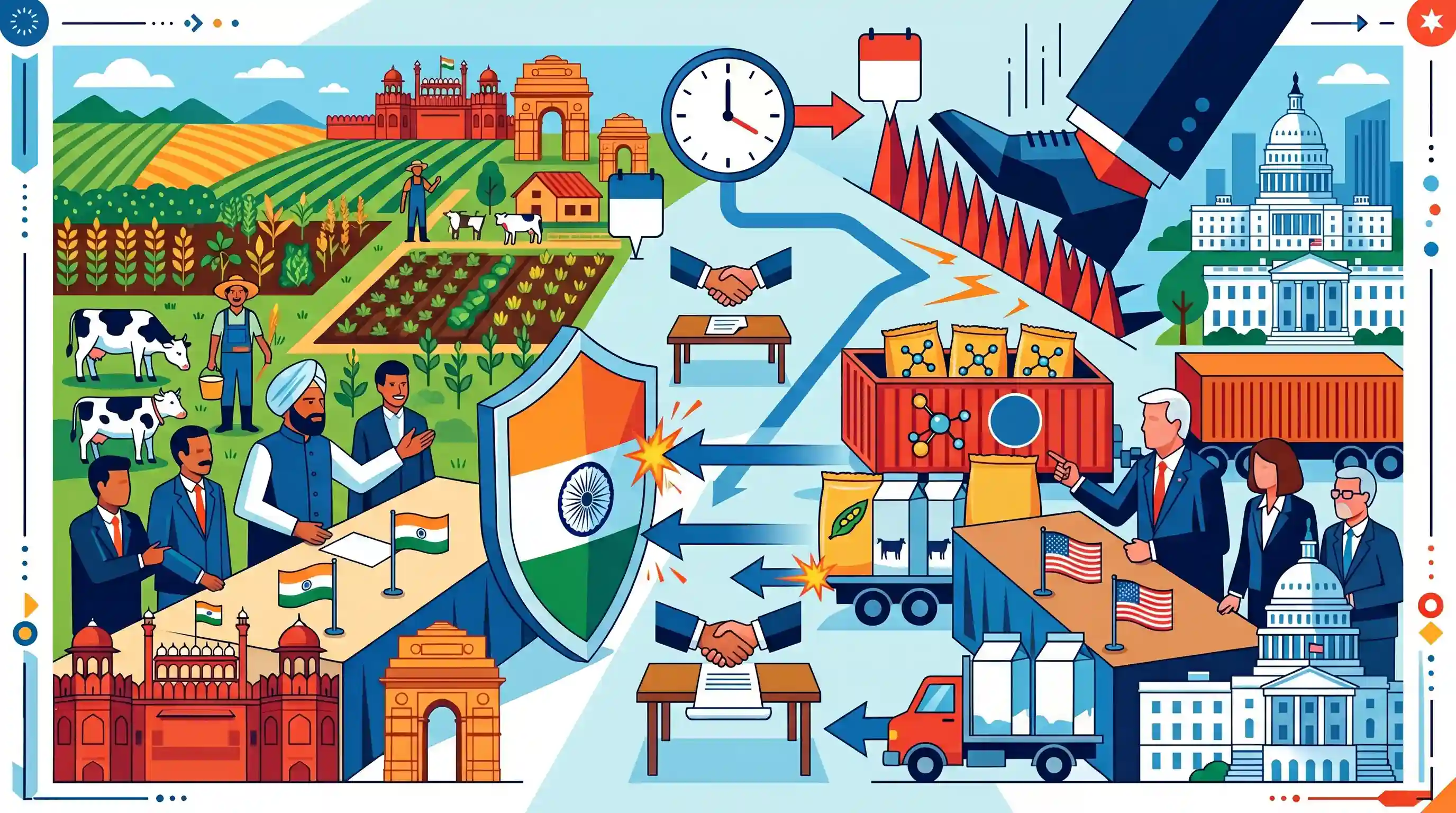
India is negotiating a 'mini' trade deal with the United States, targeting a July 8 deadline with a possible extension to August 1. The talks face significant hurdles over US demands for India to allow imports of Genetically Modified (GM) crops, such as soybean meal and DDGS for animal feed, and dairy products like cow milk. These issues strike at sensitive Indian domestic sectors. Meanwhile, US President Donald Trump's threat of new tariff hikes by August 1 underscores the protectionist pressures shaping the negotiations. The deal is critical for easing economic frictions within the broader India-US strategic partnership.
Key Points
- India and the US are working to finalize a 'mini' bilateral trade deal, aiming for a July 8 deadline with a potential buffer up to August 1.
- The US has extended a tariff pause to August 1, threatening new tariff hikes if agreements are not reached by then, although India has not formally received a warning letter.
- Key sticking points include the US pushing for India to allow imports of Genetically Modified (GM) products like soybean meal and DDGS for animal feed.
- Another major contention is the US demand for India to open its market to dairy imports, specifically cow milk, which India resists.
- These negotiations reflect the ongoing friction in India-US economic ties as both nations navigate domestic sensitivities in agriculture and rising global protectionist pressures.
Important Terms
India-US Limited Trade Package

An interim bilateral agreement focusing on a subset of trade issues—such as specific tariff reductions—rather than a comprehensive Free Trade Agreement (FTA), aimed at resolving immediate economic frictions.
UPSC context
GS-2 (IR) and GS-3 (Economy). Tests understanding of trade diplomacy, 'mini-deals,' and incrementalism in complex bilateral partnerships.
Distiller’s Dried Grains with Solubles (DDGS)
A nutrient-rich, protein-dense byproduct of grain-based ethanol fermentation used as livestock feed. It is a major trade hurdle when derived from genetically modified (GM) corn.
UPSC context
GS-3 (Agriculture). Relevant for biotechnology in animal-rearing and the impact of biofuel byproducts on domestic farm-gate prices.
Genetically Modified (GM) Crops
Crops whose genetic material is altered via genetic engineering. India permits only GM cotton for cultivation; imports of GM-derived food or feed remain a sensitive regulatory 'red line.'
UPSC context
GS-3 (Science & Tech/Environment). Tests knowledge of biosafety regulations (GEAC), the 'precautionary principle,' and food sovereignty.
Generalised System of Preferences (GSP)
A non-reciprocal, preferential tariff system where developed countries grant duty-free or reduced-tariff access to exports from developing nations to support their economic growth.
UPSC context
GS-3 (Economy). A recurring friction point in US-India trade; tests knowledge of WTO exceptions and 'Special and Differential Treatment.'
Sanitary and Phytosanitary (SPS) Measures
WTO-authorized regulations protecting human, animal, or plant health from risks like pests or contaminants in food trade; often cited as 'non-tariff barriers' in agricultural negotiations.
UPSC context
GS-3 (Agriculture/Economy). Key in dairy and GM disputes; tests understanding of international safety standards and technical barriers to trade.
Market Access
The degree to which a country permits foreign goods and services into its domestic market, influenced by tariffs, quotas, and technical regulations.
UPSC context
GS-3 (Economy). Central to trade negotiations; tests understanding of trade liberalisation vs. protectionism and reciprocal trade interests.
Prelims Trap
India completely bans the import of all genetically modified (GM) crops, foods, and animal feed products without exception.
India permits imports of certain GM derivatives (e.g., GM soybean oil). Furthermore, GM animal feed imports like crushed soy meal have occasionally been permitted via special GEAC exemptions.
Static Concepts Connected
What is the WTO SPS Agreement and how does it justify India's dairy restrictions?
- SPS Agreement: Allows member nations to set basic rules protecting human, animal, or plant life from risks arising from pests, diseases, toxins, or food additives.
- Scientific basis: Regulations cannot be arbitrary disguised protectionism; they must be scientifically justified or based on international standards (like Codex Alimentarius).
- India's Dairy Rule: India mandates certification that imported dairy comes from animals not fed blood meal, utilizing sanitary norms to uphold domestic livestock standards.
How is the import of Genetically Modified (GM) products regulated in India?
- GEAC Authority: The Genetic Engineering Appraisal Committee (MoEFCC) under the Environment Protection Act 1986 is the apex body approving imports of all GM organisms.
- FSSAI Mandate: FSSAI regulates imported food products for human consumption, requiring mandatory prior approval for any food products containing 1% or more GM ingredients.
- DGFT Enforcement: The Directorate General of Foreign Trade (DGFT) enforces these restrictions at borders, ensuring shipments lack unapproved GM events.
Cross-Topic Patterns
GM Feed vs. Food Inflation Control
Allowing cheap US DDGS and GM soy feed lowers input costs for India's poultry sector and tames inflation, but threatens domestic maize and soybean farmers' livelihoods and MSP realizations.
Biofuel Byproducts and Trade Friction
DDGS is a high-protein byproduct of corn ethanol production. US biofuel mandates create massive DDGS surpluses, driving aggressive US market access demands in agriculture-sensitive developing economies like India.

Expect a 2026 multi-statement prelims question linking WTO's SPS measures with India's GEAC regulations on GM animal feed imports.
Linked PYQs · 5
Linked PYQs · 5
- 2019MainsGS2
‘What introduces friction into the ties between India and the United States is that Washington is still unable to find for India a position in its global strategy, which would satisfy India's national self-esteem and ambitions.’ Explain with suitable examples.
- 2012MainsGS2
Discuss the likely negative impact of the protectionist measures proposed by the US on India's software industry.
- 2025MainsGS3
What are the challenges before the Indian economy when the world is moving away from free trade and multilateralism to protectionism and bilateralism? How can these challenges be met?
- 2018MainsGS3
How would the recent phenomena of protectionism and currency manipulations in world trade affect macroeconomic stability of India?
- 2019MainsGS3
How can biotechnology help to improve the living standards of farmers?
