Bilateral Trade Agreement Negotiations and Reciprocal Tariffs
Source:The Hindu ↗
Why It Matters
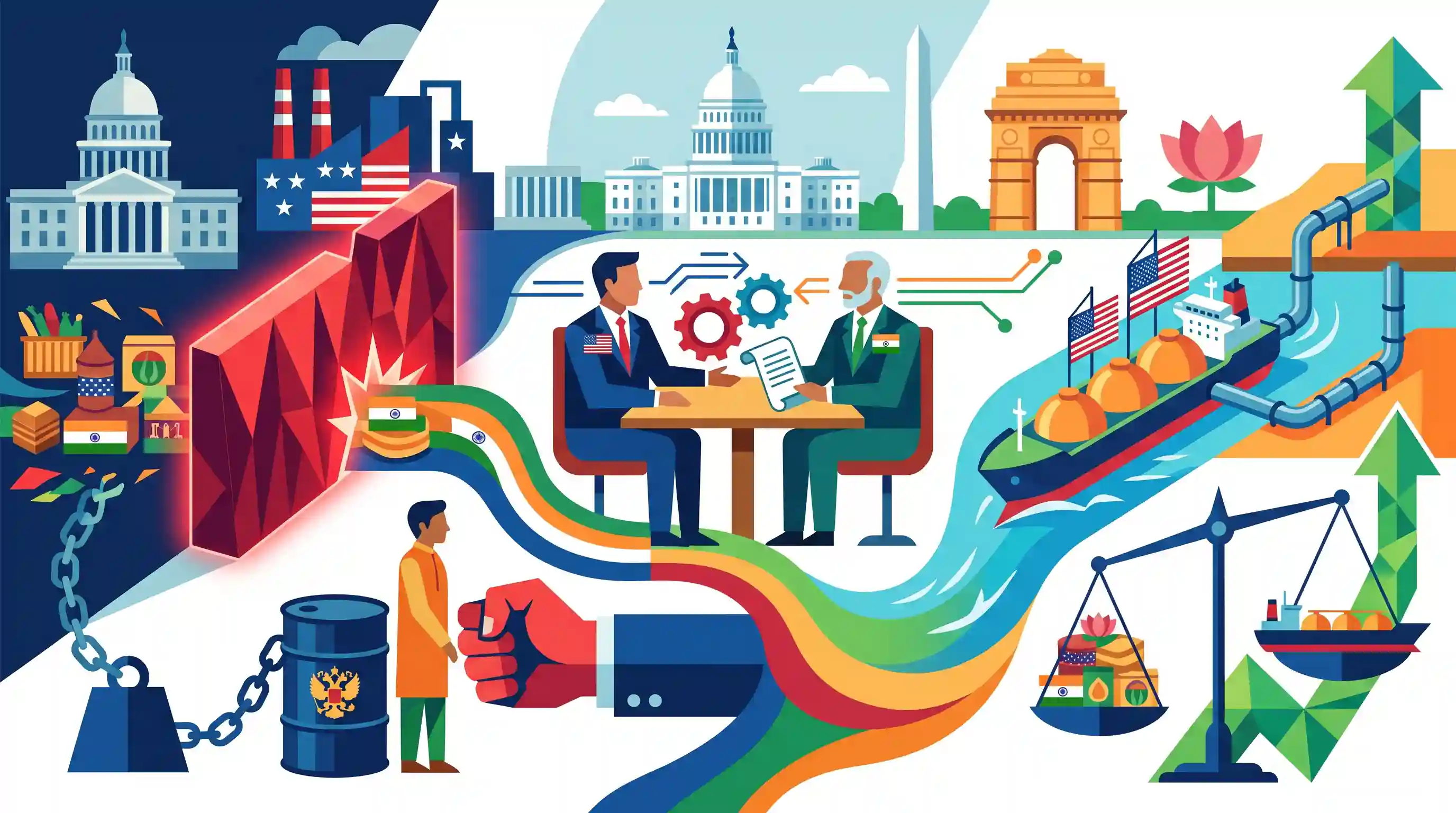
The dynamics of the U.S.-India trade deal highlight the intersection of trade policy and geopolitics. With protectionist tariffs acting as diplomatic penalties (e.g., over Russian oil) and new energy agreements (U.S. LPG imports) being used to balance trade deficits, aspirants must understand how bilateral economic negotiations shape India's macroeconomic stability and foreign policy autonomy.
Summary
The first tranche of the U.S.-India Bilateral Trade Agreement (BTA), focused on resolving reciprocal tariffs, is nearing closure. Negotiations had stalled after the U.S. levied a 50% tariff on Indian imports, which included a penalty for India's oil imports from Russia. Easing tensions are marked by recent talks in Washington and a structured contract for India to import LPG from the U.S., an effort aimed at reducing the bilateral trade deficit.
Key Points
- India and the U.S. are nearing the closure of the first tranche of their Bilateral Trade Agreement (BTA), which specifically addresses reciprocal tariffs.
- Negotiations had previously stalled in August after the U.S. imposed a 50% tariff on Indian imports, which included a 25% penalty for India's ongoing oil imports from Russia.
- The sixth round of negotiations resumed in Washington in October 2025, signaling an easing of bilateral trade tensions.
- To address the U.S.'s high trade deficit with India, a structured contract was announced for India to import LPG from the U.S., a strategic move to help balance bilateral trade.
Important Terms
Bilateral Trade Agreement (BTA)

A formal economic pact between two nations to facilitate trade and investment by reducing or eliminating barriers such as tariffs, quotas, and import restrictions.
UPSC context
GS Paper II (International Relations) and Paper III (Economy); tests knowledge of trade diplomacy and economic integration.
Reciprocal Tariffs
Retaliatory import duties imposed by a country in direct response to tariffs levied by a trading partner, often following a 'tit-for-tat' strategy to ensure trade parity.
UPSC context
GS Paper II (Effect of policies of developed countries on India's interests); tests understanding of protectionism and trade wars.
Trade Deficit
An economic condition where the total value of a country's imports exceeds its exports, leading to a negative balance of trade and affecting the current account.
UPSC context
GS Paper III (Indian Economy); critical for understanding Balance of Payments (BoP) and currency stability.
Energy Security
The uninterrupted availability of energy sources at an affordable price, achieved through diversifying suppliers and reducing dependence on politically volatile regions.
UPSC context
GS Paper III (Infrastructure and Energy); tests strategic planning for resource self-reliance and geopolitical risk management.
Ministry of Commerce and Industry
The nodal Indian government department responsible for formulating and implementing foreign trade policy, promoting exports, and negotiating bilateral and multilateral trade deals.
UPSC context
GS Paper II (Governance) and Paper III (Economic Development); tests knowledge of institutional frameworks for trade.
Prelims Trap
India runs a bilateral trade deficit with the US, which it aims to reduce by exporting energy.
India actually runs a structural goods trade surplus with the US (over $40 billion). The US uses this surplus to demand reciprocal tariffs.
Static Concepts Connected
How do Bilateral Trade Agreements bypass the WTO MFN rule?
- The MFN Principle: The Most-Favored-Nation (MFN) rule requires members to offer equal tariff treatment to all WTO trading partners without discrimination.
- Article XXIV Exception: GATT Article XXIV provides an exception, allowing BTAs/FTAs to offer preferential tariffs to specific partners, provided overall trade barriers to third parties are not raised.
How are retaliatory tariffs regulated under the WTO framework?
- DSB Authorization: Legal retaliatory tariffs require prior authorization from the WTO Dispute Settlement Body (DSB) after a member fails to comply with a ruling.
- Unilateral Bypasses: Nations increasingly bypass the DSB, deploying unilateral reciprocal tariffs under national security exceptions (Article XXI), forcing transactional bilateral settlements instead.
Cross-Topic Patterns
Energy imports as a trade equalizer
India strategically imports US LPG and crude to offset its massive goods trade surplus, pacifying US protectionist demands while securing its own domestic energy requirements.
Geopolitical tariffs vs. Strategic Autonomy
The US weaponizing tariffs (a 25% penalty) to target India's Russian oil purchases marks a shift from purely economic protectionism to direct geopolitical coercion via trade policy.

Expect a 2026 mains question on the shift from multilateral WTO dispute resolution to transactional bilateralism in US-India trade.
Linked PYQs · 3
Linked PYQs · 3
- 2025MainsGS3
What are the challenges before the Indian economy when the world is moving away from free trade and multilateralism to protectionism and bilateralism? How can these challenges be met?
- 2018MainsGS3
How would the recent phenomena of protectionism and currency manipulations in world trade affect macroeconomic stability of India?
- 2018MainsGS2
What are the key areas of reform if the WTO has to survive in the present context of "Trade War', especially keeping in mind the interest of India?
