US to Lift Punitive Tariffs on Indian Goods Post Oil Shift
Source:The Hindu ↗
Why It Matters
This issue is highly relevant for UPSC aspirants as it demonstrates the direct intersection of trade tariffs, energy security, and geopolitics. It serves as a prime case study of how external sanctions (on Russia and Iran) challenge India's strategic autonomy and force realignments in its foreign and economic policies.
Summary
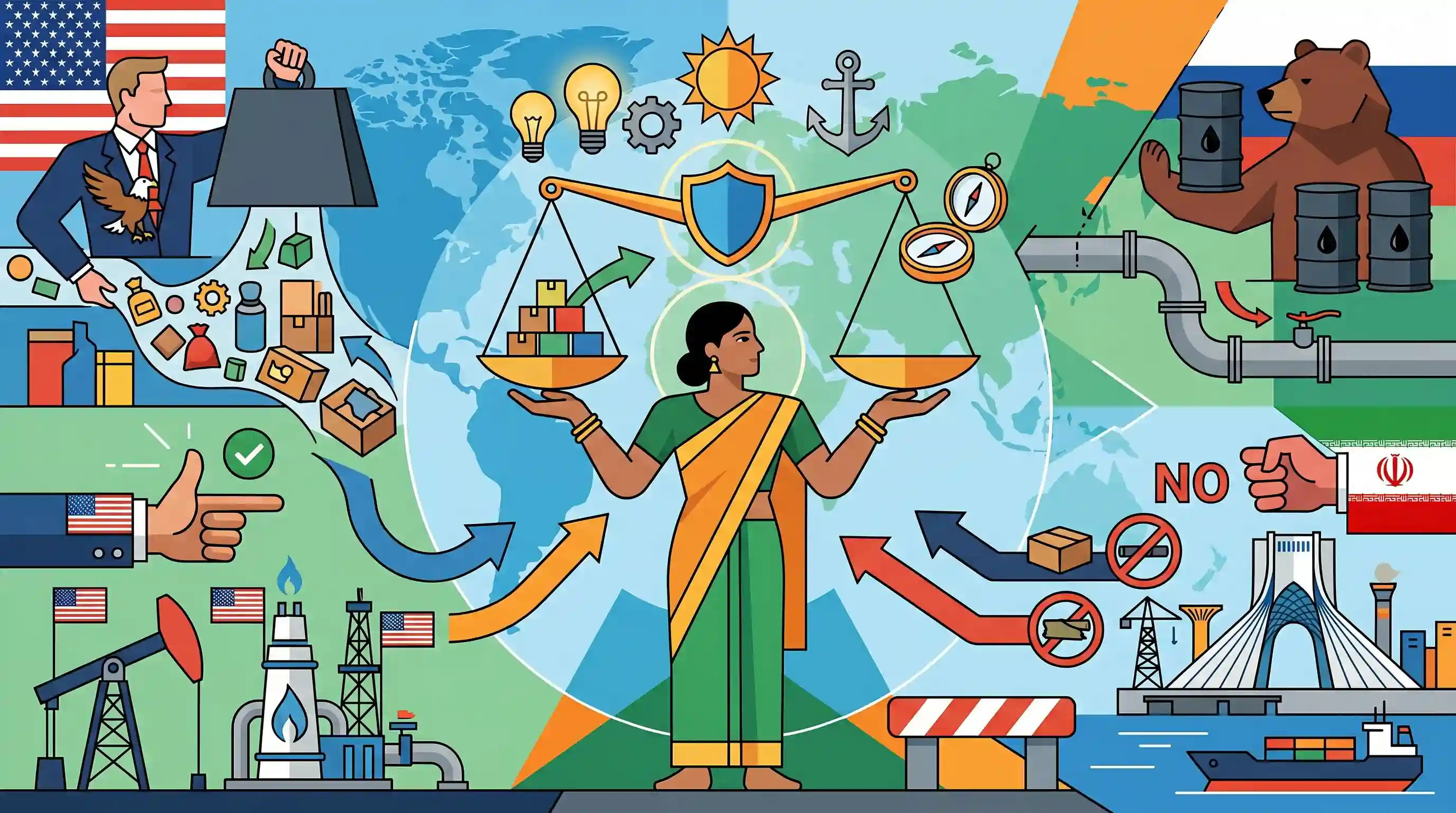
The United States has announced the removal of a 25% punitive tariff on Indian goods, contingent upon India's commitment to significantly reduce its purchase of Russian oil in favor of US energy products. While this resolves a major trade friction between the two nations, the US simultaneously issued threats of tariffs against countries trading with Iran, casting a shadow over India's strategic interests, particularly the development of the Chabahar port. The developments underscore a highly transactional US foreign policy that forces India to carefully balance its immediate economic and energy security needs against its long-standing principle of strategic autonomy.
Key Points
- The US agreed to remove an additional 25% punitive tariff on Indian goods starting February 7, following India's commitment to shift its energy procurement away from Russia and towards the US.
- The move is part of the US's broader strategy to economically isolate Russia and enforce sanctions, with India's Russian oil imports already dropping to a 38-month low in late 2025.
- The US administration also threatened punitive tariffs against countries maintaining trade relations with Iran, directly impacting India's strategic investments in Iran's Chabahar port.
- The development highlights the growing transactional nature of US diplomacy, raising concerns among diplomats about the erosion of India's strategic autonomy in foreign policy.
Important Terms
India-US Interim Trade Framework

A 2026 bilateral agreement where the US removed 25% punitive tariffs on Indian goods in exchange for India halting Russian oil imports and increasing US energy/defense purchases.
UPSC context
GS Paper II: Bilateral relations. Tests understanding of trade diplomacy, tariff politics, and the 'reciprocity' principle in India-US economic ties.
Strategic Autonomy
India's core foreign policy doctrine emphasizing independent decision-making based on national interest, avoiding alignment with any single power bloc while engaging multiple partners.
UPSC context
GS Paper II: India's Foreign Policy. Tests ability to analyze how India balances relations with rival powers (e.g., USA vs. Russia/Iran).
Chabahar Port
A strategic Indian-operated deep-sea port in Iran providing a transit corridor to Afghanistan and Central Asia, bypassing Pakistan and countering China’s Gwadar Port.
UPSC context
GS Paper II: Regional Connectivity. Tests knowledge of India's 'Extended Neighbourhood' policy and the impact of external sanctions on strategic infrastructure.
CAATSA
A US law enabling sanctions against countries engaging in "significant transactions" with Russian, Iranian, or North Korean defense/intelligence sectors, often impacting India’s strategic procurements.
UPSC context
GS Paper II: International Sanctions. Tests understanding of secondary sanctions and their role as a tool of US geopolitical influence over India.
Transactional Foreign Policy
A foreign policy style prioritizing immediate national gains and reciprocal "deals" over long-term alliances, shared values, or traditional diplomatic norms.
UPSC context
GS Paper II: Global Politics. Tests analysis of shifting international orders and the challenges posed by unpredictable major-power diplomacy.
Energy Security
Ensuring uninterrupted availability of energy sources at an affordable price, currently central to India's balance between Russian oil imports and US energy partnerships.
UPSC context
GS Paper III: Infrastructure & Energy. Tests awareness of how geopolitical conflicts (e.g., Ukraine/Iran) directly affect India's domestic economic stability.
Prelims Trap
"India's investments in the Chabahar Port are permanently exempt from US sanctions under a UN waiver."
The US sanctions waiver for Chabahar is temporary, conditional, and periodically reviewed. Aspirants often confuse past geopolitical waivers with permanent exemptions.
Static Concepts Connected
What is the strategic significance of Iran's Chabahar Port for India?
- Bypassing Pakistan: Provides India with direct sea-land access to Afghanistan and resource-rich Central Asia, completely bypassing Pakistani territory.
- Countering Gwadar: Serves as India's primary geostrategic counter to China's Gwadar port, which is located just 170 km away and forms a critical node of the BRI/CPEC.
- INSTC Node: Acts as a crucial oceanic gateway for the International North-South Transport Corridor (INSTC), reducing freight time to Russia and Europe.
How do secondary sanctions (like CAATSA) function internationally?
- Extraterritorial Reach: Unlike primary sanctions, secondary sanctions penalize third-party foreign entities (like Indian companies) for conducting business with a sanctioned nation (e.g., Iran or Russia).
- Enforcement Mechanism: They are enforced by threatening to cut off the third party's access to the US financial system, dollar transactions, and domestic US markets.
Cross-Topic Patterns
Energy shifts & strategic autonomy
India's pivot from Russian to US oil shows how energy procurement is increasingly weaponized, forcing a direct trade-off between immediate economic needs and traditional non-aligned foreign policy.
Unilateral tariffs bypassing WTO mechanisms
Linking domestic market access to geopolitical demands sidesteps WTO dispute resolutions, reflecting a global shift toward transactional trade diplomacy over multilateral, rule-based economic systems.

Expect a multi-statement Prelims question linking Chabahar’s geography, INSTC connectivity, and US secondary sanctions in 2026.
Linked PYQs · 5
Linked PYQs · 5
- 2019MainsGS2
‘What introduces friction into the ties between India and the United States is that Washington is still unable to find for India a position in its global strategy, which would satisfy India's national self-esteem and ambitions.’ Explain with suitable examples.
- 2025MainsGS2
"Energy security constitutes the dominant kingpin of India's foreign policy, and is linked with India's overarching influence in Middle Eastern countries.” How would you integrate energy security with India's foreign policy trajectories in the coming years?
- 2017MainsGS2
The question of India's Energy Security constitutes the most important part of India's economic progress. Analyze India's energy policy cooperation with West Asian countries.
- 2018MainsGS2
In what ways would the ongoing US-Iran Nuclear Pact Controversy affect the national interest of India? How should India respond to this situation?
- 2012MainsGS2
How have the US sanctions against Iran affected India's bilateral relations with Iran?
