Section 232 Semiconductor Probe and Trade Protectionism
Source:The Hindu ↗
Why It Matters
It provides a contemporary example of how major economies are shifting away from multilateral free trade towards protectionism and bilateralism under the guise of national security. It underscores the immense geopolitical value of semiconductor manufacturing capabilities, highly relevant to India's own ambitions to build a robust domestic semiconductor ecosystem and navigate an increasingly protectionist global trade regime.
Summary
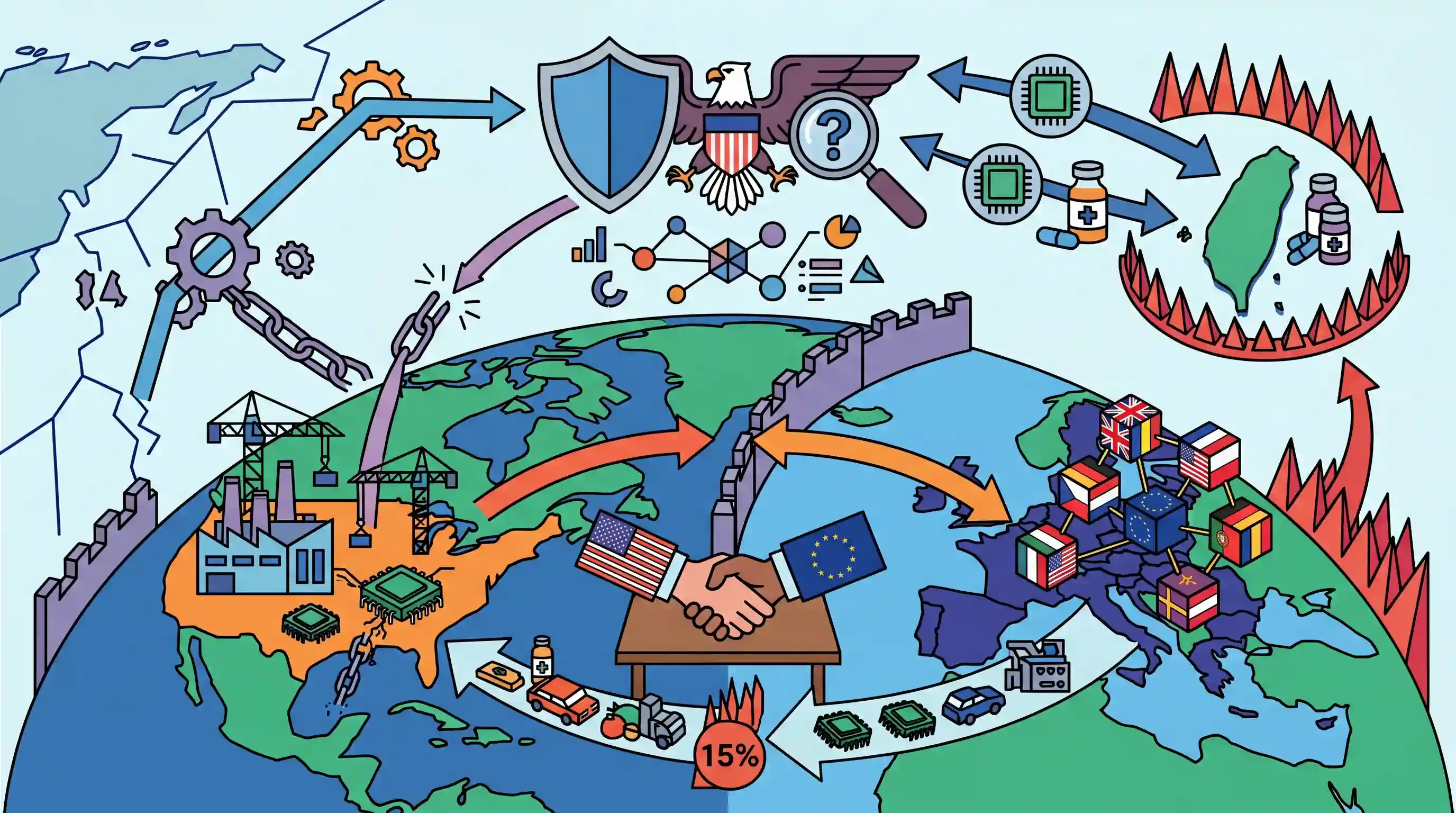
The U.S. administration is poised to conclude a national security investigation into the import of semiconductors and pharmaceuticals under Section 232 of the Trade Expansion Act of 1962, signaling potential new tariffs designed to decrease reliance on foreign suppliers, particularly Taiwan. Anticipating these tariffs, the European Union and the United States have reached a provisional bilateral agreement wherein the EU accepted a 15% blanket tariff on its exports to the U.S. to ensure its semiconductor exports are exempted from the Section 232 duties. This development highlights the growing global trend of trade protectionism, the weaponization of tariffs for national security objectives, and the geopolitical centrality of semiconductor supply chains.
Key Points
- The U.S. Commerce Department is finalizing a national security probe into semiconductor and pharmaceutical imports under Section 232 of the Trade Expansion Act of 1962.
- The investigation reflects a protectionist push to reduce U.S. reliance on foreign supply chains, particularly the dependence on Taiwanese semiconductor manufacturing.
- To avoid the impending Section 232 chip tariffs, the European Union agreed to a provisional framework with the U.S., accepting a 15% blanket tariff on EU goods entering the US in exchange for an exemption on chip imports.
- This move continues earlier efforts, such as the Biden administration's CHIPS and Science Act, which aimed to lure chipmakers to expand production within the United States.
Important Terms
Section 232 of the Trade Expansion Act of 1962

A U.S. law authorizing the President to restrict imports through tariffs or quotas if a Department of Commerce investigation finds they threaten national security.
UPSC context
GS Paper II & III; tests understanding of trade 'securitization,' unilateral trade tools, and impacts on global trade stability.
Semiconductor Supply Chains
The globally distributed network of research, design, fabrication, assembly, and testing required to produce integrated circuits; it is considered a critical strategic asset for national security.
UPSC context
GS Paper III (Economy/S&T); focuses on supply chain resilience, India's Semiconductor Mission, and the 'China Plus One' strategy.
CHIPS and Science Act
A 2022 U.S. law providing approximately $52.7 billion in subsidies to bolster domestic semiconductor manufacturing and research, aiming to reduce dependence on foreign suppliers.
UPSC context
GS Paper II & III; relevant for comparing global industrial policies (e.g., India's PLI schemes) and technological diplomacy.
Trade Protectionism
Government policies, such as tariffs and quotas, designed to restrict international trade to shield domestic industries and workers from foreign competition.
UPSC context
GS Paper III (Economy); tests the trade-off between self-reliance (Atmanirbhar Bharat) and global integration amid 'de-globalization' trends.
Global Value Chains (GVCs)
International production sharing where different stages of a product's lifecycle—from design to distribution—are fragmented across multiple countries, with each stage adding value.
UPSC context
GS Paper III (Economy); vital for understanding India’s integration into world trade and manufacturing competitiveness.
Bilateral Trade Agreements
Preferential trade treaties between two nations aimed at reducing trade barriers or resolving specific disputes, often serving as alternatives to multilateral WTO agreements.
UPSC context
GS Paper II (International Relations); focuses on India's evolving FTAs and the strategic shift toward 'friend-shoring' and bilateralism.
Prelims Trap
"Section 232 of the Trade Expansion Act is a WTO provision allowing tariffs on national security grounds."
Section 232 is a domestic U.S. law, not a WTO agreement. The actual WTO provision for national security exceptions is GATT Article XXI.
Static Concepts Connected
How does the WTO address national security exceptions in trade?
- GATT Article XXI: Permits WTO members to breach trade obligations if necessary to protect their essential security interests.
- Reviewability: Once considered entirely self-judging, recent WTO panel rulings established that the invocation of Article XXI is subject to objective review by the dispute settlement body.
- Current Trend: It is increasingly invoked to justify unilateral tariffs (e.g., semiconductors, steel), leading to bilateral 'managed trade' rather than multilateral free markets.
What is the strategic focus of the India Semiconductor Mission (ISM)?
- Nodal Agency: Operates as an independent business division under the Digital India Corporation (MeitY) to build a sustainable semiconductor and display ecosystem.
- PLI Support: Provides massive financial incentives (outlay of ₹76,000 crore) for setting up Semiconductor Fabs, Display Fabs, and OSAT/ATMP facilities.
- Geopolitical Aim: Capitalize on 'China-plus-one' and 'friend-shoring' trends to reduce India's import dependency on East Asian tech hubs like Taiwan.
Cross-Topic Patterns
Friend-shoring vs. Multilateralism
Bilateral 'managed trade' deals (like the US-EU tariff pact) bypass WTO frameworks, linking directly to the geoeconomic shift of 'friend-shoring' critical tech supply chains away from adversaries.
US CHIPS Act vs. India's PLI
The U.S. CHIPS Act represents aggressive state-led industrial policy. This directly competes with India's PLI scheme, increasing the cost of attracting global semiconductor FDI to India.

Expect a 2026 Prelims question linking WTO's GATT Article XXI (security exceptions) with unilateral trade barriers and 'friend-shoring'.
Linked PYQs · 3
Linked PYQs · 3
- 2025MainsGS3
India aims to become a semiconductor manufacturing hub. What are the challenges faced by the semiconductor industry in India? Mention the salient features of the India Semiconductor Mission.
- 2025MainsGS3
What are the challenges before the Indian economy when the world is moving away from free trade and multilateralism to protectionism and bilateralism? How can these challenges be met?
- 2018MainsGS3
How would the recent phenomena of protectionism and currency manipulations in world trade affect macroeconomic stability of India?
