Proposed UN Peacekeeping Force for Gaza and Chapter VII Mandate
Source:Indian Express ↗
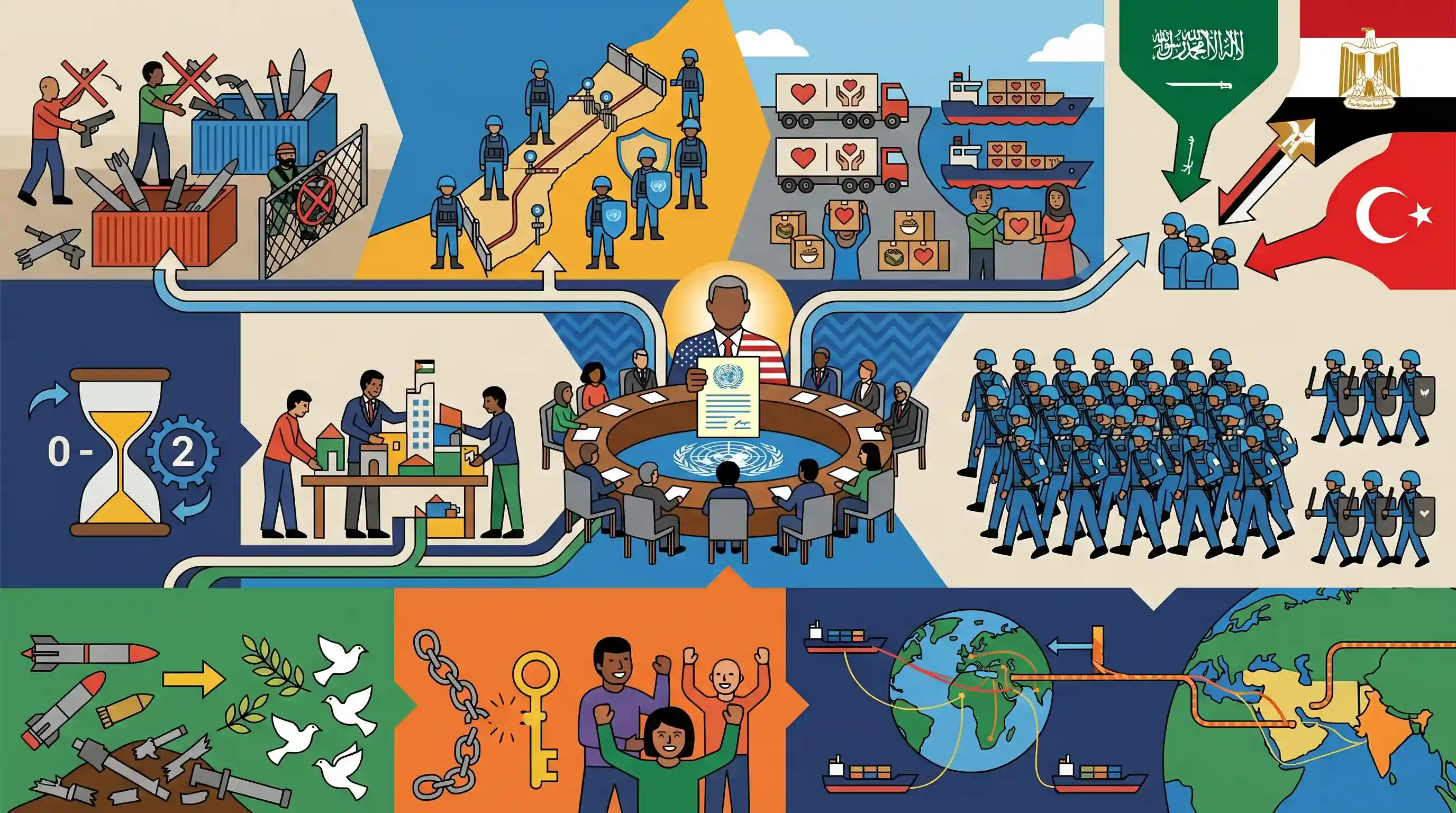
Why It Matters
This article is critical for understanding the evolving nature of international conflict resolution, the practical application of Chapter VII mandates by the UN Security Council, and the geopolitical dynamics of the Middle East peace process. It highlights the strategic interventions of global powers (US, Russia, China) and the involvement of regional Arab states, highly relevant for GS2 IR and questions on international organizations.
Summary
The United States has introduced a draft United Nations Security Council resolution seeking a two-year mandate to establish a transitional government and a 20,000-strong International Stabilisation Force (ISF) in Gaza. Following up on a recent US-brokered peace plan, the ISF aims to demilitarize Gaza by disarming non-state groups like Hamas, securing borders, and ensuring the safe delivery of humanitarian aid. The resolution proposes invoking Chapter VII of the UN Charter, allowing the force to use 'all necessary measures'. Potential troop contributors include several Middle Eastern and Eurasian states such as Saudi Arabia, Egypt, and Turkey, provided all hostilities cease and hostages are released.
Key Points
- The US has circulated a UN Security Council resolution proposing a two-year transitional governance body and an International Stabilisation Force (ISF) in Gaza.
- The ISF, estimated at 20,000 troops, would be authorized to use 'all necessary measures' (Chapter VII of the UN Charter) to secure borders, deliver aid, and protect civilians.
- The resolution calls for the complete demilitarization of non-state actors in Gaza, directly targeting the disarmament of Hamas, and conditions the ISF's deployment on the release of hostages.
- Proposed contributors to the ISF include key regional and international players like Egypt, Qatar, Saudi Arabia, Turkey, UAE, Indonesia, and Azerbaijan.
- The diplomatic maneuver is viewed as an extension of the Trump administration's 20-point peace plan, with US officials confident of bypassing potential Russian or Chinese vetoes.
Important Terms
International Stabilisation Force (ISF)

A multinational peacekeeping force authorized by UNSC Resolution 2803 (2025) to provide security, train Palestinian police, and oversee the demilitarization of the Gaza Strip.
UPSC context
GS Paper II: International Relations. Relevant for conflict resolution, peacekeeping mandates, and the role of major powers in West Asia.
Chapter VII of the UN Charter
The section of the United Nations Charter that empowers the Security Council to take enforcement actions, including military force, to maintain or restore international peace and security.
UPSC context
GS Paper II: International Institutions. Tests knowledge of collective security mechanisms and binding international law mandates.
Board of Peace (BoP)
A transitional governance administration established to oversee Gaza's civil governance, reconstruction, and the International Stabilisation Force during a two-year mandate following the conflict.
UPSC context
GS Paper II: International Relations. Important for understanding post-conflict state-building and transitional administration models in geopolitics.
United Nations Security Council (UNSC)
The primary UN organ responsible for maintaining international peace, with the unique authority to issue binding resolutions and authorize military interventions.
UPSC context
GS Paper II: Important International Institutions. Frequent topic regarding institutional reform and India's bid for permanent membership.
Hamas
A Palestinian political and militant organization that has governed Gaza since 2007; the US-led stabilization plan seeks its permanent disarmament and removal from power.
UPSC context
GS Paper II: Effect of Politics of Developed/Developing Countries. Essential for understanding non-state actors in West Asian geopolitics.
UNSC Resolution 2803
The specific 2025 UN resolution that mandated the International Stabilisation Force and the Board of Peace to transition Gaza toward long-term stability and demilitarization.
UPSC context
GS Paper II: Important International Institutions. Tests awareness of current global diplomatic developments and their impact on international security.
Prelims Trap
"The UN Charter's Chapter VII mandates traditional UN Peacekeeping operations based strictly on host country consent."
Chapter VII actually authorizes coercive peace ENFORCEMENT ('all necessary measures'/'use of force'). Traditional, consent-based peacekeeping falls informally under Chapter VI (or 'VI and a half').
Static Concepts Connected
How does UN Peacekeeping differ from Chapter VII Peace Enforcement?
- Chapter VI (Consent-based): Deals with the pacific settlement of disputes. Traditional peacekeeping relies heavily on the consent of the host nation and conflicting parties.
- Chapter VII (Coercive): Authorizes the UN Security Council to use economic sanctions or military force ('all necessary measures') to restore peace, not requiring host consent.
- Use of Force: Traditional peacekeepers only use force in self-defense or mandate defense. Chapter VII forces can conduct proactive offensive/combat operations to enforce peace.
What guides India's troop contributions to foreign military missions?
- UN Command Requirement: India traditionally deploys troops abroad strictly under a direct UN mandate and UN flag (Blue Helmets).
- Non-Interventionist Stance: India generally refrains from joining multinational peace-enforcement coalitions or military alliances that operate outside standard, consent-based UN peacekeeping frameworks.
- Leading Contributor: Despite avoiding non-UN enforcement coalitions, India is historically one of the largest troop contributors to traditional UN peacekeeping missions globally.
Cross-Topic Patterns
Arab states in active Gaza security roles
The inclusion of UAE, Saudi Arabia, and Egypt in the ISF proposal reflects a post-Abraham Accords shift where Arab nations take direct security roles in Palestinian territories, moving beyond mere diplomatic support.
P5 veto dynamics and UN paralysis
The US attempt to navigate potential Russian or Chinese vetoes connects to the broader theme of UNSC institutional paralysis, frequently tested alongside demands for UN structural reforms.

Distinguishing Chapter VII peace enforcement from traditional UN peacekeeping is highly likely as a multi-statement question in 2026.
Linked PYQs · 4
Linked PYQs · 4
- 2025MainsGS2
"The reform process in the United Nations remains unresolved, because of the delicate imbalance of East and West and entanglement of the USA vs. Russo-Chinese alliance.” Examine and critically evaluate the East-West policy confrontations in this regard.
- 2023PrelimsGS1
Consider the following statements: Statement-I: Israel has established diplomatic relations with some Arab States. Statement-II: The 'Arab Peace Initiative' mediated by Saudi Arabia was signed by Israel and Arab League. Which one of the following is correct in respect of the above statements?
- 2024MainsGS2
‘Terrorism has become a significant threat to global peace and security.’ Evaluate the effectiveness of the United Nations Security Council's Counter Terrorism Committee (CTC) and its associated bodies in addressing and mitigating this threat at the international level.
- 2015MainsGS2
Discuss the impediments India is facing in its pursuit of a permanent seat in UN Security Council.
