US trade delegation to visit India for bilateral pact talks
Source:The Hindu ↗
Why It Matters
The evolving India-U.S. trade dynamic highlights the complexities of negotiating bilateral agreements amidst rising protectionist tendencies and tariff impositions globally. For UPSC aspirants, this article illustrates the interplay between foreign policy, international trade regulations (like Sections 122 and 301), foreign direct investment in critical technology sectors, and the domestic imperative of safeguarding MSMEs.
Summary
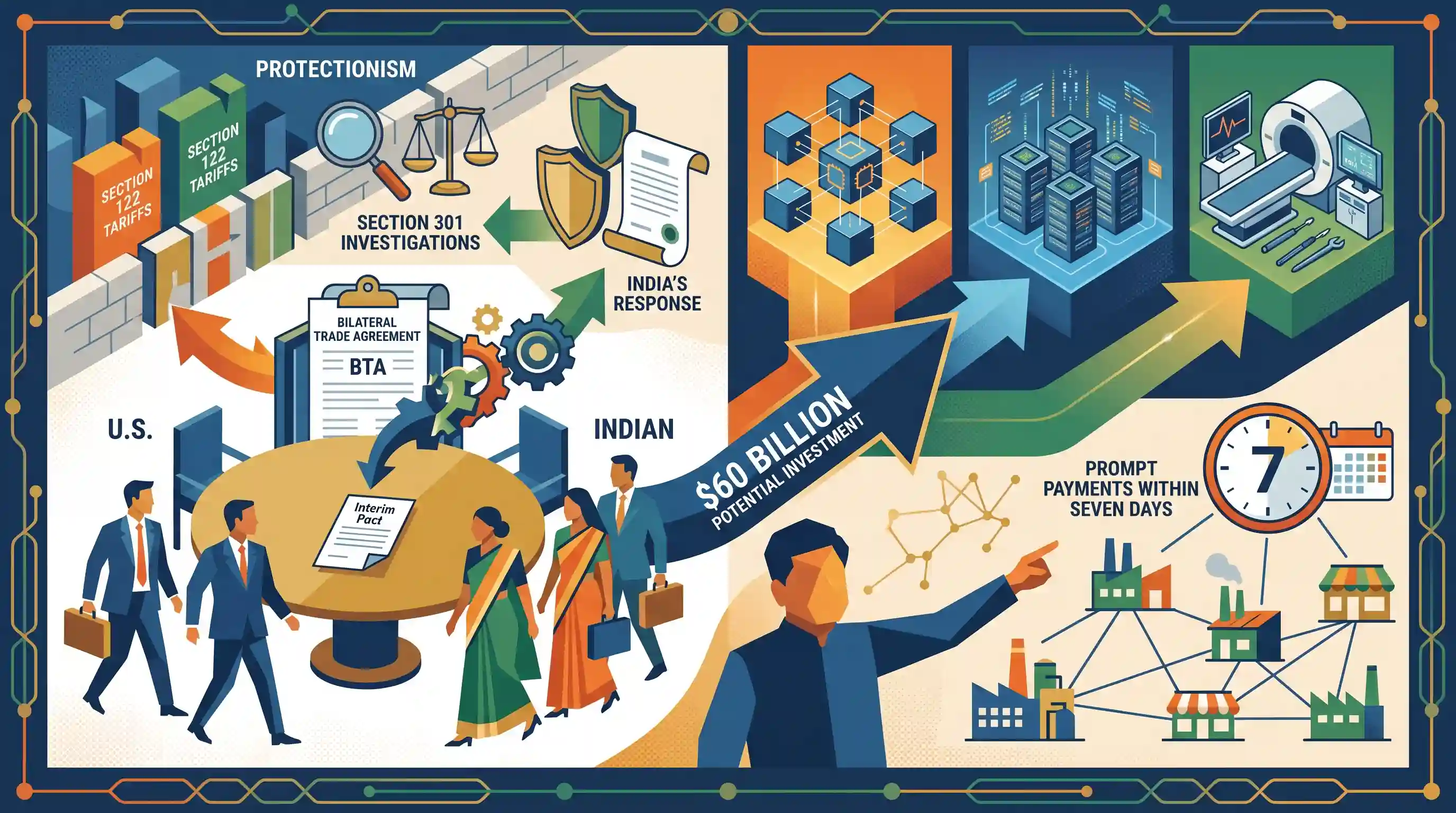
A U.S. delegation is scheduled to visit India next month for crucial trade negotiations, aiming to finalize an interim pact and progress towards a broader Bilateral Trade Agreement (BTA). These discussions follow recent protectionist measures by the U.S., including the imposition of tariffs under Section 122 and investigations under Section 301 of the Trade Act, to which India has submitted responses. Despite these hurdles, India aims to leverage up to $60 billion in potential American investments in advanced sectors like quantum computing, digital data centres, and medical devices. Additionally, Commerce Minister Piyush Goyal emphasized the need to support Indian MSMEs, suggesting that U.S. firms should ensure prompt payments within seven days to boost the sector.
Key Points
- A U.S. delegation is expected to visit India next month to take forward negotiations for an interim trade pact and a broader Bilateral Trade Agreement (BTA).
- Trade talks are navigating challenges posed by recent U.S. actions, including 10% additional duties under Section 122 and ongoing probes under Section 301 of the U.S. Trade Act regarding excess production and labour standards.
- India is looking to harness upwards of $60 billion in potential U.S. industry commitments across critical domains such as technology, digital data centres, quantum computing, high-precision defence, and medical devices.
- Commerce and Industry Minister Piyush Goyal urged U.S. companies operating in India to support the domestic MSME sector by reducing their payment cycles to seven days.
Important Terms
Bilateral Trade Agreement (BTA)

A formal treaty between two nations to facilitate trade and investment by reducing or eliminating barriers like tariffs, quotas, and non-tariff restrictions.
UPSC context
GS-II: International Relations (India-US bilateral ties); GS-III: Economy (Trade policy and WTO compliance).
Section 301 of the US Trade Act
A provision under the US Trade Act of 1974 that authorizes the USTR to investigate and penalize foreign trade practices deemed unfair or harmful to US interests.
UPSC context
GS-III: Economy; tests understanding of trade protectionism and its impact on Indian exports like steel and solar.
Section 122 of the US Trade Act
A legal provision granting the US President temporary authority to impose tariffs (up to 15%) for 150 days to address serious balance-of-payments deficits.
UPSC context
GS-III: Economy; relevant to global trade wars and US-India tariff disputes over balance-of-payments emergencies.
MSMEs (Micro, Small and Medium Enterprises)
Enterprises classified by investment and turnover thresholds under the MSMED Act, 2006; they are vital for employment and contribute significantly to India's GDP and exports.
UPSC context
GS-III: Economy; focuses on growth, liquidity challenges (delayed payments), and their role in the "Atmanirbhar Bharat" initiative.
Interim Trade Agreement
A limited trade pact covering specific sectors or products, acting as a precursor to a comprehensive Free Trade Agreement or Bilateral Trade Agreement.
UPSC context
GS-II: International Relations; tests knowledge of gradual economic integration and GATT Article XXIV requirements.
Prelims Trap
"US Section 301 investigations are conducted under the mandate of the WTO's dispute settlement mechanism."
Section 301 is a unilateral U.S. domestic law tool allowing retaliatory tariffs outside the WTO's multilateral framework. UPSC often traps students by framing such tools as WTO-mandated.
Static Concepts Connected
What differentiates an Early Harvest Scheme from a Free Trade Agreement (FTA)?
- Early Harvest: A precursor pact reducing tariffs on a limited, specific list of goods to build trust before finalizing a full FTA.
- Comprehensive FTA: A broader agreement covering goods, services, intellectual property, investment, and binding dispute resolution.
- WTO Article XXIV: WTO requires FTAs to cover "substantially all trade," making prolonged early harvest schemes legally ambiguous if they do not culminate in an FTA.
How does Indian law protect MSMEs against delayed payments from buyers?
- MSMED Act 2006: Legally mandates buyers to clear dues to micro and small enterprises within a maximum of 45 days of acceptance of goods or services.
- Penal Interest: Buyers delaying payments beyond the statutory period must pay compound interest at three times the RBI notified bank rate.
- Section 43B(h) IT Act: Disallows tax deductions for companies if they fail to pay MSME suppliers within the 45-day window, enforcing timely working capital flow.
Cross-Topic Patterns
Deep-tech FDI under the iCET framework
The targeting of $60B in quantum, data centres, and defence reflects a strategic bilateral pivot from traditional IT services to high-value deep-tech manufacturing, anchored by the India-US iCET initiative.
Unilateralism vs WTO Dispute Settlement
U.S. reliance on Section 301 to bypass WTO multilateral mechanisms highlights the growing global trend of weaponizing domestic laws for protectionism amidst an inactive WTO Appellate Body.

Expect a 2026 prelims question pairing 'Early Harvest Schemes' (WTO GATT Art XXIV) with unilateral trade tools like US Section 301.
Linked PYQs · 3
Linked PYQs · 3
- 2012MainsGS2
Discuss the likely negative impact of the protectionist measures proposed by the US on India's software industry.
- 2023MainsGS3
Faster economic growth requires increased share of the manufacturing sector in GDP, particularly of MSMEs. Comment on the present policies of the Government in this regard.
- 2016MainsGS3
Justify the need for FDI for the development of the Indian economy. Why there is gap between MOUs signed and actual FDIs? Suggest remedial steps to be taken for increasing actual FDIs in India.
