US tariffs legal defense and India Pakistan ceasefire implications
Source:Indian Express ↗
Why It Matters
This development is highly relevant for UPSC aspirants as it vividly illustrates the 'weaponization of trade' where protectionist measures are justified as essential foreign policy tools. It connects GS2 topics like India-US relations, US influence in South Asia (India-Pakistan dynamics), and the bypassing of multilateral institutions like the WTO, with GS3 themes of global trade wars and protectionism.
Summary
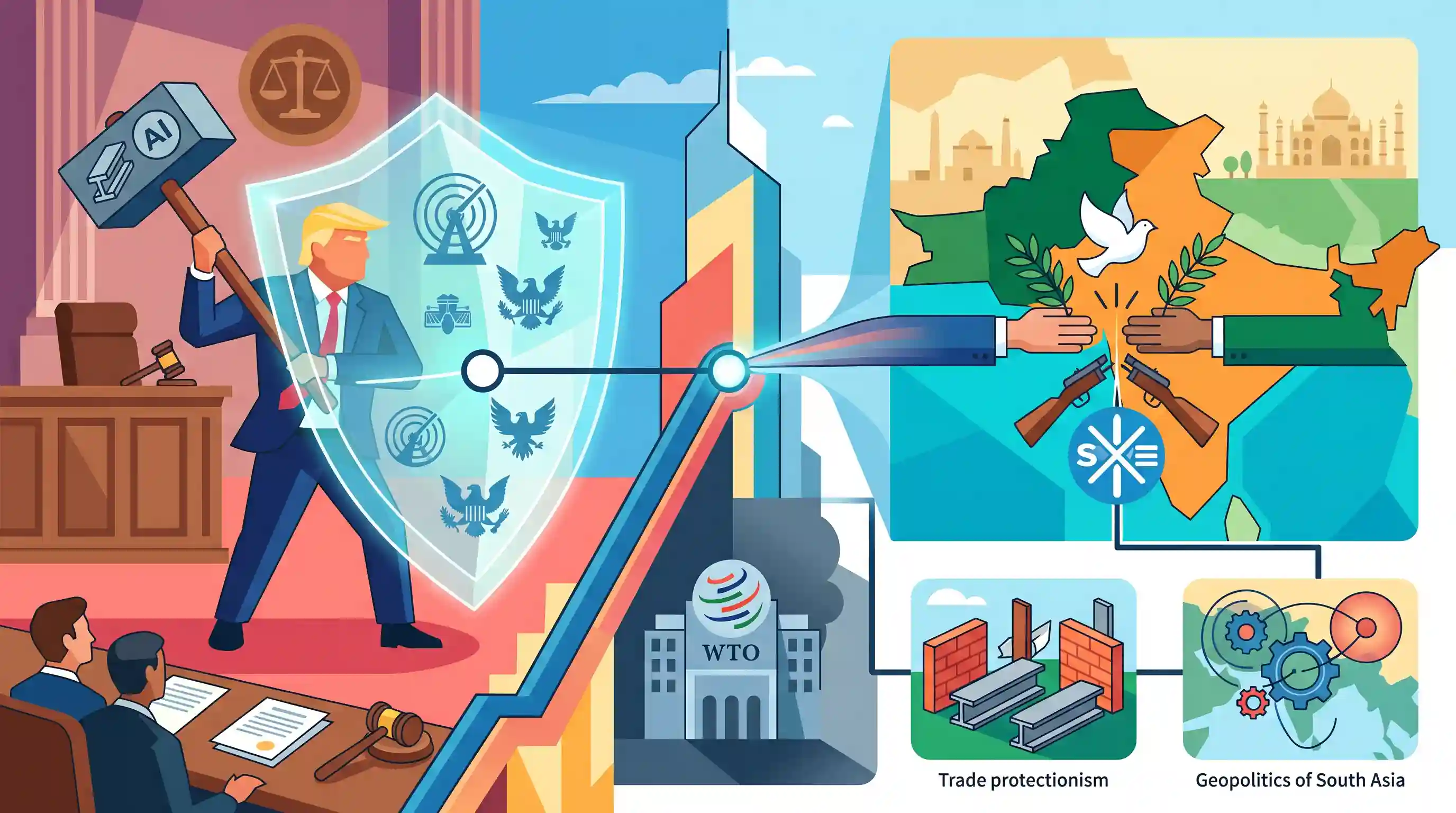
Defending its imposition of Section 232 tariffs on imports like steel and aluminum in US court, the Trump administration argued that stripping the President of these tariff powers would severely undermine US national security and foreign policy leverage. To illustrate the stakes, the administration claimed that a legal setback to this executive authority could jeopardize sensitive diplomatic achievements, explicitly citing the US role in mediating the India-Pakistan ceasefire. This legal defense highlights the growing intersection of protectionist trade policies and geopolitics, demonstrating how the US utilizes economic tools under 'national security exceptions' to project power and influence regional dynamics in South Asia.
Key Points
- The US administration defended Section 232 tariffs in court by arguing that trade measures are inextricably linked to the President's national security and foreign policy authority.
- The government explicitly cited that undermining these executive powers could jeopardize diplomatic achievements, claiming it would put the India-Pakistan ceasefire at risk.
- The article underscores the increasing weaponization of trade and economic policies to achieve broader geopolitical and diplomatic objectives.
- It highlights the trend of bypassing multilateral trade rules (like WTO norms) by invoking broad 'national security exceptions'.
Important Terms
Section 232 of the Trade Expansion Act of 1962

A US legal provision allowing the President to impose tariffs or quotas on imports if a Department of Commerce investigation determines they threaten national security.
UPSC context
GS-2 and GS-3; relevant for understanding trade barriers and 'national security' as a tool for economic statecraft.
National Security Exception (GATT Article XXI)
A WTO clause permitting member nations to bypass trade obligations to protect 'essential security interests' during war, international emergencies, or concerning fissionable materials.
UPSC context
GS-3; tests knowledge of legal loopholes in global trade and the 'self-judging' nature of international security claims.
International Emergency Economic Powers Act (IEEPA)
A 1977 US law authorizing the President to regulate international commerce and impose sanctions after declaring a national emergency in response to an external threat.
UPSC context
GS-2; highlights the expansion of executive authority in foreign policy and its intersection with global economic stability.
Trade Protectionism
Economic policy of restricting imports through tariffs, quotas, or subsidies to shield domestic industries and workers from foreign competition.
UPSC context
GS-3; core concept regarding globalization, 'Aatmanirbhar Bharat', and shifts in the post-liberalization global order.
Operation Sindoor
A 2025 Indian military operation targeting terrorist infrastructure in Pakistan following a terror attack in Pahalgam, leading to a significant regional crisis.
UPSC context
GS-2; specific current affairs term regarding India-Pakistan relations and recent regional security dynamics.
Director General of Military Operations (DGMO)
The high-ranking military officer responsible for executing operations; the India-Pakistan DGMO hotline is a primary mechanism for managing cross-border tensions and ceasefires.
UPSC context
GS-2; critical for understanding institutional crisis-management frameworks and India's bilateral approach to border disputes.
World Trade Organization (WTO)
The global body regulating international trade rules, providing a framework for negotiating agreements and resolving disputes between its 164 member nations.
UPSC context
GS-3; fundamental for topics on global economic governance and India’s interests in multilateral trade negotiations.
Prelims Trap
"Section 232 of the WTO agreement allows member nations to impose unilateral tariffs for national security."
Section 232 is a US domestic law (Trade Expansion Act of 1962), not a WTO provision. The WTO equivalent is GATT Article XXI.
Static Concepts Connected
What is the National Security Exception under GATT Article XXI?
- Core provision: Allows a WTO member to breach standard trade obligations if necessary to protect its essential security interests.
- Emergency use: Typically invoked during war or international emergencies, but increasingly used by nations to justify broad protectionist tariffs (e.g., on steel/aluminium).
- Threat to WTO: Its frequent invocation threatens foundational WTO principles like Most Favoured Nation (MFN), as it relies largely on self-judging criteria by the invoking state.
How does the Most Favoured Nation (MFN) principle function in the WTO?
- Equal treatment: Mandates that a WTO member must treat all other members equally; any trade favor granted to one must immediately be granted to all.
- GATT Article I: Enshrined in GATT Article I, it aims to prevent discriminatory trade practices and unilateral tariff walls.
- Valid exceptions: Permits exemptions for Free Trade Agreements (FTAs) and preferential treatment for developing nations (Generalized System of Preferences).
Cross-Topic Patterns
Geoeconomics and Trade Weaponisation
The blending of domestic tariff laws with diplomatic mediation highlights how major powers increasingly use geoeconomic tools—bypassing multilateral WTO norms—to exert strategic leverage over regional conflicts.
Third-party Mediation vs. Indian Bilateralism
India traditionally rejects third-party mediation in Pakistan conflicts (Shimla Agreement). US court claims of leveraging trade powers to sustain the ceasefire directly challenge India's strict bilateralism stance.

Expect a 2026 Mains question on how the weaponisation of trade by developed nations via 'security exceptions' undermines WTO's authority.
Linked PYQs · 3
Linked PYQs · 3
- 2018MainsGS2
What are the key areas of reform if the WTO has to survive in the present context of "Trade War', especially keeping in mind the interest of India?
- 2018MainsGS3
How would the recent phenomena of protectionism and currency manipulations in world trade affect macroeconomic stability of India?
- 2025MainsGS3
What are the challenges before the Indian economy when the world is moving away from free trade and multilateralism to protectionism and bilateralism? How can these challenges be met?
