US Section 301 Tariffs and Trade Deal Leverage on India
Source:Indian Express ↗
Why It Matters
This article is important for UPSC GS3 (International Trade, Global Protectionism, and Bilateral Relations) as it analyzes how developed nations use domestic trade laws like Section 301 and dual-rate tariff structures to influence trade policies and compel developing nations into bilateral pacts.
Summary
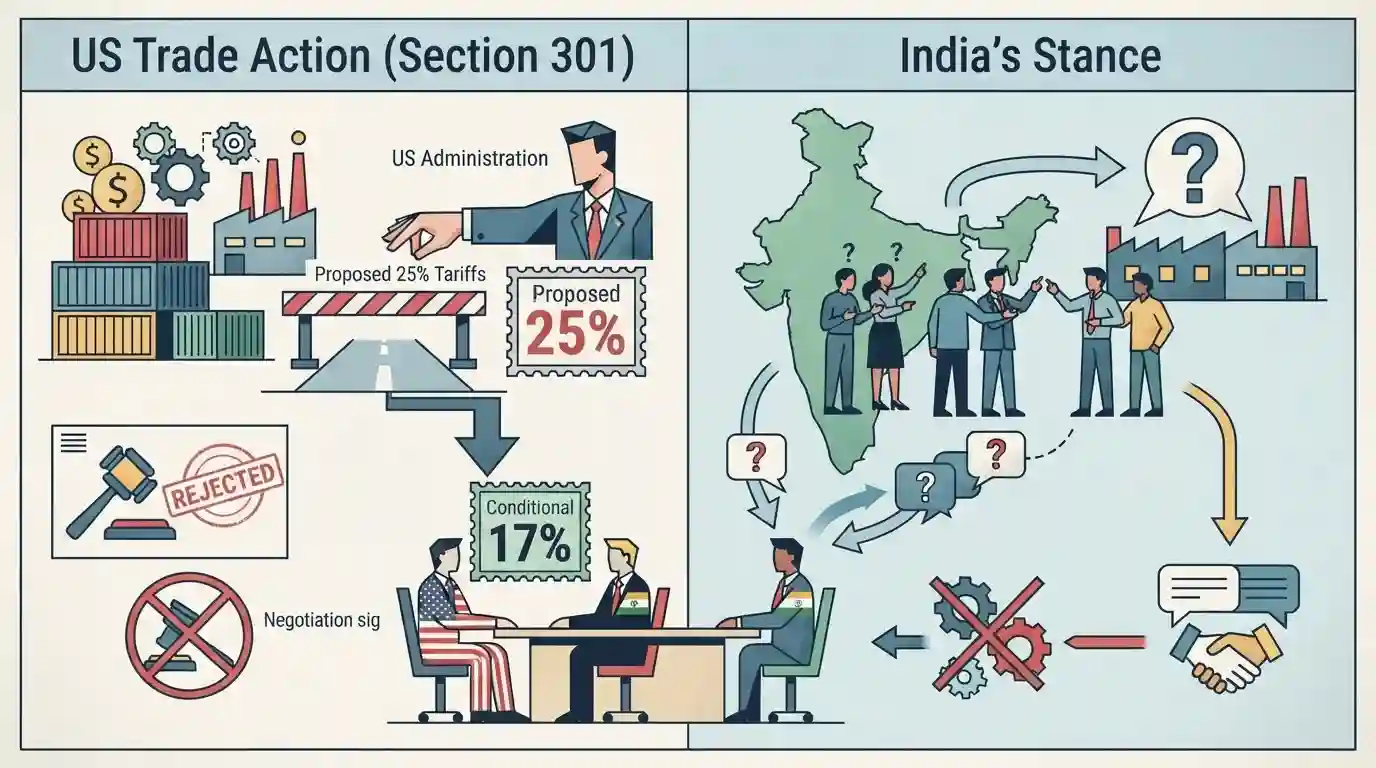
The US administration has proposed 25% tariffs on 14 trading partners, including India, under Section 301 of the US Trade Act, citing structural industrial overcapacity and forced labour. The rate offers a conditional discount to 17% if a formal bilateral trade agreement is signed, functioning as a strategic lever for trade negotiations following earlier legal setbacks to reciprocal tariffs. India has rejected the overcapacity claims, asserting that concerns should be addressed through ongoing trade talks.
Key Points
- The United States proposed a final tariff rate of 25% on India under Section 301 investigations regarding forced labour and industrial overcapacity, which reduces to 17% if a bilateral trade deal is finalized.
- The dual-rate structure acts as a leverage tool by Washington to compel trading partners into unilateral trade pacts, substituting previous reciprocal tariffs struck down by the US Supreme Court.
- India's Commerce Ministry maintained that India has no structural excess capacity and that trade issues should be resolved through ongoing bilateral trade negotiations.
- Sectors targeted under the investigation include solar modules, petrochemicals, steel, textiles, health-related goods, construction materials, and automotive products.
Important Terms
Section 301 of the US Trade Act of 1974

A provision of the US Trade Act of 1974 empowering the U.S. Trade Representative to investigate and take punitive actions against foreign trade practices that burden U.S. commerce.
UPSC context
GS Paper II/III: Important International Institutions, Bilateral Groupings, and Global Trade Dynamics. Tests understanding of US trade protectionism and legal mechanisms.
Office of the United States Trade Representative (USTR)
The Executive branch agency in the United States responsible for developing and recommending international trade policy, leading trade negotiations, and conducting Section 301 investigations.
UPSC context
GS Paper II/III: Bilateral Relations and Global Economic Governance. Tests knowledge of key US regulatory bodies impacting Indian exports.
International Emergency Economic Powers Act (IEEPA)
A US statute granting the President broad powers to declare a national emergency to deal with unusual and extraordinary threats originating outside the US, often used for economic sanctions and tariffs.
UPSC context
GS Paper III: International Trade and Protectionism. Tests understanding of US executive powers deployed for unilateral trade measures and judicial pushback.
Prelims Trap
Section 301 tariffs are sanctioned and administered directly by the World Trade Organization as multilateral safeguards.
Section 301 is an instrument of domestic US law (US Trade Act of 1974), not a WTO-mandated trade remedy mechanism like anti-dumping duties.
Static Concepts Connected
What is Section 301 of the US Trade Act and how does it relate to the WTO?
- Unilateral Power: Domestic Authority: Grants the USTR broad discretionary power to investigate and retaliate against foreign trade practices deemed burdensome to US commerce.
- WTO Conflict: WTO Incompatibility: Often criticized for bypassing multilateral dispute settlement mechanisms, as unilateral tariff impositions violate WTO bound rates.
- Historical Use: Historical Context: Used extensively in the 1980s against Japan and recently revived for broad geopolitical trade leverage.
Cross-Topic Patterns
Section 301 Tariffs vs. WTO Dispute Settlement
US unilateral trade enforcement under Section 301 bypasses WTO appellate mechanisms, raising core questions on multilateralism versus bilateral economic coercion in UPSC GS-2.
Industrial Overcapacity and Global Supply Chains
Overcapacity allegations in steel, solar, and petrochemicals link US trade policy directly to industrial policy and domestic production subsidies under GS-3.

Section 301 discretionary authority + WTO rules violation + India's export vulnerabilities likely as a multi-statement Prelims question.
Linked PYQs · 2
Linked PYQs · 2
- 2025MainsGS3
What are the challenges before the Indian economy when the world is moving away from free trade and multilateralism to protectionism and bilateralism? How can these challenges be met?
- 2018MainsGS3
How would the recent phenomena of protectionism and currency manipulations in world trade affect macroeconomic stability of India?
