Impact of United States Global Tariff Hikes on India
Source:Indian Express ↗
Why It Matters
The article is highly relevant for understanding the shift from multilateral free trade to unilateral protectionism. It directly addresses the themes of recurring UPSC Mains questions regarding global trade wars, the declining relevance of the WTO, and India's economic strategy amidst shifting global supply chains.
Summary
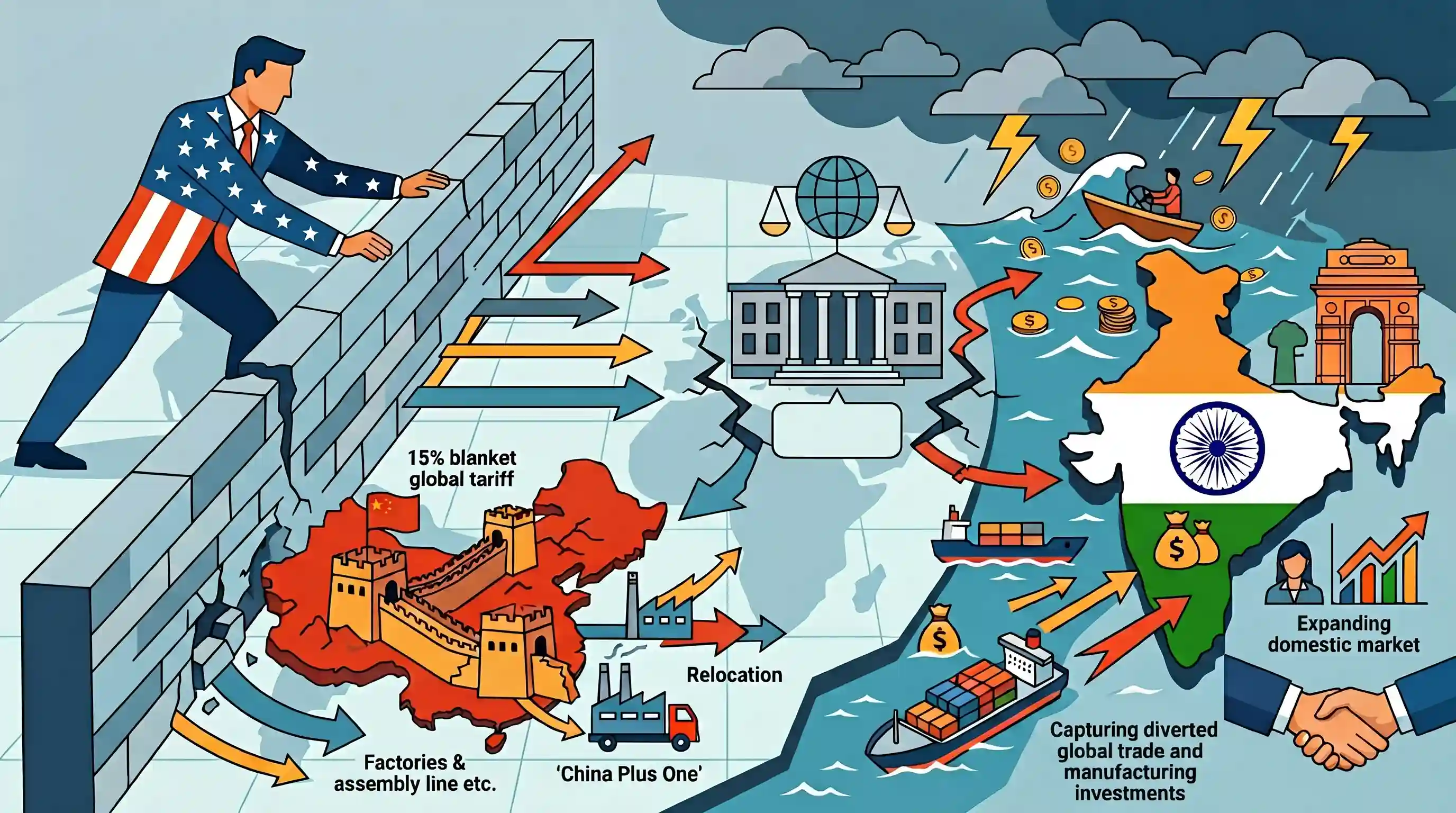
The article analyzes the economic and geopolitical implications of the US implementing a 15% blanket global tariff under Donald Trump. While the move reflects a sharp pivot towards unilateral protectionism—bypassing traditional global trade arbitration mechanisms such as the WTO's dispute settlement body—India might surprisingly benefit. The tariffs are expected to disproportionately penalize China, which could face duties up to 60%, thereby accelerating the 'China Plus One' supply chain shift. Consequently, India, with its expanding domestic market and strategic bilateral ties with the US, stands a strong chance to capture diverted global trade and manufacturing investments, provided it can successfully navigate the broader macroeconomic uncertainties triggered by a potential global trade war.
Key Points
- The US administration's proposal of a 15% global tariff marks a definitive shift towards unilateral protectionism, moving away from multilateral free trade norms.
- The move bypasses the WTO's traditional dispute settlement mechanisms (often referred to as the 'Supreme Court of global trade'), further weakening the global rules-based trading order.
- Despite facing the 15% tariff, India could gain a relative competitive advantage due to the anticipated harsher tariffs (potentially up to 60%) that the US may levy against China.
- The tariff hike is likely to accelerate the 'China Plus One' strategy, pushing global supply chains to relocate manufacturing bases away from China and towards emerging markets like India.
- To fully capitalize on this global trade realignment, India must leverage its strategic bilateral relationship with the US while managing potential macroeconomic shocks from an ensuing global trade war.
Important Terms
China Plus One strategy

A global business strategy where companies diversify supply chains by establishing manufacturing bases in countries other than China to mitigate geopolitical and supply chain risks.
UPSC context
GS Paper 3: Effects of Liberalization, Industrial Policy; tests understanding of India's manufacturing potential and export competitiveness.
Dispute Settlement Body (DSB)
A WTO organ that adjudicates trade conflicts. It is currently in crisis as its Appellate Body is paralyzed due to the U.S. blocking member appointments since 2019.
UPSC context
GS Paper 2: Important International Institutions; tests knowledge of multilateral trade governance and the shift toward unilateralism.
Protectionism
Economic policy of restricting imports through tariffs, quotas, or regulations to shield domestic industries from foreign competition, often contrasted with free-trade principles.
UPSC context
GS Paper 3: Indian Economy and issues relating to planning, mobilization of resources, and growth; tests impact of global trade shifts.
Section 122 (Trade Act of 1974)
A U.S. legal provision allowing the President to impose temporary import surcharges (up to 15%) for 150 days to address large balance-of-payment deficits.
UPSC context
GS Paper 2: Effect of policies of developed countries on India's interests; tests legal instruments used in global trade wars.
Supply Chain Resilience
The ability of a supply chain to withstand and recover from disruptions, such as pandemics or geopolitical tensions, often through diversification and localizing production.
UPSC context
GS Paper 3: Changes in industrial policy and their effects on industrial growth; relevant to G20 and Indo-Pacific cooperation.
Bilateral Trade Agreement (BTA)
A treaty between two nations to reduce trade barriers and increase market access, currently a major focus of India-U.S. diplomatic engagements to mitigate tariff impacts.
UPSC context
GS Paper 2: Bilateral groupings and agreements involving India; tests strategic economic diplomacy and trade negotiation capacity.
Prelims Trap
"India is exempted from the new 15% US global tariff due to strategic bilateral trade waivers."
India is not exempt. The 15% tariff is a 'blanket' global levy. India's benefit is strictly relative because China faces a much steeper 60% rate.
Static Concepts Connected
Why is the WTO's Dispute Settlement Mechanism currently paralyzed?
- Appellate Body: Acts as the highest global trade court, tasked with hearing appeals on trade disputes between member countries.
- US Blockade: The US has continuously blocked new judicial appointments since 2019, preventing the minimum three-judge quorum required to hear appeals.
- MPIA Alternative: The Multi-Party Interim Appeal Arbitration Arrangement was created by some members to bypass the deadlock, but the US and India are not signatories.
What are Trade Creation and Trade Diversion in international economics?
- Trade Creation: Occurs when policy changes cause trade to shift from a high-cost domestic producer to a lower-cost, more efficient foreign producer.
- Trade Diversion: Occurs when tariffs or trade agreements shift imports from the most efficient global supplier to a less efficient but tariff-advantaged supplier (e.g., bypassing China for India).
Cross-Topic Patterns
China Plus One + PLI Strategy
India's ability to capitalize on US-China trade wars relies heavily on domestic manufacturing incentives (PLI scheme) to absorb diverted supply chains in critical sectors like electronics and specialty steel.
Trade Protectionism + Imported Inflation
Blanket US tariffs often trigger imported inflation for developing nations. As intermediate goods become costlier, domestic MSMEs face reduced export competitiveness, complicating the RBI's macroeconomic management.

Expect a multi-statement Prelims question linking WTO Appellate Body paralysis, US protectionism, and 'China Plus One' supply chain shifts.
Linked PYQs · 3
Linked PYQs · 3
- 2018MainsGS3
How would the recent phenomena of protectionism and currency manipulations in world trade affect macroeconomic stability of India?
- 2025MainsGS3
What are the challenges before the Indian economy when the world is moving away from free trade and multilateralism to protectionism and bilateralism? How can these challenges be met?
- 2018MainsGS2
What are the key areas of reform if the WTO has to survive in the present context of "Trade War', especially keeping in mind the interest of India?
