US tariff policies threaten global trade and supply chain stability
Source:The Hindu ↗
Why It Matters
This article illustrates the tangible macroeconomic impacts of protectionist policies and trade wars. It provides critical context for understanding how geopolitical decoupling affects global trade patterns, risks to developing economies, and opportunities for India to capitalize on the restructuring of global supply chains.
Summary
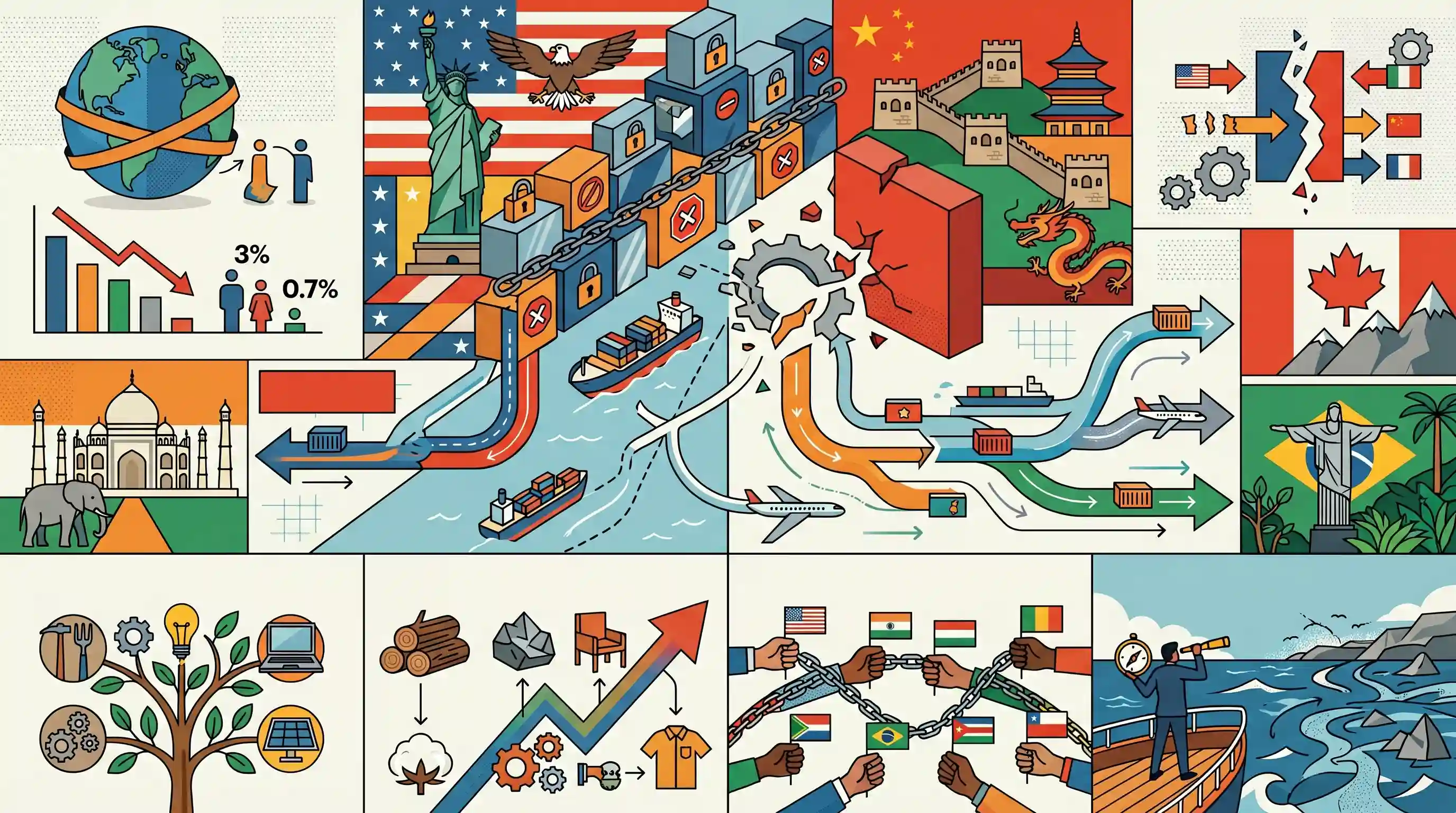
According to a top United Nations economist, U.S. tariff policies and the escalating trade war with China could shrink global trade by 3% and reduce global GDP by 0.7% by 2040. While U.S. President Donald Trump has paused "reciprocal tariffs" for most countries for 90 days, the tit-for-tat escalation with China continues, virtually halting bilateral goods trade. The International Trade Centre notes that while this disruption severely harms overall trade, it is causing significant supply chain shifts, redirecting exports toward nations like India, Canada, and Brazil. Developing nations are urged to prioritize economic diversification, value addition, and regional integration to navigate these long-term geopolitical uncertainties.
Key Points
- Escalating U.S.-China reciprocal tariffs (145% on Chinese imports, 125% on U.S. imports) have effectively halted direct bilateral trade between the world's two largest economies.
- A top U.N. economist warns that global trade volume could shrink by 3%, while global GDP could contract by 0.7% by 2040 due to protectionist measures.
- The disruption is prompting a massive restructuring of global supply chains, with exports from heavily impacted countries like Mexico and Vietnam redirecting toward India, Canada, Brazil, and the Middle East.
- Developing economies face severe risks; for instance, Bangladesh's critical garment sector could lose $3.3 billion annually if facing a reciprocal 37% U.S. tariff.
- To build resilience against such geopolitical shocks, developing countries must proactively focus on diversification, value addition, and regional economic integration.
Important Terms
Reciprocal Tariffs

Trade duties imposed by a country that mirror the exact rates set by its trading partners, shifting from multilateral rules toward a "tit-for-tat" bilateral approach.
UPSC context
GS-III (Economy/Trade); relevant for 'Effect of policies of developed countries on India’s interests' (GS-II).
International Trade Centre (ITC)
A joint agency of the UN and WTO dedicated to helping small and medium-sized enterprises (SMEs) in developing countries connect to global markets.
UPSC context
GS-II (International Institutions); crucial for understanding multilateral trade assistance and SME export promotion.
CEPII
The leading French research center in international economics that provides trade modeling and data to global organizations for policy forecasting.
UPSC context
GS-III (Economy); tests familiarity with international bodies providing data for global trade projections and economic stability.
Protectionism
An economic policy of restricting imports through tariffs, quotas, or subsidies to protect domestic industries from foreign competition.
UPSC context
GS-III (Globalization/Liberalization); central to the debate on free trade versus national economic security.
Asia Society Policy Institute (ASPI)
A US-based "think-and-do tank" that addresses geopolitical and economic challenges in the Asia-Pacific, particularly US-China trade and regional security.
UPSC context
GS-II (International Relations); important for understanding non-state actors' influence on regional trade policy and norms.
Economic Diversification
The process of broadening a nation's economic activities across multiple sectors to reduce vulnerability to market shocks and single-commodity dependencies.
UPSC context
GS-III (Economic Development); key strategy for resilience in developing economies amidst global supply chain shifts.
United Nations (UN)
The global organization that coordinates international cooperation; its trade-focused arms (e.g., UNCTAD, ITC) provide the framework for inclusive global economic growth.
UPSC context
GS-II (Important International Agencies); tests knowledge of the institutional framework governing global trade and development.
Prelims Trap
"The International Trade Centre (ITC) is an exclusive agency of the World Trade Organization."
The ITC is not a purely WTO or UN body. It is a joint mandate agency of BOTH the UN and the WTO, focusing on SME internationalization.
Static Concepts Connected
What is Trade Diversion in international economics?
- Definition: Occurs when trade shifts from a more efficient global exporter to a less efficient one due to the imposition of trade barriers or preferential agreements.
- Current Context: U.S. reciprocal tariffs on China artificially divert export opportunities to countries like India and Mexico, even if China was originally the most cost-effective producer.
What are the valid exceptions to the WTO's Most-Favored-Nation (MFN) principle?
- Regional Agreements: Countries can set lower tariffs for partners within Free Trade Agreements (FTAs) or Customs Unions without extending them to all WTO members.
- GSP: The Generalized System of Preferences allows developed nations to offer preferential, non-reciprocal tariffs to developing countries.
- Trade Remedies: Anti-dumping and countervailing duties can be applied specifically against nations engaging in unfair trade practices, bypassing MFN rules.
Cross-Topic Patterns
Supply chain shifts and domestic PLI schemes
India's domestic Production Linked Incentive (PLI) schemes are strategically timed to capitalize on this global trade diversion and the "China-Plus-One" supply chain restructuring driven by US-China tariff wars.
Protectionism driving Regional Integration
As multilateral WTO frameworks stall due to superpower friction, developing nations are increasingly pivoting to regional economic integration (like RCEP or AfCFTA) as a protective buffer against tariff shocks.

Expect a GS-3 question in 2026 linking rising Western protectionism, the breakdown of WTO frameworks, and India's 'China-Plus-One' gains.
Linked PYQs · 4
Linked PYQs · 4
- 2025MainsGS3
What are the challenges before the Indian economy when the world is moving away from free trade and multilateralism to protectionism and bilateralism? How can these challenges be met?
- 2018MainsGS3
How would the recent phenomena of protectionism and currency manipulations in world trade affect macroeconomic stability of India?
- 2018MainsGS2
What are the key areas of reform if the WTO has to survive in the present context of "Trade War', especially keeping in mind the interest of India?
- 2012MainsGS2
Why is international trade perceived to have failed to act as an "engine of growth" in many developing countries including India?
