India experiences major corporate earnings downgrades from tariffs
Source:The Hindu ↗
Why It Matters
The article provides a real-world case study of how external trade shocks (U.S. protectionism) directly threaten India's macroeconomic stability and how fiscal policy (tax cuts) is used as a counter-cyclical tool to stimulate domestic consumption. It perfectly aligns with GS3 topics on the effects of liberalization and changes in industrial policy.
Summary
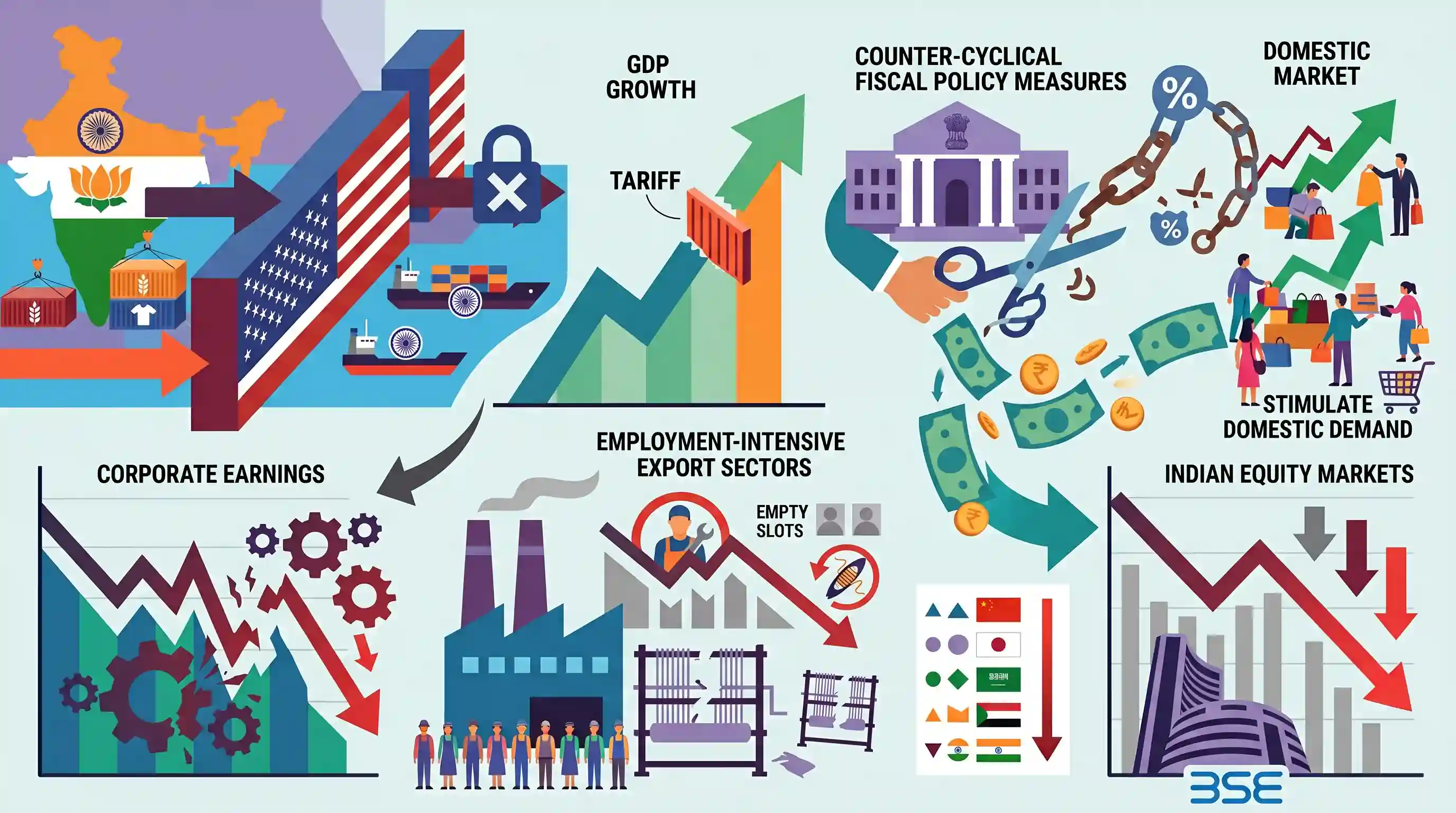
Steep U.S. tariffs are severely impacting India's macroeconomic outlook, leading to Asia's sharpest corporate earnings downgrades. Analysts warn that prolonged protectionism could shave up to 1 percentage point off India's GDP growth and harm employment-intensive export sectors like textiles. In a swift counter-cyclical move, the Indian government announced consumption tax cuts to stimulate domestic demand and buffer the economy against the external trade shock. Despite robust historical GDP growth, sluggish corporate earnings over recent quarters have triggered a shift in investor sentiment, making Indian equity markets the least-preferred in the region.
Key Points
- India faces the steepest corporate earnings downgrades in Asia following steep U.S. tariff hikes of up to 50%, with 12-month forward earnings estimates for large and mid-cap firms cut by 1.2%.
- A sustained 50% U.S. tariff could reduce India's GDP growth by 1 percentage point, hitting employment-intensive export sectors like textiles the hardest.
- To offset the external trade shock, the Indian government has initiated consumption tax cuts, aiming to boost domestic consumption and insulate the domestic economy.
- Analysts estimate these counter-cyclical tax reforms could add 0.35-0.45 percentage points to India's GDP growth by March 2027.
- Despite averaging 8.8% real GDP growth from FY2022 to FY2024, sluggish corporate earnings have made India the least-preferred Asian equity market among fund managers, according to Bank of America.
Important Terms
Trade Protectionism

Economic policy of shielding domestic industries from foreign competition through methods such as tariffs, import quotas, and government subsidies to restrict international trade.
UPSC context
Relevant for GS Paper III (Economy) under industrial policy and trade; impacts India’s export-led growth and global trade relations.
Counter-cyclical Fiscal Policy
A fiscal strategy where the government moves opposite to the business cycle, such as by reducing taxes or increasing spending during economic slowdowns to stimulate demand.
UPSC context
GS Paper III (Economy); tests understanding of fiscal policy instruments and government intervention during economic shocks.
Macroeconomic Stability
A situation where an economy has low inflation, steady growth, and manageable debt, enabling it to withstand external shocks like trade wars or tariff hikes.
UPSC context
GS Paper III (Economy); critical for evaluating the health of the Indian economy and its resilience to global volatility.
Consumption Tax (GST)
An indirect tax levied on the supply of goods and services; in India, it is the Goods and Services Tax (GST), used as a fiscal tool to influence domestic consumption.
UPSC context
GS Paper III (Taxation); covers indirect tax reforms and the government's ability to stimulate demand through fiscal measures.
Nifty 50
The flagship index of the National Stock Exchange (NSE) representing the weighted average of 50 of the largest Indian companies across various sectors.
UPSC context
GS Paper III (Economy/Capital Markets); acts as a barometer for corporate performance and investor sentiment in the Indian equity market.
Corporate Earnings
The net income or profit of a corporation; downgrades occur when analysts lower their future profit expectations due to worsening economic conditions.
UPSC context
GS Paper III (Economy); links private sector health to overall GDP growth and investment cycles.
Prelims Trap
"Consumption tax cuts deployed during an economic slowdown represent a pro-cyclical fiscal policy."
Cutting taxes to stimulate demand during a slowdown is a counter-cyclical policy. Pro-cyclical would mean increasing taxes during a slowdown, which worsens the economic cycle.
Static Concepts Connected
What is a Counter-Cyclical Fiscal Policy?
- Definition: Government actions that deliberately move in the opposite direction of the economic cycle to stabilize macroeconomic fluctuations.
- During a slowdown: Decreasing taxes and increasing public spending to stimulate domestic demand and buffer against external shocks.
- During a boom: Increasing taxes and cutting public spending to cool down an overheating economy and control inflation.
Why can GDP grow robustly while corporate earnings stagnate?
- Government CapEx: High GDP growth might be driven by heavy state infrastructure spending (CapEx), which does not immediately translate to listed private sector profit margins.
- Margin Squeeze: Corporate revenues might grow, but external shocks like high tariffs or raw material inflation can severely squeeze net profit margins.
- Unorganized Sector: A significant portion of GDP growth may stem from agriculture or the unorganized sector, which are entirely excluded from corporate earnings indices like Nifty 50.
Cross-Topic Patterns
US Protectionism vs China-Plus-One
While India hoped to gain from US-China trade decoupling, blanket US tariffs hit allied and emerging markets equally, forcing a pivot back to domestic demand reliance.
Earnings Downgrades & FPI Outflows
As India becomes a 'least-preferred' equity market, resultant FPI outflows can trigger rupee depreciation, forcing the RBI to intervene and deplete forex reserves.

Expect a 2026 prelims statement testing the trade-off between counter-cyclical tax cuts and widening fiscal deficit during trade shocks.
Linked PYQs · 4
Linked PYQs · 4
- 2018MainsGS3
How would the recent phenomena of protectionism and currency manipulations in world trade affect macroeconomic stability of India?
- 2025MainsGS3
What are the challenges before the Indian economy when the world is moving away from free trade and multilateralism to protectionism and bilateralism? How can these challenges be met?
- 2021PrelimsGS1
Consider the following : 1. Foreign currency convertible bonds 2. Foreign institutional investment with certain conditions 3. Global depository receipts 4. Non-resident external deposits Which of the above can be included in Foreign Direct Investments?
- 2015PrelimsGS1
With reference to Indian economy, consider the following statements : 1. The rate of growth of Real Gross Domestic Product has steadily increased in the last decade. 2. The Gross Domestic Product at market prices (in rupees) has steadily increased in the last decade. Which of the statements given above is/are correct?
