US Tariff Hike Impact on Indian Aquaculture and Shrimp Exports
Source:The Hindu ↗
Why It Matters
Understanding the impact of protectionist trade measures (like Countervailing Duties) and Free Trade Agreements on Indian exports is crucial for GS-3 (Economy) and GS-2 (International Relations). It illustrates the vulnerability of India's allied agricultural sectors, like aquaculture, to global trade dynamics and highlights the necessity for diplomatic intervention to safeguard domestic industries.
Summary
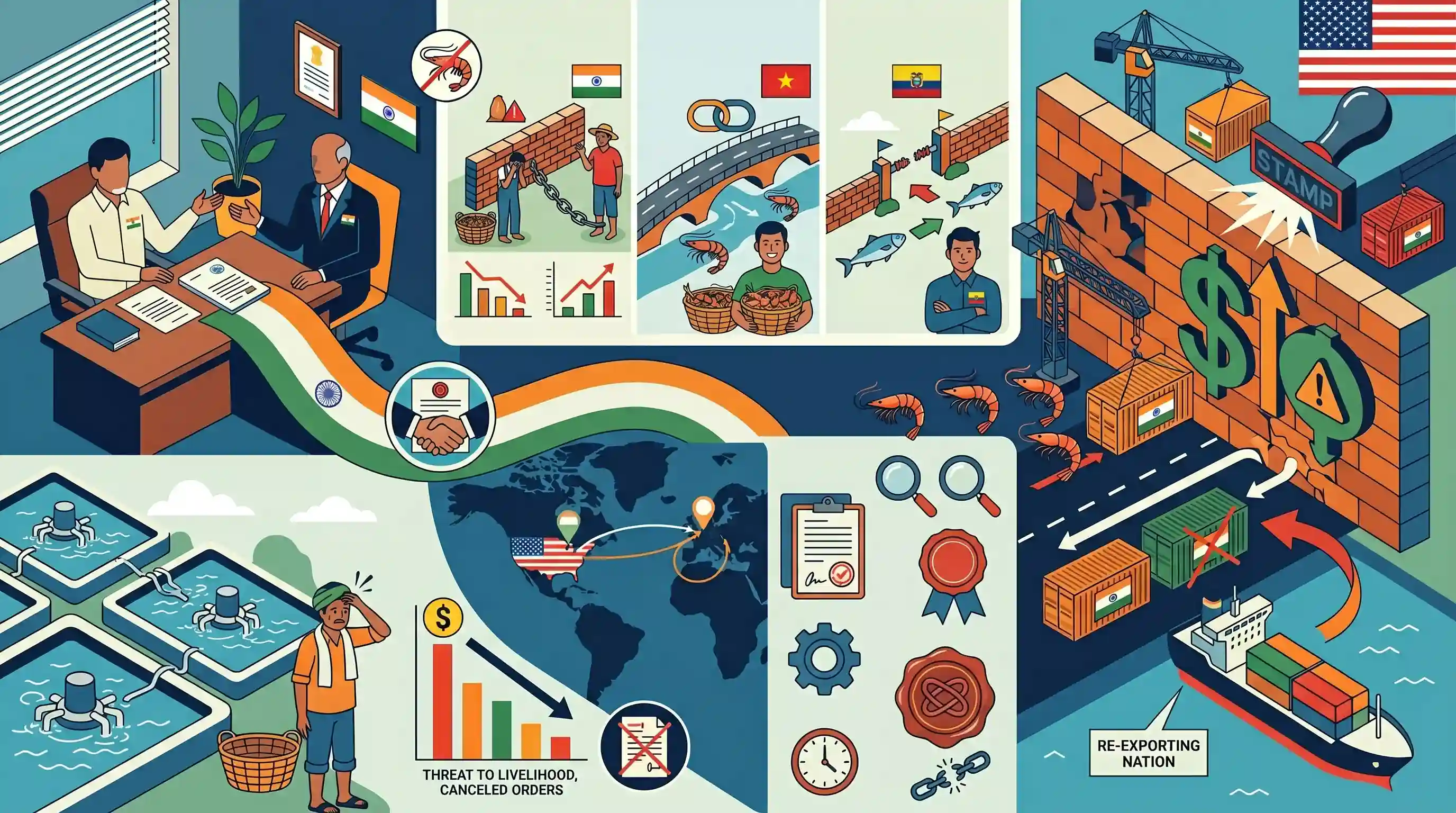
Andhra Pradesh Chief Minister N. Chandrababu Naidu has requested the Union Commerce Ministry to intervene following a significant hike in US import tariffs on Indian marine products. The US recently increased the import duty on Indian shrimp, a crucial export, to approximately 27%, placing Indian aqua farmers at a severe disadvantage compared to global competitors like Ecuador. Highlighting the critical role of the aquaculture sector—India exported $2.55 billion in marine foods to the US in 2023-24—Naidu also pointed out the impact of high non-tariff barriers in the EU and the loss of competitiveness against countries like Vietnam that benefit from Free Trade Agreements (FTAs). Consequently, major re-exporting nations have begun canceling orders from India, threatening the livelihoods of aqua farmers.
Key Points
- The US has raised the import duty on Indian marine food products, primarily shrimp, from 5.77% Countervailing Duty to a combined tariff close to 27%.
- Andhra Pradesh Chief Minister Chandrababu Naidu has urged the Union government to intervene, noting that competitors like Ecuador face only a 10% tariff, creating a 20% disadvantage for Indian exporters.
- In 2023-24, India exported $2.55 billion of marine food to the US, with shrimp comprising 92% of the shipments.
- Indian shrimp exporters face non-tariff barriers and high duties in the EU market (4-7% duty and 50% inspection rates), while nations with Free Trade Agreements (FTAs) like Vietnam enjoy zero-duty access.
- Re-exporting hubs such as Vietnam, Thailand, and Japan have reportedly canceled orders from India due to the prohibitive US taxes on the final products.
Important Terms
Countervailing Duty (CVD)

A trade-remedy tariff imposed by an importing country to offset subsidies provided by the exporting country’s government, ensuring a level playing field for domestic producers.
UPSC context
GS-III (Economy/International Trade); crucial for understanding trade disputes, WTO compliance, and protectionist measures affecting Indian exports.
Anti-Dumping Duty (ADD)
A protectionist tariff imposed on foreign imports that are priced below fair market value ('dumped'), protecting domestic industries from predatory pricing strategies.
UPSC context
GS-III (Economy); often tested alongside CVD as a mechanism to counter unfair trade practices under WTO rules.
Marine Products Export Development Authority (MPEDA)
A statutory body under the Ministry of Commerce and Industry, established in 1972 to promote, regulate, and develop the export of Indian marine products.
UPSC context
GS-III (Agriculture/Allied Sectors); essential for questions on the 'Blue Economy' and statutory bodies supporting India’s export growth.
Non-Tariff Barriers (NTBs)
Regulatory trade restrictions—such as quotas, sanitary standards (SPS), and technical barriers (TBT)—that impede imports without using direct taxes or tariffs.
UPSC context
GS-III (International Trade); focuses on 'invisible' protectionism and the challenges Indian exporters face in advanced markets like the EU.
Free Trade Agreements (FTAs)
Pact between countries to reduce or eliminate tariffs and other trade barriers on goods and services, facilitating easier cross-border market access.
UPSC context
GS-II (International Relations) and GS-III (Economy); evaluates India’s trade competitiveness against rivals like Vietnam in global markets.
Union Commerce Ministry
The nodal central agency responsible for formulating and implementing India's Foreign Trade Policy (FTP) and managing commercial relations with other nations.
UPSC context
GS-II (Government Policies); relevant for understanding the executive's role in bailing out distressed sectors during international trade crises.
Blue Economy
A strategic framework for the sustainable use of ocean and aquatic resources for economic growth, improved livelihoods, and ecosystem health.
UPSC context
GS-III (Environment/Economy); a recurring theme in aquaculture development and sustainable management of India's long coastline.
Prelims Trap
"Countervailing Duties are levied to punish foreign companies for dumping goods below production cost."
Countervailing Duty (CVD) neutralizes foreign government subsidies. Anti-Dumping Duty (ADD) specifically targets companies selling goods below production cost or normal market value.
Static Concepts Connected
What are the primary trade remedy measures permitted under WTO rules?
- Countervailing Duty (CVD): Offsets domestic subsidies provided by the exporting country's government to its producers.
- Anti-Dumping Duty (ADD): Tackles specific goods being exported and sold at less than their normal domestic value.
- Safeguard Duty: Temporary restriction applied when a sudden surge in imports threatens to injure the domestic industry.
How do Sanitary and Phytosanitary (SPS) measures act as Non-Tariff Barriers?
- SPS Measures: Focus specifically on food safety, animal, and plant health (e.g., EU inspecting Indian shrimp for chemical residues).
- Protectionist Tool: Strict hygiene regulations can be weaponized by developed nations as a protectionist barrier to block agricultural and marine imports from developing nations.
Cross-Topic Patterns
Vietnam's FTA advantage vs India's demographics
India's lack of FTAs with the EU and US hampers its labor-intensive sectors (like aquaculture and textiles) against competitors like Vietnam, directly nullifying India's demographic and production advantages.
Blue Economy meets Global Protectionism
Andhra Pradesh's vulnerability to US tariffs shows how state-level agricultural strategies (like the Blue Revolution) are deeply entangled in global trade protectionism and WTO dispute mechanisms.

Expect a GS-3 Mains question on how Non-Tariff Barriers (SPS measures) and protectionist trade remedies impact India's Blue Economy exports.
Linked PYQs · 2
Linked PYQs · 2
- 2025MainsGS3
What are the challenges before the Indian economy when the world is moving away from free trade and multilateralism to protectionism and bilateralism? How can these challenges be met?
- 2017MainsGS3
Explain various types of revolutions, took place in Agriculture after independence in India. How these revolutions have helped in poverty alleviation and food security in India?
